
Harbin's LMEB Benchmark Reveals AI Memory Retrieval Is Broken
A new benchmark evaluates embedding models on fragmented, context-dependent, and temporally distant retrieval, revealing that MTEB scores do not predict memory performance.
 Pro
Takeaways
- LMEB is a new benchmark evaluating embedding models on long-horizon memory retrieval across 22 datasets and 193 tasks.
- Covers four memory types: episodic, dialogue, semantic, and procedural, with AI and human data.
- bge-multilingual-gemma2 leads with 61.41 NDCG@10, followed by NV-Embed-v2 at 60.25.
- LMEB and MTEB show near-zero correlation (-0.115 Pearson), measuring orthogonal capabilities.
- Larger models frequently lose to smaller ones; scale alone does not determine memory retrieval quality.
- Open-source framework compatible with MTEB, Transformers, Sentence-Transformers, and vLLM backends.
Text embedding models get benchmarked to death on passage retrieval, but almost nobody has measured how well they actually recall memories. A team from Harbin Institute of Technology and collaborators is trying to close that gap with LMEB, a benchmark built specifically for the kind of retrieval that memory-augmented agents need: fragmented conversations, scattered events, and information from many sessions ago.
The motivation is straightforward. Memory embeddings are crucial for memory-augmented systems, but their evaluation is underexplored in current text embedding benchmarks, which narrowly focus on traditional passage retrieval and fail to assess models' ability to handle long-horizon memory retrieval tasks involving fragmented, context-dependent, and temporally distant information. In other words, MTEB tells you how well a model finds a Wikipedia paragraph, not whether it can dig up something your user said three weeks ago.
Four flavors of memory
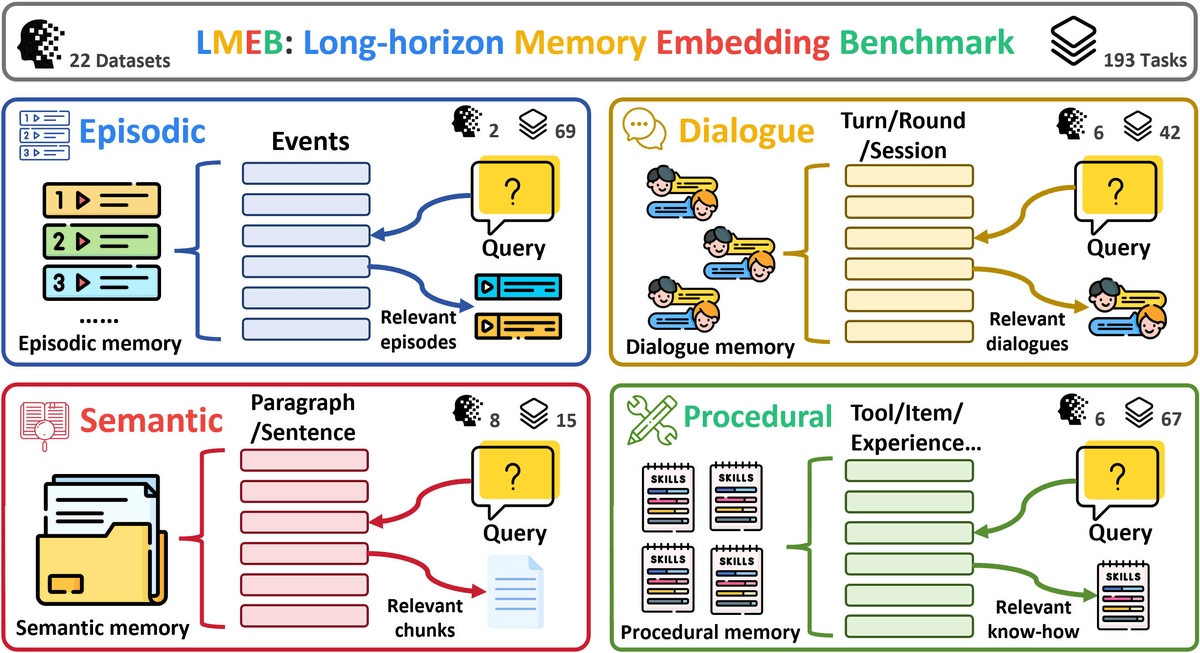
LMEB organizes retrieval around a taxonomy borrowed from cognitive science. LMEB spans 22 datasets and 193 zero-shot retrieval tasks across 4 memory types: episodic, dialogue, semantic, and procedural, with both AI-generated and human-annotated data. These memory types differ in terms of level of abstraction and temporal dependency, capturing distinct aspects of memory retrieval that reflect the diverse challenges of the real world.

Each type stresses a different retrieval skill:
- Episodic: recalling specific past events tied to time, place, and entities (datasets like EPBench and KnowMeBench).
- Dialogue: pulling relevant turns from long multi-session chat histories (LoCoMo, LongMemEval, REALTALK, ConvoMem, MemBench, TMD).
- Semantic: retrieving general knowledge from long documents (QASPER, NovelQA, LooGLE, SciFact, Covid-QA, MLDR).
- Procedural: fetching learned skills, tool docs, or action trajectories (Gorilla, ToolBench, ReMe, MemGovern, DeepPlanning).
Granularity varies from turn-level and session-level chunks in dialogue tasks to full trajectories in procedural ones. Queries with relative time expressions get an explicit anchor appended so the model isn't guessing what "2 days ago" means. Everything is normalized into a BEIR-style format with queries.jsonl, corpus.jsonl, qrels.tsv, and an optional candidates.jsonl that scopes retrieval to a specific conversation history instead of the whole corpus.
How the leaderboard shakes out
The team ran 15 embedding models spanning three orders of magnitude in size, from EmbeddingGemma-300M up to KaLM-Embedding-Gemma3 at 12B parameters. Retrieval is scored with NDCG@10 and a capped Recall@10, tested both with and without task instructions prepended to the query.
The headline result: the best-performing model (bge-multilingual-gemma2) achieves a Mean (Dataset) score of 61.41 on N@10 under the w/ inst. setting, suggesting that the tasks are sufficiently challenging without being excessively difficult. NV-Embed-v2 comes in a close second at 60.25, with KaLM-Embedding-Gemma3 at 60.10. Below is a snapshot of the top of the leaderboard under the instruction-conditioned setting:
| Model | Size | N@10 (Mean Dataset) |
|---|---|---|
| bge-multilingual-gemma2 | 9B | 61.41 |
| NV-Embed-v2 | 7B | 60.25 |
| KaLM-Embedding-Gemma3 | 12B | 60.10 |
| Qwen3-Embedding-8B | 8B | 55.94 |
| multilingual-e5-large-instruct | 560M | 55.06 |
| Qwen3-Embedding-0.6B | 596M | 54.71 |
Notice something odd: larger embedding models, such as KaLM-Embedding-Gemma3, bge-multilingual-gemma2, and Qwen3-Embedding-8B, do not always outperform smaller models. Qwen3-Embedding-4B (4B params) actually lands below its 0.6B sibling on the mean score, and the 560M multilingual-e5 model beats several 7B+ competitors. Scale is not the deciding factor here; training data and architecture matter more.
The orthogonality problem
The most consequential finding is that being good at MTEB doesn't buy you much on LMEB. The correlation analysis between LMEB and MTEB (eng, v2) (retrieval subset) shows low Pearson and Spearman correlation coefficients of -0.115 and -0.130, respectively, demonstrating that the two benchmarks are orthogonal in the domains they evaluate.
The gap is even worse for dialogue memory, where the Pearson correlation drops to -0.496. Models trained hard on open-domain passage retrieval seem to actively lose ground on retrieving fragmented conversational history. Semantic and procedural tasks correlate a bit better with MTEB (0.10 and 0.29 Pearson), but not enough to say the benchmarks measure the same thing.
Instructions also cut both ways. Models like KaLM-Embedding-Gemma3, Qwen3-Embedding-8B, and bge-multilingual-gemma2 gain substantially when you prepend a task instruction to the query. But bge-m3, bge-large-en-v1.5, and EmbeddingGemma-300M actually do worse with instructions, and NV-Embed-v2 is roughly indifferent. That variance likely traces back to whether the model was trained with instruction-style contrastive objectives in the first place.
What this is actually useful for
If you're building a personal assistant, an agent with a memory store, or something like OpenClaw, LMEB gives you a way to pick an embedding model that will actually retrieve the right conversation turn or past event, not just the right Wikipedia paragraph. The benchmark's design principles emphasize zero-shot evaluation, easy extensibility, and support for common backends including Transformers, Sentence-Transformers, and vLLM.
The evaluation framework and datasets are open source at the LMEB GitHub repo and on Hugging Face, with a public leaderboard for reproducible comparisons. Adding a new embedding model requires minimal code changes, and new datasets can be plugged in by dropping files into the standardized IR-style format.
The main limitation the authors acknowledge is that LMEB is text-only. Multimodal memory retrieval, where relevant memories might sit across text, images, audio, and video, is left for future work. For now, if your system needs to remember what a user said three sessions ago or which tool it used last Tuesday, this is the first benchmark that actually tests for it.