
Harbin's HATS Framework Triples AI Agent Success Rates on Hard Web Tasks
A CVPR 2026 paper reframes GUI agent training data as a hardness problem, doubling success rates on AndroidWorld and tripling them on WebArena.
 Pro
Takeaways
- HATS is a CVPR 2026 framework that synthesizes GUI agent training data by targeting semantic-ambiguous actions.
- It uses HD-MCTS to combine hardness-driven exploration with alignment-guided refinement in a closed loop.
- Doubles AndroidWorld success (22.60% vs 11.30%) and triples WebArena success (20.60% vs 6.53%) over OS-Genesis.
- Instructions are validated by replay and rewritten until action-level recall exceeds 0.7.
- Misalignment during replay becomes a hardness reward that steers future MCTS exploration.
- Code, dataset, and model checkpoint released on GitHub and Hugging Face.
Training vision-language models to click, scroll, and type through real apps sounds simple until you look at the data. Most automated trajectory pipelines produce a mountain of trivial taps and back presses, then agents trained on them fall apart the moment a button means two different things. A new CVPR 2026 paper called HATS attacks that problem head-on, and the numbers are hard to ignore: the framework more than doubles success rates on AndroidWorld and more than triples them on WebArena compared to the previous state-of-the-art synthesis pipeline.
The team, from Harbin Institute of Technology Shenzhen, NUS, and Huawei Noah's Ark Lab, argues that current GUI agents fail because their training data is missing the hard cases. They call these semantic-ambiguous actions, meaning interactions whose meaning depends on context, order, or subtle visual cues, and they built a closed-loop system that specifically hunts for them.

Why the current data pipeline is broken
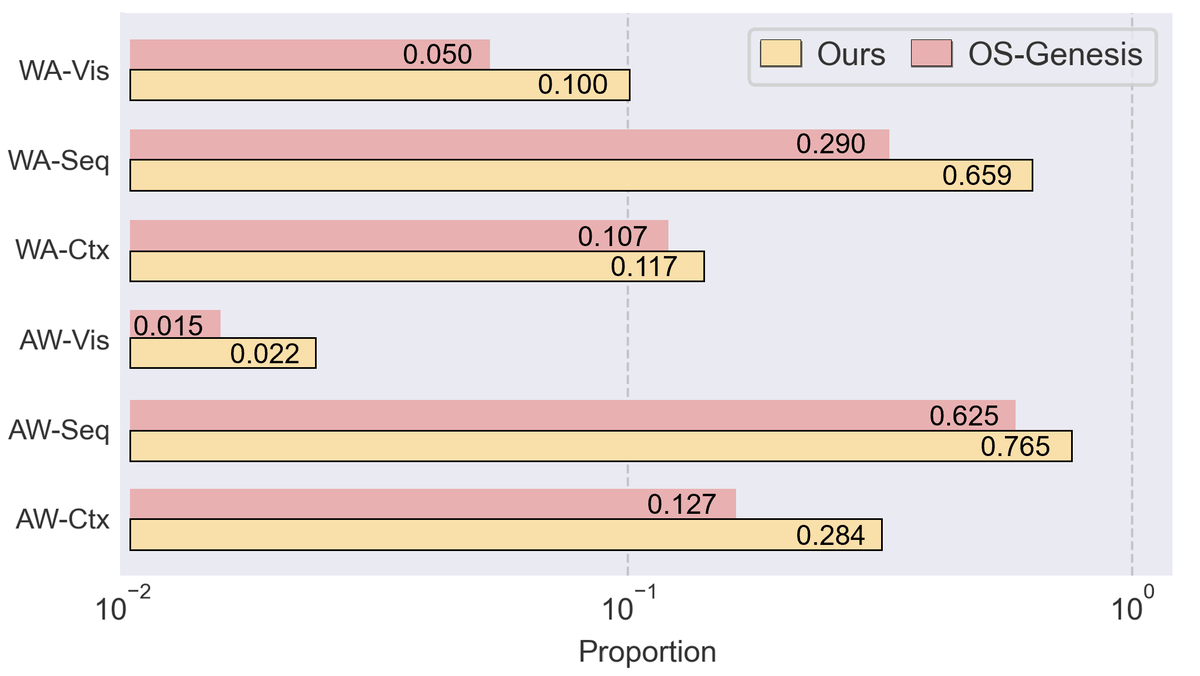
The dominant approach for cheap trajectory data, OS-Genesis, does reverse task synthesis: let an agent wander a UI with random clicks, then use an LLM to write task descriptions that match what happened. It scales, but the paper finds that over 70% of the collected traces collapse into obvious actions like opening a menu or hitting back. Meanwhile the trajectories that actually matter, such as a plus icon that behaves differently depending on which screen you're on, or a submit button that only works after a hidden prerequisite step, are rare and often paired with vague, unreplayable instructions.
Concretely, the authors flag three flavors of ambiguity that GUI agents need to survive in the wild:
- Context dependence: identical icons trigger different functions depending on where you tap them.
- Sequential dependence: an action only works after a specific prerequisite step.
- Visual ambiguity: elements that look nearly identical but lead to different outcomes.
Two loops that feed each other
HATS wraps everything inside a customized Monte Carlo Tree Search called HD-MCTS. Instead of using an environment reward, which GUI synthesis doesn't have, the tree is driven by a hardness signal derived from how badly the current data is aligned. Two modules take turns.
The Hardness-Driven Exploration module replaces uniform random walking with a UCB policy that prefers branches where instructions and executions previously failed to line up. High hardness means the language-to-interface mapping is unstable, so the search is pushed to revisit that region and gather more evidence.

The Alignment-Guided Refinement module then validates each rollout. It generates an initial natural-language instruction from a coherent sub-trajectory, replays the instruction in the environment, and measures action-level reconstruction recall, which checks how many of the reference actions the replay actually reproduces. If the score falls below 0.7, the instruction is rewritten with missing context (widget identifiers, prerequisite steps, navigation hints) and re-executed. Only trajectories that pass verification enter the training corpus.
The closed loop is the real trick. Misalignment during replay is converted into a hardness reward using r = (R + ε)^-α, then backpropagated up the MCTS tree. That reward biases future selection toward exactly the ambiguous regions that broke replay in the first place. Exploration feeds refinement, refinement scores feed exploration.
The results are lopsided
Under a matched 1K-trajectory synthesis budget, HATS was compared against Zero-Shot CoT, Task-Driven Generation, Self-Instruct, and OS-Genesis across three backbones (InternVL2-4B, InternVL2-8B, Qwen2-VL-7B). On AndroidWorld with InternVL2-4B, overall success rate climbed from 11.30% for OS-Genesis to 22.60% for HATS. On WebArena the gap widens further: 6.53% to 20.60% on the same backbone, and 8.16% to 24.87% on InternVL2-8B. The biggest jumps come in the hardest categories, such as Social and Communication tasks where OS-Genesis on Qwen2-VL-7B scored 0.00% and HATS reached 30.77%.
Ablations back up the design choices. Recall-based hardness beat a precision variant (50.8% vs 36.0% success rate on their subset) because recall penalizes missing steps, which is the dominant failure mode. Multi-round refinement monotonically improves both recall (0.26 to 0.40) and downstream success (16.00% to 23.07%) across three rounds.
What's shipped
The team has released the full package on GitHub, including the MCTS driver, Android emulator tooling, and WebArena harness, along with a HATS-Dataset and a fine-tuned HATS-Model checkpoint on Hugging Face. For anyone training GUI agents on a fixed data budget, the practical takeaway is that spending compute on hardness-targeted MCTS plus replay verification beats collecting more random rollouts by a wide margin, especially on the tasks that were previously unsolvable.