
Harbin's DGS-Net Grabs Cluttered Objects With 79% Real-World Success
A new end-to-end network and 350k-grasp dataset let a five-fingered robot hand plan grasps in cluttered scenes from a single depth image.
 Pro
Takeaways
- DGS-Net predicts full 20-DoF dexterous grasps end-to-end from single-view point clouds in cluttered scenes.
- Achieves 88.63% simulation success and 78.98% real-world success on a UR3 with DexHand Pro.
- Penetration depth of 0.375 mm beats DexGraspNet 2.0 despite training on far less data.
- Dataset covers 307 objects, 240 scenes, and 350k+ validated grasps with pre-grasp gestures.
- Two-stage pipeline generates object-level grasps first, then transfers and filters them into scenes.
- Dataset and repo available at github.com/4taotao8/DGS-Net; code not yet released.
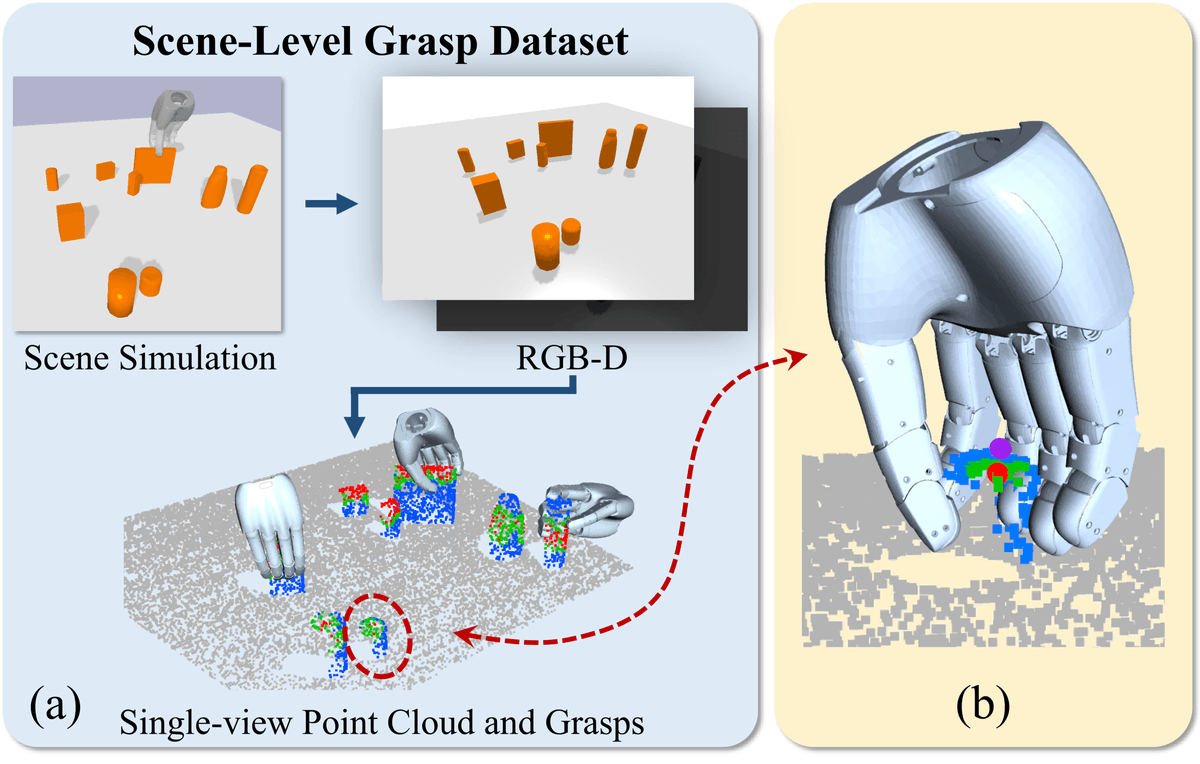
Most robot grasping research still lives in an easy world: one object on a table, a two-finger gripper, and a clean point cloud. Real warehouses and factories look nothing like that. A team from Harbin Institute of Technology and King's College London just released DGS-Net, a network that predicts full 20-joint dexterous hand grasps directly from a single depth camera view of a cluttered scene, along with a supporting dataset of over 350,000 validated grasps in multi-object scenes.
The headline numbers: 88.63% grasp success in simulation and 78.98% on a real UR3 arm with a five-fingered DexHand Pro, with an average finger-into-object penetration depth of just 0.375 mm. That penetration figure is roughly an order of magnitude better than most prior dexterous methods, and the whole pipeline runs in 0.45 seconds per prediction.
Why single-view clutter breaks existing systems
Dexterous grasping uses a hand with many joints, closer in shape to a human hand, rather than the two-jaw parallel grippers that dominate industrial robotics. The extra degrees of freedom (15 active joints here) let the fingers wrap around irregular objects, but they also blow up the search space and make data collection painful.
The dominant datasets for this problem, like DexGraspNet and Dexonomy, focus on isolated objects. That leaves two gaps that matter in production:
- No inter-object interference. Real scenes have occlusion, contact, and stacking that change which grasps are actually feasible.
- No pre-grasp gesture. Existing datasets record the final closed pose but skip the shape the hand takes while approaching, which is exactly where collisions happen.
Common workarounds bolt on preprocessing: run segmentation with SAM, complete the missing parts of the point cloud, then predict a grasp on the reconstructed object. Each stage adds latency and compounds error. DGS-Net skips all of it and predicts grasps end-to-end from the raw single-view point cloud.
Splitting the prediction in two

The backbone is Point Transformer V3, a sparse transformer for point clouds that gives the network a large receptive field over the whole scene. On top of that, the authors split the prediction into two modules because directly regressing 20 joint angles from raw geometry is unreliable; the correlation between local point cloud shape and finger configuration is too weak.
- Global module. For every point in the scene, predict a grasp reference score (how good a place is this to grasp) and a 6D rotation for the hand at that point. The 6D rotation representation avoids the discontinuities that quaternions and Euler angles suffer near singularities.
- Local module. Take the top-scoring reference points, fuse local and global features through self-attention, and predict three things: a 3D grasp offset, the 20-DoF pre-grasp joint angles, and the 20-DoF final grasp joint angles.
The grasp offset is a small but important trick. Because the input point cloud is incomplete, the highest-scoring visible point rarely coincides with the ideal tool center point of the hand. The network learns a displacement vector to correct that gap, so the final target is T = P_reference + offset. In the ablation, adding this offset alone lifted success from 71.10% to 74.81%.
Building a dataset the hand can actually learn from

The generation pipeline runs in two stages inside PyBullet, covering 307 objects across five geometric classes (cuboid, cylinder, stick, sphere, bowl), each scaled at five sizes.
Stage one, per object. The tool center point is dropped randomly inside the object's bounding box with random rotations across all three axes. Rather than scripting hand gestures, the pipeline imposes geometric constraints on the fingertip plane, either circular for curved objects or rectangular for planar ones. Fingertip positions are computed, inverse kinematics solves the joint angles, and admittance control closes the fingers until they conform to the surface. A grasp counts as successful only if it survives gravity applied along all six axes for 100 simulation steps.
Stage two, per scene. Five to fifteen objects are dropped under gravity into a shared workspace. Each object's grasp set gets transformed into the scene, and any grasp that would collide with a neighbor is filtered out. Every layout is rendered from 256 viewpoints on a hemisphere, producing over 60,000 RGB-D images and 350,000 valid grasps.
Pre-grasp poses are derived by scaling down the final joint angles: 0.6x for the pitch joints, 1.0x for yaw (to keep the finger orientation), and 0.2x for the coupled distal joints so the fingertips don't close prematurely and hit the object during approach.
What the numbers actually say
The most striking result is penetration, which measures how much the simulated hand physically intersects the object during the grasp. Lower is better because real hardware cannot penetrate objects, so heavy penetration in simulation usually means the grasp will fail or slip on real hardware.
| Method | Penetration depth (mm) | Penetration volume (mm3) | Success rate |
|---|---|---|---|
| HGC-Net | 12.93 | 13,970 | 71.9% |
| Dexonomy | 8.28 | 7,314 | - |
| DexGraspNet 2.0 | 0.594 | 1,452 | 73.59% |
| DGS-Net | 0.375 | 559 | 74.81% |
DGS-Net beats DexGraspNet 2.0 on both penetration metrics despite training on a much smaller dataset. Diversity, measured through PCA of grasp configurations, comes in slightly worse than DexGraspNet 2.0 (35.18% vs 27.14%, where lower is more diverse), which the authors attribute to their smaller data scale.
In real-world tests on 29 novel objects across 25 scenes and 138 grasp attempts, DGS-Net hit 78.98% success and 86.86% clearance with no fine-tuning on real data, beating HGC-Net (66.7%), a geometric baseline (74.0%), and Graspit! (58.5%).
Where it helps and where it doesn't
The method suits bin picking, semi-structured assembly, and any setting where a five-fingered hand needs to clear cluttered surfaces without object priors. The low penetration and pre-grasp modeling make it particularly relevant for fragile or safety-critical items in intelligent manufacturing and chemical handling, which the authors explicitly call out as target domains.
Limitations worth flagging:
- Two-finger and three-finger grasps are underrepresented in the training data (roughly 6.4% combined), so pinch-style grasps on thin objects are weaker.
- The bowl category has very few samples, limiting concave-object performance.
- Arm motion planning is treated as separate. The paper acknowledges that kinematic constraints of the robot arm often decide whether a technically valid grasp is actually reachable.
- The whole system is tied to the DexHand Pro, a variant of the DLR/HIT Hand II. Porting to a Shadow Hand or Allegro would require regenerating the dataset.
Availability
The dataset is released through the project's GitHub repository, with the full 60k-image collection hosted on Baidu Pan. Each sample ships with scene point clouds, RGB-D captures from 256 viewpoints, segmentation masks, grasp semantic labels, pre-grasp and final joint configurations, and occlusion metadata. The repository currently hosts the dataset and documentation; network training code is not yet posted.