
Harbin Researchers Expose How AI Image Models Learned to Oversaturate Reality
A new dataset, metric, and training-free refinement expose why realistic prompts still produce cartoon-vivid images, and fix it.
 Pro
Takeaways
- New paper shows T2I preference metrics like HPSv3 and PickScore systematically favor oversaturated, high-contrast images over realistic ones.
- Authors release CFD, a 1.33M-image dataset with ordered color fidelity levels built by sweeping classifier-free guidance scales.
- Color Fidelity Metric (CFM) uses Qwen2-VL plus a softrank loss and hits 84.9 Spearman with human ratings versus 74.4 for HPSv3.
- CFR is a training-free refinement that modulates guidance spatially and temporally via CFM's cross-modal attention.
- Applied to SD3.5, PixArt-Sigma, and Hunyuan-DiT, CFR cuts saturation error by 0.08 to 0.11 with no FID or CLIPScore loss.
- Benchmark ranks SRPO highest at 9.05 CFM, with aesthetic-tuned models like Playground-v2.5 scoring worst on color realism.
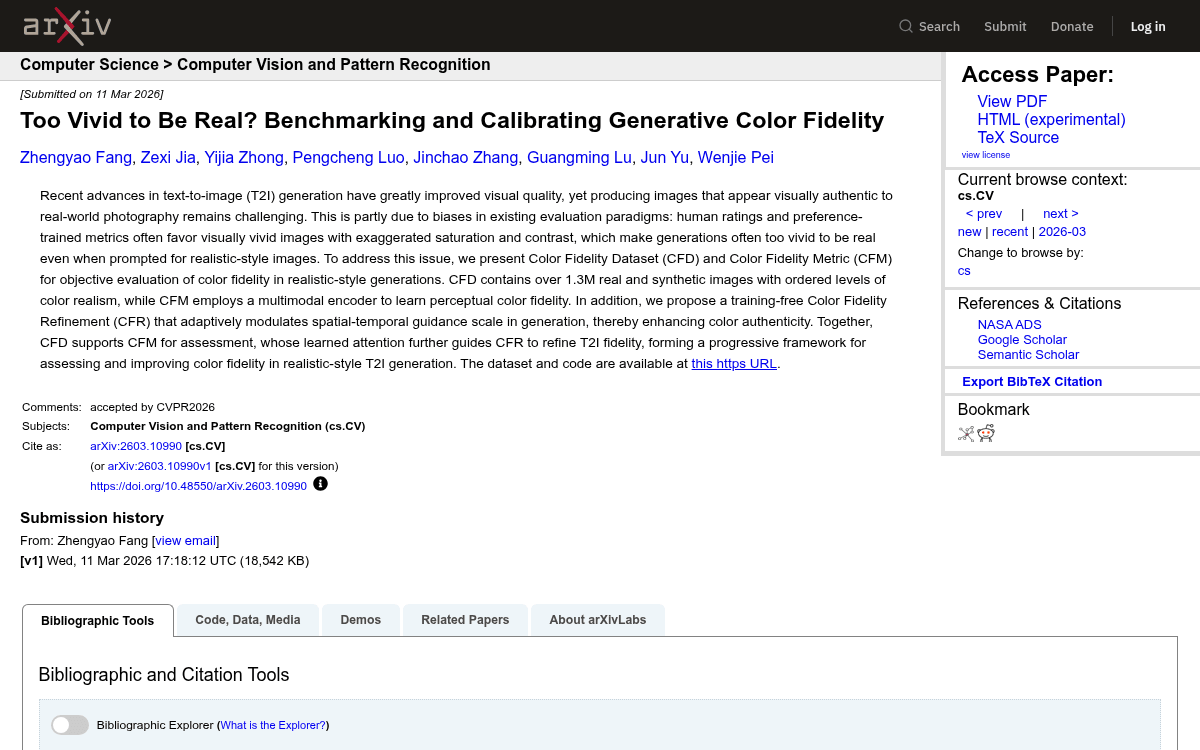
Text-to-image models have gotten remarkably good at rendering coherent scenes, but there is a persistent tell that gives away a synthetic image: the colors are just a bit too loud. A new paper from Harbin Institute of Technology and collaborators, Too Vivid to Be Real?, argues this is not an accident of model capacity but a bias baked into how we evaluate generations, and proposes a benchmark plus a training-free fix.
The vividness trap in preference metrics
The core diagnosis is uncomfortable for anyone using reward models to fine-tune diffusion systems. Human ratings and preference-trained metrics often favor visually vivid images with exaggerated saturation and contrast, prompting models to over-optimize for striking colors even when the prompts explicitly request realistic-style outputs. The authors run a controlled saturation-scaling experiment on real photographs and show that popular metrics such as PickScore, ImageReward, HPSv3, and MPS consistently assign higher scores to unnaturally vivid images, resulting in unreliable evaluations of realistic-style generations.
That creates a training loop where models chase saturated palettes to win preference scores, and evaluators reward them for it. There has been no dedicated benchmark or metric that isolates color realism from semantic alignment or aesthetic appeal, which is what this paper sets out to build.

Building an ordered dataset from guidance scale
The trick behind the Color Fidelity Dataset (CFD) is a clever use of classifier-free guidance as a controllable distortion knob. Increasing the guidance scale enforces stronger adherence to textual semantics but often introduces over-saturated colors and enhanced contrast, while smaller values yield faded or washed-out tones. By sweeping guidance, the team can generate sequences of images with progressively worse color fidelity but identical semantics, giving them ordinal supervision without needing millions of human labels.
The construction pipeline:
- 189,490 high-quality real-world photographs across 12 categories serve as the perceptual upper bound.
- Captions are auto-generated with Qwen2.5-VL, then fed to 11 different T2I models.
- Each real image is paired with six synthetic variants of increasing distortion, forming a color fidelity sequence of seven images, producing about 190K groups and 1.33M images total.
- A human study collected over 20,000 ratings across 6,690 images with average Spearman inter-rater correlation above 0.85.

A metric that learns rankings, not scores
The Color Fidelity Metric (CFM) uses Qwen2-VL as a joint vision-language backbone and adds an MLP head that reads out a scalar from a special <|Reward|> token. Rather than regressing to human scores directly, it is trained with a differentiable softrank loss over each group of seven images, where the real photo has rank 1 and the most saturated synthetic has rank 7. The loss computes pairwise sigmoid probabilities, sums them into soft ranks, and minimizes MSE against the ground-truth ordering.
The results are a clear step-change over aesthetic reward models. CFM achieves over 80% accuracy on both pairwise discrimination settings, while existing T2I aesthetic metrics show lower accuracy due to their bias toward vivid, high-contrast imagery. On the human correlation test, CFM hits 84.9 Spearman versus 74.4 for HPSv3 and 71.2 for PickScore. An ablation shows that removing the text branch drops discrimination accuracy by 6.5 points, confirming that judging color realism requires knowing what the scene is supposed to look like.
Fixing generations without retraining
The second contribution is Color Fidelity Refinement (CFR), a plug-in that repurposes CFM's cross-modal attention at inference time. The idea: attention maps light up where color deviates from natural photographic statistics, so the guidance scale should be reduced in exactly those regions.
Concretely, at each denoising step t, the guidance field becomes:
s_t(u, v) = s_0 * [1 - lambda * alpha(t) * a'(u, v)]
alpha(t) = 1 - t/T   # temporal decay
a'(u, v)             # normalized attention from CFM
Regions with high color-semantic discrepancy get their guidance attenuated more, and the effect fades as denoising progresses so semantic structure stays intact. Applied to SD3.5, PixArt-Sigma, and Hunyuan-DiT, saturation values decrease by 0.08 to 0.11 and CFM scores increase by 1.3 to 2.0 points across all three models, while maintaining comparable image quality (FID) and semantic alignment (CLIPScore).

What shows up in the model rankings
Running CFM as an objective benchmark across 11 T2I systems produces some notable orderings. The recent SRPO achieves the highest overall CFM score of 9.05, with Qwen-Image and Flux-dev also demonstrating competitive performance, whereas models that emphasize aesthetic optimization such as Playground-v2.5 tend to produce reduced color fidelity. The pattern lines up with the paper's thesis: aesthetic tuning correlates with worse color realism.
Ablations also reveal that the spatial component of CFR does most of the work. Temporal-only modulation actually hurts, degrading FID by 4.7 and pushing CFM into negative territory, because uniformly weakening guidance breaks text conditioning. Attention-driven spatial modulation is where the correction happens; the temporal decay just stabilizes it.
Where this is useful and where it isn't
For anyone building image pipelines that need photographic authenticity, product photography, editorial imagery, dataset generation for downstream vision training, this offers two immediately practical tools: a metric that will not reward you for over-saturating your outputs, and an inference-time correction that requires no retraining and works with any diffusion model using CFG. The dataset and code are on GitHub.
The limitations are honest. Color distortions simulated solely through CFG adjustments remain limited in scope and may not fully represent the wide range of color deviations in real-world generative outputs. The metric is specifically for realistic-style prompts, so if you want stylized, painterly, or deliberately punchy generations, CFM will correctly penalize them, which is not what you want. And because CFR relies on CFM's attention, it inherits any blind spots in what CFM considers realistic across the 12 curated categories.