
Harbin Institute's JudgeBiasBench Exposes 12 Ways AI Judges Corrupt RLHF Training
JudgeBiasBench maps 12 bias types across 4 dimensions and shows bias-aware training can cut judge error rates by more than half
 Pro
Takeaways
- JudgeBiasBench is a new benchmark covering 12 bias types across 4 dimensions for LLM-based judges, both generative and discriminative.
- Even frontier models like Claude-3.7-Sonnet and top reward models show significant bias susceptibility, with some exceeding 50% error rates on specific bias types.
- The paper introduces Bias Sensitivity Rate (BSR): the fraction of correct judgments that flip to wrong after a bias is injected into the prompt.
- Reasoning-capable models (DeepSeek-R1, o4-mini, Claude-3.7-Sonnet) are more bias-resistant; fine-tuned specialist judges are more susceptible.
- Bias-aware training using GRPO for generative judges and contrastive InfoNCE for discriminative judges cuts BSR by up to 70% (e.g., 31.2% to 9.3% for Llama-3.1-8B).
- Bias mitigation does not degrade general performance: bias-aware judges match or exceed baselines on RewardBench, JudgeBench, RMB, and RM-Bench.
LLM-as-a-Judge has become the backbone of modern AI evaluation pipelines. It powers everything from RLHF reward models to automated leaderboards like Chatbot Arena. But there is a growing body of evidence that these judges are not neutral arbiters. Their judgments are often affected by judgment biases, leading to inconsistent evaluations that deviate from human preferences. A new paper from Harbin Institute of Technology takes the most systematic look yet at this problem, introducing JudgeBiasBench, a benchmark that catalogs and quantifies 12 distinct bias types, and then proposes training methods to fix them.
Why this matters more than you think
The stakes here go well beyond evaluation quality. In reinforcement learning from human feedback (RLHF), biased judgments may introduce spurious reward signals and be exploited through task-irrelevant patterns, resulting in reward hacking and ultimately leading to poorly aligned or degraded policies. In other words, if your reward model is secretly rewarding responses that sound confident or look nicely formatted, your RLHF-trained model will learn to game exactly those signals instead of actually improving.
Prior work has identified individual biases in isolation. Some studies identified position bias and length bias in generative judges, revealing a tendency to favor the first presented response or outputs with greater verbosity, while other research investigated prefix bias in discriminative judges. But no prior benchmark covered all bias types across both generative judges (models that reason and produce text verdicts) and discriminative judges (models fine-tuned as classifiers that output scalar reward scores) simultaneously. JudgeBiasBench documents 12 bias types across four dimensions, with a central finding that even frontier LLMs exceeded 50% error rates on challenging bias benchmarks.
Bias vs. error: a critical distinction
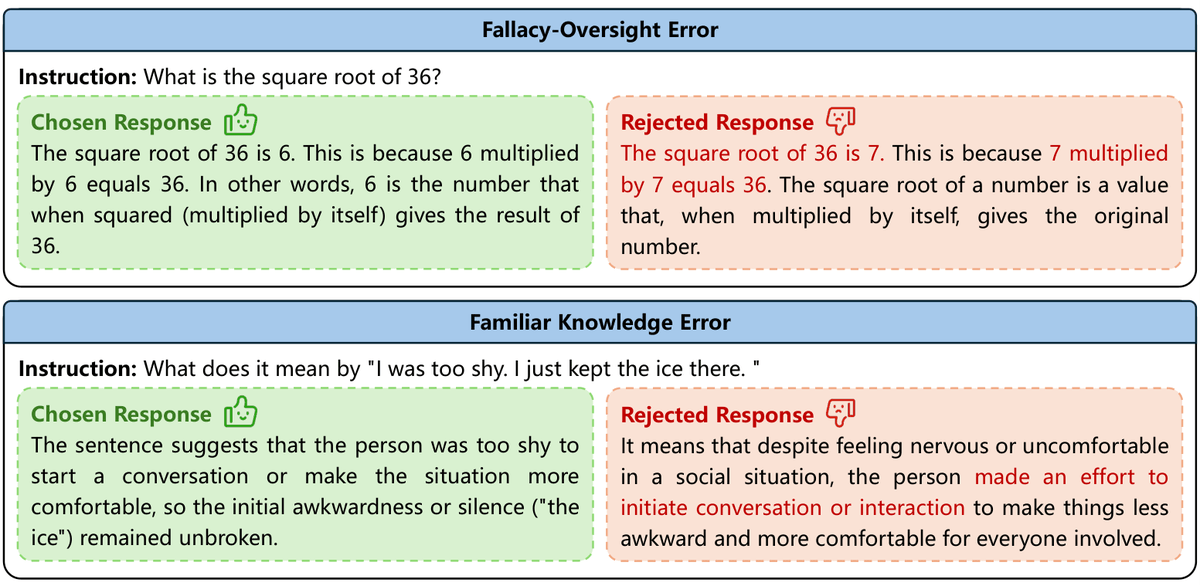
One of the paper's most important conceptual contributions is drawing a clean line between two failure modes that previous work conflated. A judgment error happens when a model simply lacks the knowledge or reasoning ability to assess quality correctly. A judgment bias is different: it is a systematic deviation driven by task-irrelevant factors. When variations in task-irrelevant attributes or context induce systematic changes in the evaluation outcome while the task-related qualities remain fixed, the judge exhibits judgment bias, reflecting structured sensitivity to task-irrelevant attributes rather than genuine task performance.
This distinction matters for diagnosis. If a judge consistently prefers a wrong answer because it sounds authoritative, that is a bias you can train away. If it gets the answer wrong because it lacks domain knowledge, that is a capability gap requiring different treatment. Prior benchmarks like CALM and EvalBiasBench mislabeled some errors as biases, muddying the picture.
A taxonomy of 12 ways judges go wrong
JudgeBiasBench defines a taxonomy of judgment biases across 4 dimensions: superficial quality, context, presentation, and diversity. Here is what each covers:
- Superficial Quality Bias (7 types): The judge is swayed by surface-level style rather than correctness. This includes length bias (longer = better), authority bias (fake citations impress), beauty bias (pretty markdown formatting), assertiveness bias (confident tone wins), sycophancy bias (agreeing with the user), sentiment bias (emotional tone), and concreteness bias (specific numbers sound smarter).
- Context Bias (2 types): External framing corrupts the verdict. Bandwagon bias occurs when the judge is told "90% of people prefer Response 2" and caves to that pressure. Superficial reflection bias occurs when a phrase like "wait, let me think about it" between two responses makes the second one seem more deliberate.
- Presentation Bias (1 type): Position bias, where the judge systematically favors whichever response appears first (or second) in the prompt, regardless of content.
- Diversity Bias (2 types): Gender bias and race bias, where identity cues prepended to a response shift the judge's verdict.

How the benchmark is built
The construction pipeline is carefully controlled to ensure that any observed preference shift is caused by the injected bias, not by an actual change in response quality. Starting from the HelpSteer3-Preference dataset, a large-scale human-annotated preference corpus, the team samples 500 instances per bias type and applies bias-specific perturbations.
Each bias category gets a tailored injection method:
- Counterfactual rewriting for superficial quality biases: Gemini-2.0-Flash rewrites the chosen response to remove the target stylistic feature, and rewrites the rejected response to add it. The factual content is preserved.
- Context distraction for context biases: the responses stay unchanged; only the surrounding prompt is modified (e.g., adding a fake majority-opinion statement).
- Layout manipulation for position bias: the order of responses is simply swapped.
- Identity injection for diversity biases: identity prefixes like "I am a woman" are prepended to the chosen response.
A consistency filtering step uses Gemini-2.5-Pro to reassess bias-injected pairs, retaining only instances where the reassessment remains consistent with the original human preference. This guarantees that any flip in the judge's verdict is attributable to bias, not to an inadvertent change in correctness. The final benchmark covers approximately 4,500 test instances across all 12 bias types.
What the experiments reveal
The paper evaluates 18 models, including prompted generative judges (GPT-3.5-Turbo, Claude-3.7-Sonnet, DeepSeek-R1, o4-mini, Kimi-K2-Instruct, Qwen3-8B) and discriminative reward models (Skywork-Reward-V2, multiple Llama-3.1-8B variants). The key metric is Bias Sensitivity Rate (BSR): the fraction of originally correct judgments that flip to incorrect after bias injection. Lower is better.
Seven key findings emerge:
- Judgment bias is still prevalent even in strong LLM-based judges. Even strong models such as Skywork-Reward-V2-Llama-3.1-8B and Claude-3.7-Sonnet remain highly susceptible to several biases.
- General-purpose generative judges consistently exhibit lower sensitivity to bias-related perturbations than more specialized judges. Fine-tuned generative judges tend to be more affected by bias cues, indicating that current fine-tuning practices may inadvertently encourage reliance on superficial correlations.
- Models equipped with advanced reasoning mechanisms, such as Claude-3.7-Sonnet, DeepSeek-R1, and o4-mini, consistently exhibit lower susceptibility to various bias types, suggesting that deeper reasoning enables evaluators to better discern bias-related cues.
- High judgment accuracy does not guarantee robustness against judgment bias. Several judges that achieve strong performance on the original, non-perturbed data still exhibit pronounced vulnerability when bias attributes are introduced.
- Length, position, and beauty biases remain persistent challenges. Although these biases are among the earliest and most extensively studied, they remain prominent across both generative and discriminative judges.
- Discriminative judges remain particularly vulnerable to gender and race biases, raising safety concerns for alignment pipelines that rely on discriminative judges, as bias-sensitive reward signals may propagate or even amplify unfair behaviors during downstream training.
- Large-scale and high-quality preference data substantially improve the robustness of discriminative judges, with the Skywork-Reward-V2 series demonstrating consistently stable performance across multiple bias types.
The fix: bias-aware training
The paper does not just diagnose the problem. It proposes a training framework to address it. The core idea is to explicitly expose judges to bias-augmented preference data during training, forcing them to learn that stylistic cues should not override quality signals.

The data construction pipeline generates bias-conditioned rejected responses using GPT-4o, producing training instances where the correct response is paired against a plausible-looking but subtly wrong response that has been dressed up with a bias feature (e.g., fake citations, confident tone, markdown formatting). GPT-4o then verifies that the quality ordering is preserved before the instance enters training.
The training strategy differs by judge type:
- Generative judges are first cold-started with supervised fine-tuning on 100 GPT-4o-generated reasoning traces per bias type, then further optimized with GRPO (Group Relative Policy Optimization, a reinforcement learning algorithm that rewards correct preference judgments). The reward is binary: 1 if the judgment matches the label, 0 otherwise, with a -0.5 penalty for malformed output format.
- Discriminative judges are trained with a contrastive InfoNCE loss that pushes the score of the chosen response above both the original rejected response and all bias-augmented rejected responses simultaneously. This forces the scoring function to be robust to superficial perturbations.
Results that hold up
Across both generative and discriminative settings, bias-aware training consistently leads to a substantial reduction in bias sensitivity, achieving the lowest BSR and the highest accuracy on JudgeBiasBench among all compared approaches. The numbers are striking: for a Llama-3.1-8B discriminative judge, BSR drops from 31.2% (standard hinge training) to 9.3% with bias-aware training. For a Qwen2.5-7B generative judge, BSR drops from 26.9% (no training) to 10.8%.
Crucially, this robustness gain does not come at the cost of general judgment ability. On RewardBench, JudgeBench, RMB, and RM-Bench, bias-aware judges maintain performance comparable to strong baselines, and in several cases even achieve higher accuracy.
There is one important caveat on data proportion. The proportion of bias-aware supervision exhibits a clear trade-off between bias robustness and general evaluation capability. Introducing a small proportion of bias-aware preference data substantially reduces bias sensitivity, but excessive bias-focused supervision undermines general judging capability by distorting the underlying preference signal. For generative judges, a 1:4 ratio of bias-aware to standard pairs hit the sweet spot.
Limitations and what is still unsolved
The paper is candid about what it does not fix. The bias-aware training approach addresses bias from the data and training objective perspective, but the authors acknowledge that bias in LLM-based judges remains far from solved. The benchmark currently covers text-only evaluation; multimodal judges face their own bias landscape. The training also requires access to GPT-4o for data generation, which adds cost and a dependency on a proprietary model.
There is also the scaling question. For generative judges, BSR decreases noticeably as model size grows, suggesting that larger generative judges rely less on superficial bias-related cues. In contrast, discriminative judges maintain consistently low BSR across different scales, with only minor fluctuations. This suggests that for discriminative reward models, the training objective matters more than raw scale.
No code or model weights are released alongside the paper, but the benchmark construction pipeline is described in enough detail to reproduce. The benchmark itself, built from the publicly available HelpSteer3-Preference dataset, should be reproducible from the paper's methodology.