
Hanyang's CarPLAN Beats Self-Driving Benchmarks by Fixing Imitation Learning's Hidden Flaw
A new imitation learning planner adds scene-relational forecasting and mixture-of-experts decoding to push nuPlan closed-loop scores past prior state of the art.
 Pro
Takeaways
- CarPLAN adds displacement prediction and mixture-of-experts decoding to imitation-learning planners, hitting SOTA on nuPlan.
- Displacement-Aware Predictive Encoder forecasts future spacing between ego and scene elements as a training-only auxiliary loss.
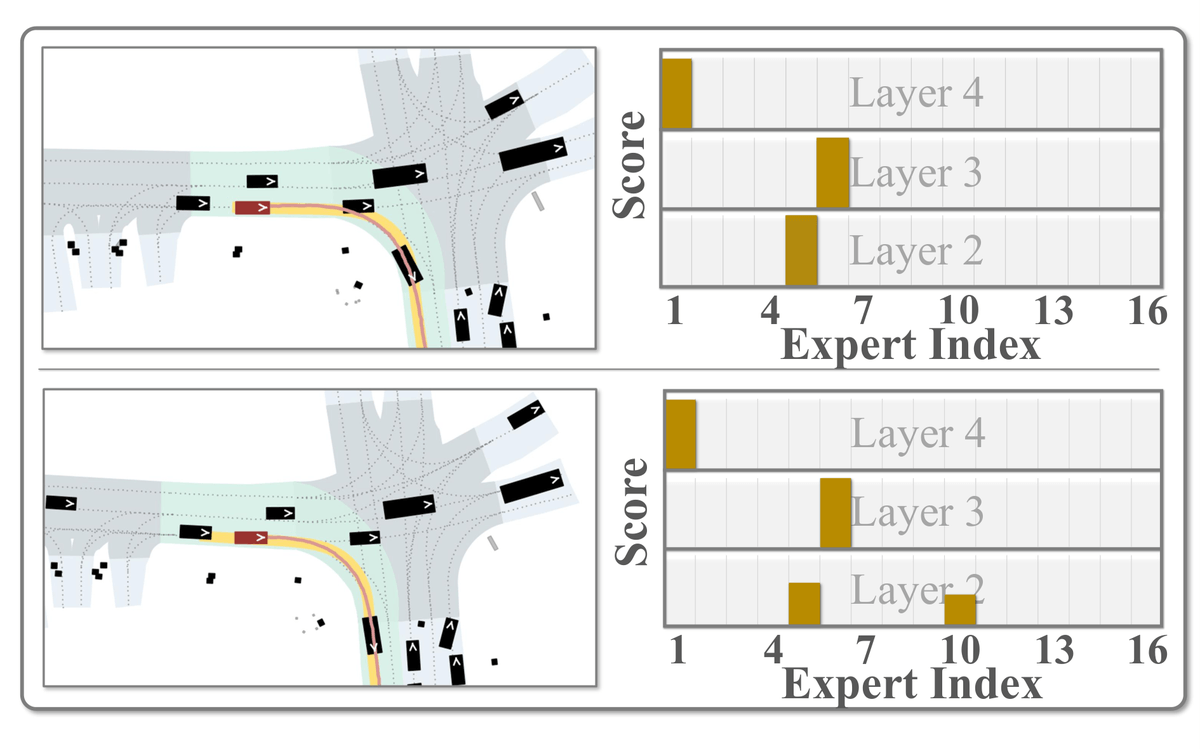
- Context-Adaptive Multi-Expert Decoder uses 16 routed plus 2 shared experts, top-2 activated per query.
- Achieves 91.4 CLS-NR and 84.6 CLS-R on Val14, beating Diffusion-Planner and BeTopNet by 1.5 and 0.9 points.
- Runs at roughly 15 FPS with the MoE decoder; DPE adds zero inference cost since it is training-only.
- Assumes perfect perception with HD maps; no public code or model release announced yet.
Imitation learning has become the default recipe for teaching self-driving cars to plan trajectories: feed the model human demonstrations, minimize the distance between predicted and logged paths, and hope the policy generalizes. A new paper from researchers at Hanyang University and Seoul National University argues that this recipe is quietly broken, and proposes a fix called CarPLAN that lands new state-of-the-art numbers on the nuPlan benchmark.
Why matching human trajectories is not enough
The core issue is that the loss functions used to train imitation learning planners measure distance between predicted and ground-truth trajectories, but those objectives are not always aligned with real-world driving requirements like collision avoidance or road boundary compliance. In some cases a trajectory with a lower L1 loss will still leave the road or hit another vehicle, while a slightly higher-loss trajectory stays safe.

The authors also point out a second gap: existing IL-based planners rely on a single shared policy network, which biases learning toward common scenarios and limits the model's ability to reflect behavior variations required across different contexts. A single set of weights ends up averaging over parking lots, highway merges, and pedestrian crossings, which are situations that demand very different driving strategies.
Two ideas bolted onto a Transformer planner
CarPLAN keeps the standard scene-encoder-plus-trajectory-decoder skeleton but adds two components. The first is the Displacement-Aware Predictive Encoder (DPE). During training, the model predicts future displacement vectors between the autonomous vehicle and every surrounding agent and map element, then adds the error on those predictions as an auxiliary loss. The DPE functions solely as a training-time supervisory signal and can be deactivated during inference, introducing no additional runtime computational overhead. In effect, it forces the encoder to internalize relative spacing without paying for it at deployment.
The second is the Context-Adaptive Multi-Expert Decoder (CMD), which drops a mixture-of-experts (MoE) block into each decoder layer. MoE is the same trick that powers sparse large language models like Switch Transformer and DeepSeekMoE: you keep many specialized sub-networks but only activate a few per input. A Scene-Aware Router analyzes the dynamic scene structure to determine the most suitable expert network for each planning instance, and dynamically selects experts based on the scene context to improve adaptability across diverse driving conditions.

How the decoder actually routes
The ablations settle on a specific configuration that is worth knowing if you want to reproduce this:
- 16 routed experts per decoder layer, with top-2 selected per query
- 2 shared experts that always fire, capturing context-invariant driving patterns
- 4 stacked decoder layers, with the first layer using a plain FFN and the remaining three using MoE
- An expert balancing loss to prevent routing collapse onto a few experts
The router is not a simple MLP over pooled features. It runs self-attention on the trajectory query, cross-attends into the displacement-aware scene features, and only then produces softmax scores over the 16 experts. Ablations show the attention-based router alone adds nearly a full CLS-NR point over an MLP router baseline.
The benchmark numbers
Evaluations run on nuPlan, which contains 1,300 hours of urban driving across 75 scenario types, plus Waymax for generalization. The key closed-loop scores:
| Benchmark | Metric | Prior best | CarPLAN |
|---|---|---|---|
| Val14 | CLS-NR | 89.9 (Diffusion-Planner) | 91.4 |
| Val14 | CLS-R | 83.7 (BeTopNet) | 84.6 |
| Test14-Hard | CLS-NR | 77.1 (BeTopNet) | 78.9 |
| Test14-Hard | CLS-R | 69.2 (Diffusion-Planner) | 72.5 |
CLS-NR is closed-loop with non-reactive traffic replaying logs, while CLS-R uses IDM-driven agents that react to the ego vehicle. The Test14-Hard split is a curated set of complex scenarios, and it is where the 3.3-point CLS-R jump is most notable. Ablations attribute a 1.5-point gain to DPE alone and 1.9 points to CMD alone, with the full model adding 3.1 points over the baseline on Test14-Hard.
What it costs and what is missing
Inference stays real-time. The MoE decoder introduces a modest increase in latency and FLOPs but still achieves real-time inference at approximately 15 FPS, versus around 17.7 FPS for the baseline. Because DPE is training-only, it adds zero inference cost.
Two caveats worth flagging. First, the paper assumes perfect perception with clean HD maps and object states, which is a strong assumption for anyone integrating this into a real stack. The authors call this out and propose extending toward an end-to-end system with joint perception training as future work. Second, there is no public code repository or model release announced in the paper, so reproducing the numbers currently means reimplementing DPE and CMD on top of a PLUTO-style backbone.
For anyone building IL-based planners today, the actionable takeaway is that auxiliary self-supervised objectives on scene geometry and sparse MoE decoding are complementary. They target different failure modes: DPE fixes what the encoder sees, CMD fixes how the decoder specializes. Both slot into an existing Transformer planner without changing the input pipeline or inference budget in any dramatic way.