
HanMoVLM Teaches AI to Judge Chinese Ink Paintings Like an Auction Expert
A new vision-language model learns to judge Chinese paintings like a trained art expert, and doubles as a verifier for text-to-image models.
 Pro
Takeaways
- HanMoVLM turns Qwen3-VL into a Chinese painting expert using an expert-validated chain-of-thought and RL rewards.
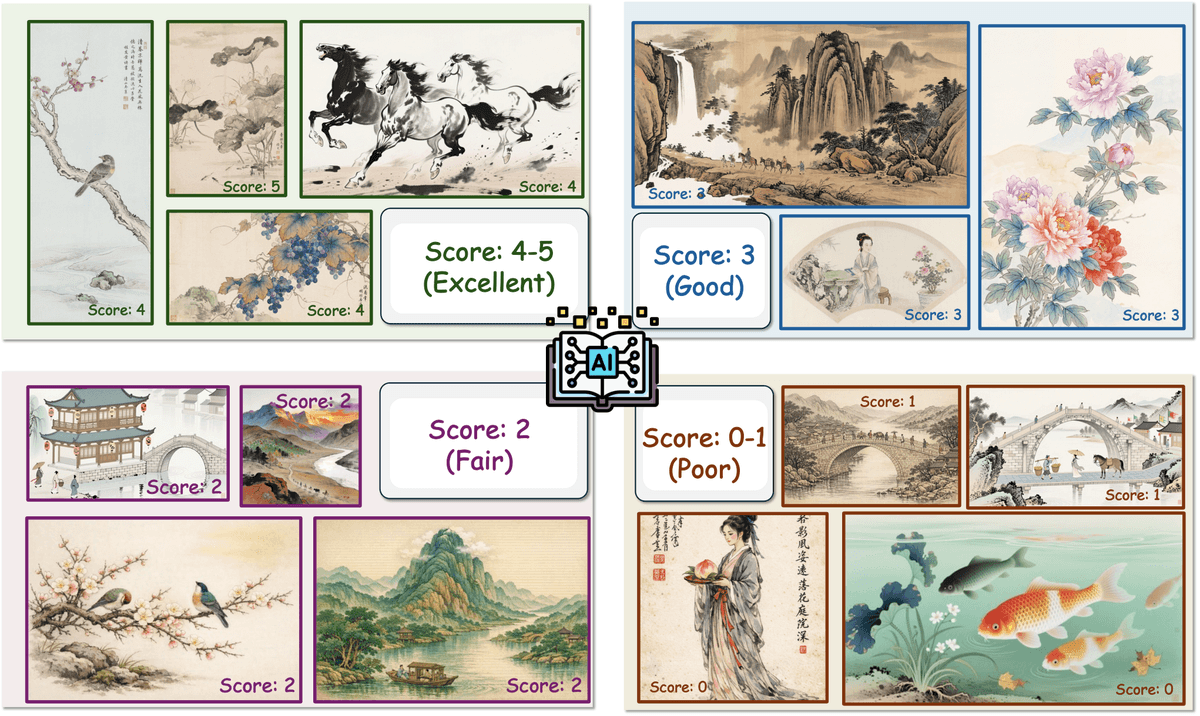
- The HanMo-Bench dataset holds 13,762 works mixing auction masterpieces with AI-generated paintings.
- Reward function grades score accuracy, reasoning similarity, and region-of-interest localization separately during GRPO.
- HanMoVLM-8B hits 46.67% accuracy and MAE 0.63, beating Gemini-3-Pro and GPT-5.1 with expert CoT.
- Human study: Kendall tau 0.758 and Spearman rho 0.845 versus 43 domain researchers, crushing PickScore and aesthetic score.
- Acts as a Best-of-N verifier for T2I models; Nano-Banana ranked best for Chinese painting generation.
Ask a top-tier vision-language model to identify a mountain, a river, or a bird in a painting and it will nail it. Ask it whether the brushwork carries bone-strength, whether the composition has spirit resonance, or whether the piece deserves a place next to an auction-grade masterpiece, and it falls apart. A new paper introduces HanMoVLM, a model specifically trained to close that gap for Chinese ink painting, along with a benchmark of auction-grade artworks and a way to plug the model into image generators as an art-critic verifier.
Why generic VLMs are artistically blind
The authors frame the problem in three parts. Artistic misalignment means the generic model lacks any real understanding of Chinese painting for assessment. There is also an understanding-evaluation gap where the model can identify elements but still cannot evaluate them. And there is a lack of high-quality annotated data reviewed by experts.
The deeper issue is cultural. Chinese painting evaluation does not rely on realism or linear perspective. It uses a system of judgment rooted in cultural depth that requires years of training to apply. Most VLMs are pre-trained on internet-scale data with heavy Western-centric bias, so their aesthetic priors simply do not match the domain.

Teaching a model to think like a critic
HanMoVLM is built on Qwen3-VL-Instruct in 4B and 8B versions, trained with LoRA (rank 64) on 8 H20 GPUs. The core idea is a hand-designed chain-of-thought that mimics how an actual Chinese art expert works through a painting. The model first identifies the overall content and locks the theme into one of three categories: Landscape, Flower and Bird, or Figure. It then analyzes local regions of interest, selects the evaluation criteria that match the theme, and applies the three-tier criteria of Chinese painting, which are Brush and Ink, Spirit Resonance, and Artistic Conception. Only then does it produce a final score.
Those three tiers are worth unpacking, because the model is explicitly told they matter in that order:
- Brush and Ink: line quality, brush control, ink layering, structural modeling.
- Spirit Resonance: whether the image feels internally alive, with rhythm and momentum.
- Artistic Conception: whether the work builds a poetic space that transcends the pixels on screen.
The prompt tells the model that Artistic Conception outweighs Spirit Resonance, which outweighs Brush and Ink. If conception is weak, refined brushwork alone is not enough to earn a high score.

A reward function that grades every step
Supervised fine-tuning on the CoT gets the model most of the way, but hallucinated reasoning is a real risk. To fix that, the team runs Group Relative Policy Optimization (GRPO, the RL method from DeepSeek-R1) with a composite reward that grades three distinct parts of the reasoning:
- Accuracy reward: how close the predicted 0-5 score is to ground truth, normalized to
1 - |pred - gt| / 5. - BERT reward: semantic similarity between the model's step-by-step commentary and expert reference responses.
- mIoU reward: overlap between predicted regions of interest and expert-drawn bounding boxes, combined with BERTScore on each region description to handle the open-vocabulary nature of the labels.
The final reward is a weighted sum, with the accuracy term dominating at a weight of 10 versus 2 for the others.
HanMo-Bench: auction records meet AI slop
HanMo-Bench contains 13,162 training paintings and 600 test paintings across Landscape, Flowers and Birds, and Figure themes. The dataset combines two very different sources. Authentic masterpieces are pulled from public auction house records along with their professional valuations. Synthetic works come from GPT-Image-1.5 and Nano-Banana, prompted by GPT-5.1 and Gemini-3-Flash to emphasize traditional styles.
The clever part is the scoring bridge. Auction valuations for real paintings are normalized into three tiers, with scores 3, 4, and 5 assigned to the top 60-100%, 10-60%, and top 10% respectively. Synthetic work is scored 0-3 by Gemini-3-Pro and then reviewed by human experts. The overlap at score 3 is deliberate. It simulates the reality that the best AI-generated Chinese paintings can now brush against the low end of the masterpiece scale, and forces the model to actually discriminate.

The numbers
On the benchmark, HanMoVLM-8B lands at MAE 0.63, RMSE 0.89, accuracy 46.67%, and BERTScore 0.56. For context, the base Qwen3-VL-Instruct 8B with expert CoT prompting reaches only 21.5% accuracy and MAE 1.51. Even Gemini-3-Pro with the expert CoT is stuck at 36.83% accuracy. The 4B HanMoVLM already outperforms every proprietary model tested. RoI localization also jumps sharply, with mIoU moving from 0.14 on the base model to 0.32 after RFT.
Ablations confirm each reward pulls its weight: dropping the accuracy reward drops score accuracy from 42.5% to 39.8%, and dropping the mIoU reward drops localization from 0.29 to 0.27.
Bolting it onto image generators
The second act is using HanMoVLM as an external verifier for text-to-image models. The setup is straightforward Best-of-N: sample 8 candidates from a T2I model, score each with HanMoVLM, keep the highest. It requires no additional training of the generator.
A human study with 43 researchers familiar with Chinese painting ranked outputs from the same prompts. HanMoVLM's rankings correlated with the experts at Kendall's tau 0.758 and Spearman's rho 0.845. For comparison, PickScore lands at 0.106 tau and standard aesthetic scores go negative at -0.258. The paper also notes that among current generators, Nano-Banana leads Chinese painting quality by about 2 points over GPT-Image-1.5, Seedream-4.0, and Qwen-Image, and that all models handle Flowers and Birds better than other themes.
Where it fits and where it does not
This is useful if you are training or deploying image generators for Chinese-market creative work, or building any tool that needs an automatable aesthetic verifier for a culturally specific domain. The bigger idea, transferable beyond Chinese art, is the recipe itself: encode expert reasoning as a structured CoT, then apply granular RL rewards to each stage of that reasoning rather than only the final answer.
The limits are honest. Accuracy on the 0-5 scale peaks below 50%, mIoU on regions of interest sits around 0.32, and the model is narrowly trained on three themes with a specific rubric. It is not a general art critic. The HanMo-Bench dataset is announced as forthcoming rather than immediately available, and there is no public code release mentioned in the paper.