
Hangzhou Dianzi's UMPS-SD Trains Generative Models 25x Faster Without Losing Accuracy
A quantum-physics-inspired training method makes tensor network generative models converge in seconds instead of minutes, using unit-sphere constraints and manifold optimization.
 Pro
Takeaways
- New paper trains MPS generative models with a unit-sphere constraint plus Riemannian optimization.
- Removes gauge directions where gradient descent wastes updates rescaling the entire tensor network.
- Space-decoupling trick lets DMRG-style core updates run in parallel across the chain.
- On EMNIST, reaches comparable test NLL roughly 25x faster than the Han et al. baseline.
- Evaluated on Bars-and-Stripes and EMNIST, keeping MPS expressive power intact.
- Best fit for discrete, moderate-dimensional data needing exact likelihoods and direct sampling.
A new paper takes a fresh swing at an old idea that quietly sits on the edge of machine learning and quantum physics: using tensor networks to model probability distributions. The work, from Haotong Duan and Zhongming Chen at Hangzhou Dianzi University with Ngai Wong at the University of Hong Kong, argues that if you constrain a matrix product state (MPS) to be unitary and train it with Riemannian optimization instead of vanilla gradient descent, you get a generative model that converges roughly an order of magnitude faster without giving up expressivity.
Tensor networks, briefly
Tensor networks were originally developed in condensed matter physics to accurately characterize the wave functions and entanglement structures of quantum many-body systems. A matrix product state (MPS), also called a tensor train in the numerics literature, factorizes a huge high-dimensional tensor into a chain of small three-index cores. In machine learning it can be used as a probabilistic model where the squared amplitude of the tensor represents a joint distribution over discrete variables, borrowing directly from the Born rule in quantum mechanics.
The canonical reference here is Han et al.'s 2018 paper, which proposed a generative model using matrix product states, a tensor network originally proposed for describing one-dimensional entangled quantum states, with efficient learning analogous to the density matrix renormalization group method that allows dynamically adjusting dimensions of the tensors and offers an efficient direct sampling approach for generative tasks. That approach became the baseline that most later MPS generative models compare against.
Why plain gradient descent stalls
The authors identify a subtle failure mode in the standard training loop. When training MPS-based generative models, local probabilities are determined by the relative values of normalization coefficients induced by the optimized MPS tensors. Under unconstrained optimization, these coefficients might oscillate or adapt slowly because some gradient directions mainly rescale the entire MPS and thus do not affect local probabilities.
In plain terms: the optimizer burns steps moving the tensors in directions that only change their overall scale, which cancels out when you normalize to get a probability. So a lot of the update budget is wasted on symmetries of the parameterization instead of actually reshaping the distribution.
The unitary MPS fix
The proposed remedy is to lock the model onto a manifold where those useless directions do not exist. The authors propose a unitary MPS-based generative model that enforces a unit-sphere constraint, limiting optimization to directions that adjust the relative weights among MPS cores. Because the state vector has unit norm by construction, the ambiguity in the parameterization is removed.
To actually optimize under that constraint, they turn to Riemannian optimization, which does gradient steps along the curved surface of the manifold rather than in flat Euclidean space and then projecting back. Parameterization-based approaches can preserve manifold structure during optimization, while Riemannian optimization avoids the computational overhead and instability associated with Euclidean projection-based methods.
The final ingredient is a space-decoupling trick. Combining a DMRG-inspired update scheme with a space-decoupled strategy enables efficient updates at the intersections of tensor manifolds and supports independent, parallel optimization of MPS cores. DMRG (density matrix renormalization group) is the workhorse algorithm from quantum many-body physics that sweeps through the tensor chain updating one or two cores at a time. Decoupling the manifold constraints across cores means those per-core updates can be done in parallel rather than strictly sequentially.
How it performs
The method is evaluated on two datasets. The first is Bars-and-Stripes, a data set containing 4 by 4 binary images where each image has either four-pixel-length vertical bars or horizontal stripes but not both, with 30 different images out of all possible ones. It is small enough that the model's behavior can be inspected analytically. The second is EMNIST, an extended version of MNIST with handwritten digits and letters.

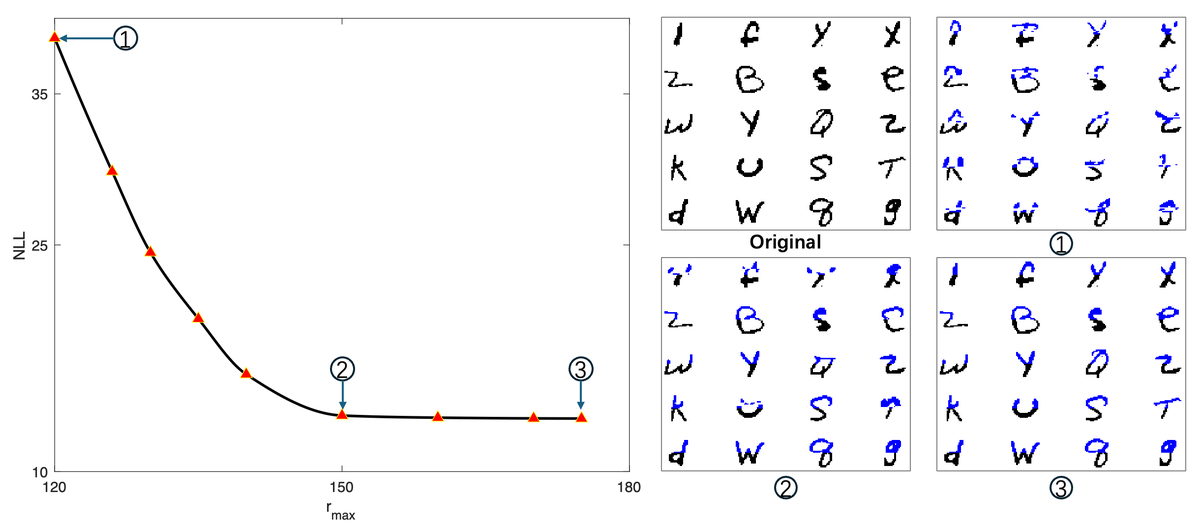
On EMNIST, the authors compare their algorithm, called UMPS-SD, against the Han et al. baseline under identical hyperparameters. Convergence is quantified using the negative log-likelihood on the test set, while the total training time is recorded to assess computational efficiency. The headline number from their reported table: UMPS-SD reaches a test NLL of 13.01 after 3 optimization loops in about 30 seconds, while the baseline MPS needs 25 loops and roughly 831 seconds to get to a comparable NLL of 12.88. That is a speedup of more than 25x to the same solution quality.
What it is good for, and what it is not
The practical appeal of MPS generative models is not that they beat diffusion or autoregressive transformers on natural images. They do not. Their appeal is different:
- Exact likelihoods and exact partition functions, unlike RBMs or VAEs which only approximate them.
- Direct, unbiased sampling from the learned distribution without MCMC.
- A clean physical interpretation and controllable expressivity through the bond dimension.
- Natural fit for problems where inputs are discrete and moderate-dimensional, such as probabilistic tabular data, combinatorial structures, quantum state tomography, and probabilistic circuits.
The weak spots are equally real. MPS is a one-dimensional structure, so it struggles with the two-dimensional locality of images at scale; tree tensor networks and PEPS handle that better. Bond dimension controls capacity but also memory and runtime, and scaling to the resolution of modern image or language datasets is not what this line of work is aiming at.
The real breakthrough
The interesting contribution here is not a new architecture, it is a cleaner optimization geometry. By identifying that the standard MPS parameterization contains gauge directions that gradient descent wastes updates on, and by removing them through a unit-sphere constraint plus parallelizable per-core Riemannian updates, the authors show you can get MPS generative models to train dramatically faster without changing the model class. For anyone working on tensor-network machine learning, or on manifold-constrained optimization more broadly, that reframing is the takeaway.