
HaLoRA Slashes AI Inference Energy by 97% on Next-Gen Memory Chips
HaLoRA trains LoRA adapters to survive RRAM hardware noise, cutting LLM inference energy to just 3% of an A100 GPU while preserving accuracy
 Pro
Takeaways
- 97% energy reduction: HaLoRA runs LLaMA-3.2 1B inference at 18.1 mJ vs 550.5 mJ on an A100 GPU by using a hybrid RRAM+SRAM chip.
- Core problem solved: RRAM memory is noisy by physics -- HaLoRA trains LoRA adapters to compensate for that noise at inference time.
- Novel training loss: A theoretically grounded upper-bound regularizer prevents the adapter from overfitting to any specific noise pattern, generalizing across noise levels.
- +22.7 accuracy points: At noise level σ=0.02, HaLoRA scores 63.1 average vs 40.4 for standard LoRA across 6 commonsense reasoning benchmarks.
- Tiny overhead: LoRA parameters are only 0.15% of LLaMA-3.2 1B's total weights, so the noise-free SRAM footprint is negligible.
- No public code yet: The paper is on arXiv; no GitHub repo has been released.
Running a fine-tuned large language model at the edge is expensive -- not just in dollars, but in watts. GPUs are power-hungry by design, and as LLMs grow, the energy bill for inference keeps climbing. A new paper published in ACM Transactions on Design Automation of Electronic Systems proposes a path to slashing that cost by 97%, by rethinking where model weights live in hardware -- and how fine-tuning should account for that.
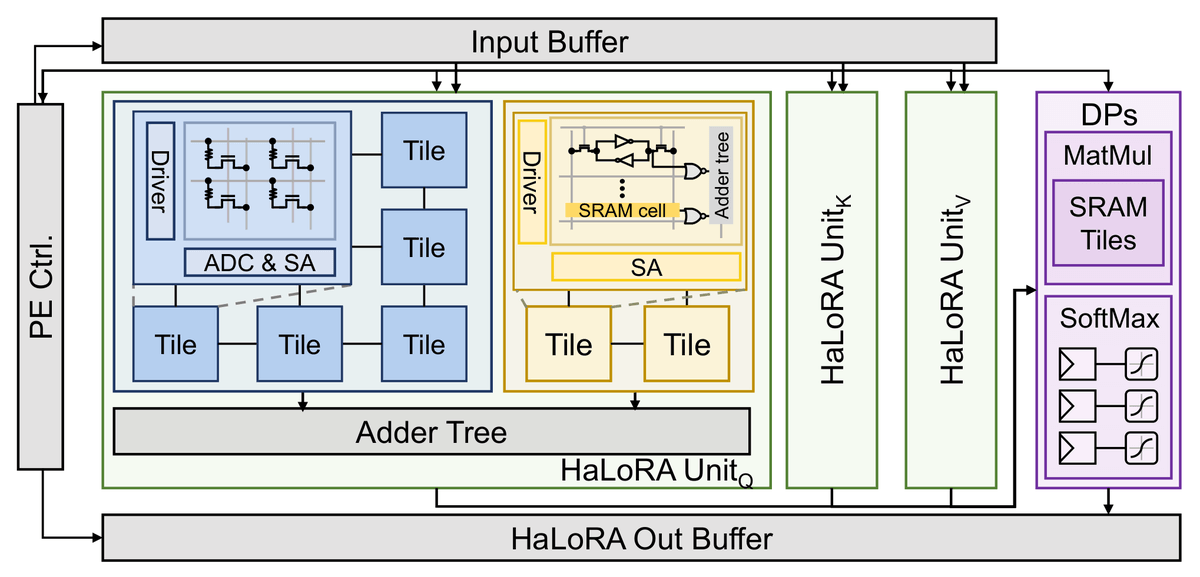
The work introduces HaLoRA (Hardware-aware Low-Rank Adaptation), a method that co-designs the LoRA fine-tuning process with a hybrid Compute-in-Memory (CIM) chip architecture. The result: a fine-tuned LLM that runs efficiently on novel memory hardware without sacrificing reasoning accuracy.
The Memory Wall Meets the Energy Wall
To understand why this matters, you need to know what Compute-in-Memory actually is. Traditional processors shuttle data back and forth between separate memory and compute units -- a bottleneck that, in LLM inference, can account for more than 80% of total system energy. CIM sidesteps this by doing the math directly inside the memory array, eliminating most of that data movement.
There are two main flavors of CIM memory relevant here:
- RRAM (Resistive Random-Access Memory): RRAM-based CIM offers better energy efficiency and computational density but introduces noise due to the non-ideality of the physical device. Weights are stored as analog resistance states, which drift and vary.
- SRAM (Static Random-Access Memory): SRAM-based CIM provides greater reliability but demands a larger silicon footprint and relatively higher power consumption for conventional vector-matrix multiplications.
The natural move is to use both. The hybrid strategy exploits this characteristic: deploying the task-agnostic pretrained weights on RRAM maximizes energy efficiency while avoiding frequent write operations, and implementing the task-specific LoRA branches on SRAM ensures accurate adaptation at a reasonable cost. The problem is that RRAM noise corrupts the pretrained weights at inference time -- and a standard LoRA adapter trained on clean weights has no idea how to compensate.

When Hardware Noise Breaks Your Fine-Tune
Despite RRAM's energy efficiency, the inherent non-ideality introduces noise during the reading process, misleading the model to generate nonsense responses. The noise from the RRAM-based weights leads to nonsense answers while the vanilla model can generate the correct answer. A standard LoRA adapter, trained assuming clean base weights, cannot compensate for this -- it was never taught to expect corrupted inputs from the frozen layers it relies on.
This is the core tension: RRAM saves energy, but its physical imperfections degrade model outputs. SRAM is clean but expensive. You want the efficiency of RRAM for the bulk of the model, and the reliability of SRAM for the parts that change per task. The question is how to make the fine-tuning process aware of this split.
How HaLoRA Works
HaLoRA's insight is elegant: train the LoRA adapter to be robust against RRAM noise from the start, so that when deployed on clean SRAM it can compensate for the noisy base weights stored in RRAM. The training procedure has two key components:
- Noise injection during training: Random noise is injected into the pretrained weights, and then the LoRA branches are optimized towards the noise-free optimal to improve their robustness. This forces the adapter to learn corrections that work even when the base weights are corrupted.
- A theoretically grounded extra loss: The gap between optimized LoRAs with and without noise is analyzed theoretically, yielding a noise-agnostic upper bound to avoid overfitting to specific noise patterns. With an extra loss minimizing this upper bound during fine-tuning, HaLoRA achieves superior robustness and accuracy given noisy RRAM-based pretrained weights during inference.
The upper bound is critical. Without it, you'd just be training a LoRA that memorizes one specific noise pattern -- useless when the actual hardware noise differs. By minimizing the bound instead of the noise itself, HaLoRA learns a general compensation strategy.
In practice, LoRA branches are inserted into five modules: query, key, value, up, and down projection layers, with a rank of 4. The LoRA parameter count stays tiny -- just 0.15% of the total parameters for LLaMA-3.2 1B -- so the SRAM footprint for the adapter is negligible.
Here's a simplified view of what the modified training loss looks like conceptually:
# Standard LoRA loss
loss = task_loss(model(x, W_frozen + AB), y)
# HaLoRA: inject noise into frozen weights, add upper-bound regularizer
W_noisy = W_frozen + gaussian_noise(sigma)
loss = task_loss(model(x, W_noisy + AB), y) + mu * upper_bound_gap(AB, W_frozen, W_noisy)
The Numbers That Matter
The energy savings are the headline. For LLaMA-3.2 1B with 512 input tokens, HaLoRA achieves 18.1 mJ energy cost, which is 3.29% of the 550.5 mJ of vanilla LoRA on an Nvidia A100 GPU. That's not a rounding error -- it's a 30x reduction in per-inference energy.
On accuracy, HaLoRA is evaluated by fine-tuning Qwen2.5 and LLaMA-3.2 on 6 popular commonsense reasoning tasks, demonstrating effectiveness and robustness at various noise types and noise levels. The benchmarks include ARC-e, OBQA, SIQA, ARC-c, WinoGrande, and PIQA. Key results:
- At a noise level of 0.02, HaLoRA achieves an average score of 63.1, surpassing standard LoRA by a significant margin of 22.7 points.
- Compared to vanilla LoRA, HaLoRA performs better under the noise-free setting and showcases better robustness at all noise levels. The noise-free improvement is a bonus -- the regularization also acts as a useful training signal in clean conditions.
- Larger models, especially with HaLoRA, tend to demonstrate better tolerance to hardware-induced noise compared to smaller models.
- Further analyses demonstrate that HaLoRA also performs well considering stuck-at faults -- a different failure mode where a memory cell gets permanently stuck at one resistance value.
Where This Fits and What It Can't Do
HaLoRA is squarely aimed at edge and on-device inference scenarios where energy is the binding constraint. Think embedded AI accelerators, always-on inference chips, or any deployment where you can't plug into a data center. In-memory computing technologies present a promising avenue to alleviate the growing data communication for LLMs by performing computations directly within memory, alleviating the von Neumann bottleneck, lessening data transfers, and enhancing energy efficiency.
The limitations are real though. The method is currently validated only on commonsense reasoning tasks with smaller models (0.5B to 3B parameters). Whether the noise-robustness training generalizes to instruction-following, code generation, or math reasoning at larger scales remains open. The authors also note that future work plans to extend HaLoRA to quantized LLMs, potentially combining HaLoRA with LoftQ. Combining hardware-noise robustness with quantization noise is a natural next step, but it's not solved yet.
There's also the hardware dependency: this only matters if you're actually deploying on RRAM-based CIM chips, which are still a niche research and specialized-edge-hardware domain. For anyone running inference on GPUs or standard CPUs, HaLoRA offers no direct benefit today. But as CIM chips move closer to production -- driven by the energy economics of always-on AI -- the software stack for them needs to exist. HaLoRA is an early, principled piece of that stack.
No public code repository is mentioned in the paper. The work is published in ACM TODAES and the preprint is available on arXiv.