
Groningen's RGP-VAE Generates Valid Brain Signal Data Without Calibration Sessions
A geometry-aware VAE learns to synthesize valid brain-signal covariance matrices, cutting calibration burden for motor imagery brain-computer interfaces.
 Pro
Takeaways
- Groningen team proposes RGP-VAE, a VAE that generates valid SPD covariance matrices for EEG motor-imagery brain-computer interfaces.
- Logarithmic and exponential maps sandwich the encoder-decoder, keeping outputs on the Riemannian manifold by construction.
- Parallel transport aligns subjects to a common reference, producing a subject-invariant latent space for cross-subject generalization.
- 100% of synthetic matrices passed SPD validity checks; a standard Euclidean VAE failed on over 40% of outputs.
- KNN gained up to +3.49% balanced accuracy; MDM was flat and SVC dropped up to 4.01 points.
- Code and demos are on the RGP-VAE project page, evaluated on MOABB.
Brain-computer interfaces that read motor imagery from EEG signals have a stubborn problem: every new user needs a long calibration session before the classifier works reliably. A team from the University of Groningen has proposed a way around that by generating synthetic EEG data with a variational autoencoder that respects the curved geometry these signals actually live on. Their Riemannian Geometry-Preserving VAE (RGP-VAE) produces fully valid synthetic covariance matrices and, for at least one common classifier, meaningfully boosts cross-subject accuracy.
Why standard VAEs break on EEG
Modern motor-imagery pipelines rarely feed raw voltage into a classifier. Instead, they compute a spatial covariance matrix per trial, which is symmetric positive-definite (SPD), and then classify these matrices using Riemannian geometry. Riemannian geometry-based classifiers currently dominate MI-BCI competitions, but their advancement toward mainstream applications is hindered by data scarcity and inter-subject variability, which necessitates lengthy calibration sessions.
The natural fix is data augmentation, but SPD matrices do not live in flat Euclidean space. Standard VAEs assume Euclidean geometry, and applying standard Euclidean operations on this curved manifold causes geometric distortions such as the swelling effect. Prior geometric augmentation methods interpolate between existing matrices, but that approach is fundamentally limited to the convex hull of the original data and cannot generate plausible variations in unexplored regions of the manifold.
Wrapping a VAE in geometric maps
The authors keep a conventional encoder-decoder MLP but sandwich it between two geometric operations. Each input covariance matrix is projected onto the tangent space at a class-specific reference point (the Riemannian Fréchet mean) using a logarithmic map, then vectorized and passed through the encoder. The decoder produces a tangent-space vector that is mapped back onto the SPD manifold with an exponential map.

Two more ingredients matter. Parallel transport is applied to geometrically transport matrices from each subject-specific reference mean to a global class reference mean via a congruence transformation, which is how the model learns features that generalize across people. And the training loss is a composite of four terms: an affine-invariant Riemannian distance between the input and reconstructed matrices, a Euclidean reconstruction error in tangent space, the usual KL divergence with annealing, and a diversity term that maximizes the geometric volume of generated tangent vectors by minimizing the negative log-determinant of the batch covariance, promoting wider spatial coverage.
Results on a 12-subject benchmark
Evaluation uses the Faller et al. dataset loaded through the Mother of All BCI Benchmarks framework, giving 5,572 trials from 12 subjects on a right-hand vs. both-feet motor imagery task. The team runs leave-one-subject-out cross-validation with three classifiers: minimum distance to mean (MDM), k-nearest neighbors, and a support vector classifier.
The validity numbers are striking. Across all folds, 100% of synthetic matrices from both prior and posterior generators passed symmetry and positive-definiteness checks, whereas a standard Euclidean VAE failed to generate valid data, with more than 40% of outputs in every fold violating positive-definiteness.
Downstream accuracy tells a more nuanced story. For KNN, posterior sampling used as the only training data gave a +3.49% balanced-accuracy gain (p=0.002), and prior sampling gave +3.00%. MDM was essentially unchanged. SVC actually got worse, dropping up to 4.01 percentage points.

The authors offer a plausible explanation: their samples cluster near class means rather than spanning the outlier ranges, so KNN benefits because the prototypical synthetic samples densify the class manifolds, creating denser and more reliable local neighborhoods for distance-based classification, while the reduced diversity likely causes the SVC to learn decision boundaries too narrowly fitted around class centres, reducing generalization to boundary-case real samples.
What this is actually good for
The headline is not "beats state of the art." It is that a generative model on the SPD manifold can be built at all without producing garbage, and that augmentation utility is classifier-specific rather than universal. The paper is honest that divergent classifier results highlight that generative capabilities on the SPD manifold do not guarantee universal downstream improvements.
Beyond accuracy, the framework has some practical hooks worth noting:
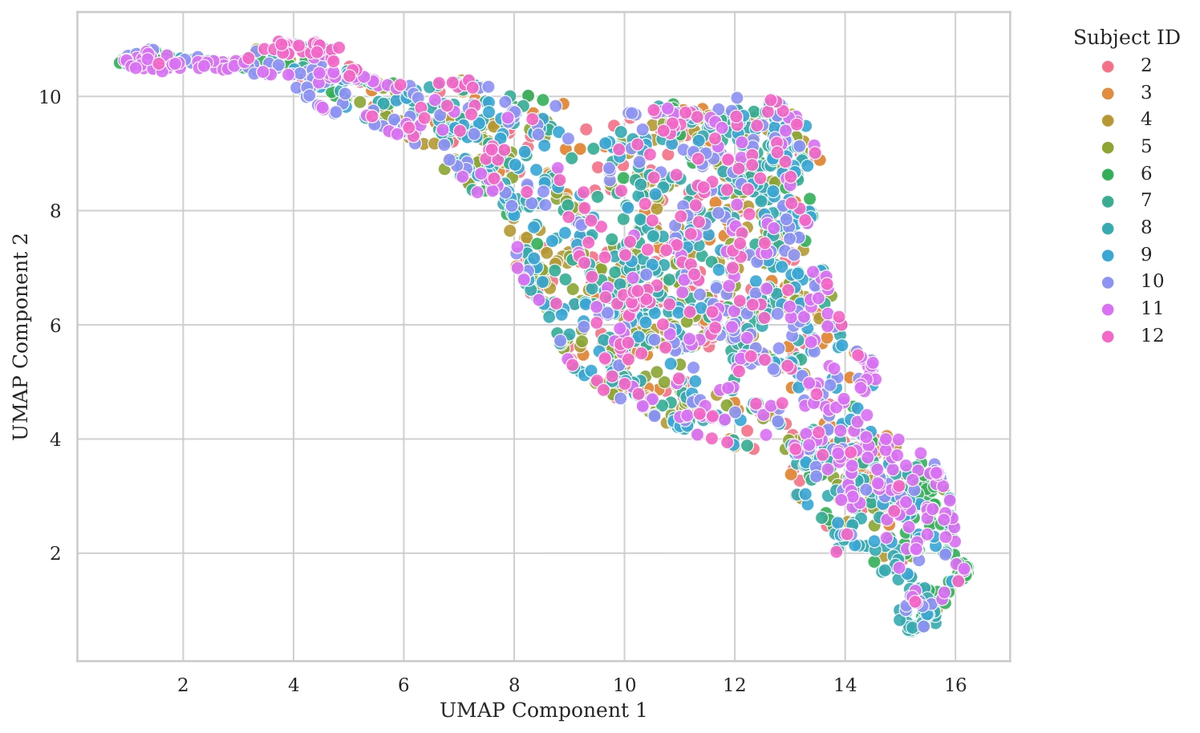
- Cross-subject generalization: a UMAP of the latent space shows subjects heavily intermingled, evidence that parallel-transport alignment produced a subject-invariant representation.
- Privacy: because synthetic covariance matrices never reveal raw voltage traces, they offer a way to share BCI data without releasing subject-level signals.
- Scalability testing: synthetic samples let you stress-test a pipeline before recruiting more participants.
- Feeding data-hungry deep models: geometric augmentation could plausibly close some of the gap that has kept deep learning behind Riemannian classifiers on small BCI datasets.
Source code and additional materials are available on the project's GitHub page. If you are working on SPD-valued signals more broadly, from diffusion tensor imaging to financial covariance forecasting, the recipe of logarithmic map, MLP, exponential map, plus a Riemannian reconstruction loss is a template worth stealing even outside of neurotechnology.