
Griffith University's WS-Net Recovers Faint Mineral Signals Satellites Always Miss
WS-Net combines Mamba state-space models and a novel Weak Signal Attention branch to recover faint spectral signatures that standard unmixing models miss, cutting error rates by up to 63%.
 Pro
Takeaways
- WS-Net is a new deep learning framework for hyperspectral unmixing that specifically recovers weak, low-abundance spectral signals that standard models miss.
- It introduces Weak Signal Attention, an inverse-attention mechanism that boosts low-similarity spectral tokens instead of amplifying dominant ones.
- A Mamba state-space branch handles long-range spectral dependencies with linear complexity, paired with a wavelet encoder for multi-scale feature extraction.
- Tested on Samson and Apex datasets, WS-Net achieves up to 55% lower RMSE and 63% lower SAD versus six state-of-the-art baselines.
- Key use cases include mineral exploration, precision agriculture, and environmental monitoring where rare materials are drowned out by dominant ones.
- Code and models will be released at github.com/leolala/WS-Mamba; paper available on arXiv.
Hyperspectral cameras don't just capture color -- they record hundreds of narrow wavelength bands per pixel, giving each material on Earth a unique spectral fingerprint. But reading those fingerprints is hard when one material dominates the scene and drowns out the faint signals of rarer ones. A new paper from Griffith University and CSIRO introduces WS-Net, a deep learning framework built from the ground up to solve exactly that problem.
The task at hand is called hyperspectral unmixing -- the process of taking a single pixel that contains a mix of materials and figuring out which materials are present and in what proportions. Hyperspectral unmixing estimates the fractional abundances corresponding to endmembers (pure material signatures) in each mixed pixel of a hyperspectral remote sensing image. Think of it as separating a smoothie back into its individual ingredients, spectrally.
When the signal is too quiet to hear
The core challenge WS-Net addresses is what the authors call weak signal collapse. This is a failure mode wherein low-magnitude endmembers are either underrepresented or completely missed in the unmixing process due to interference from dominant spectral signatures. In practical terms, if a scene has a large patch of soil and a tiny vein of a rare mineral, most models will confidently map the soil and quietly ignore the mineral.
The authors formally define a weak-signal scenario as one in which at least one endmember exhibits an average reflectance magnitude below 0.1 across more than 70% of spectral bands, or contributes less than 10% fractional abundance in over 60% of pixels. These aren't edge cases -- they're common in real-world aerial and satellite imagery.
Addressing this regime requires architectures explicitly designed to preserve and reconstruct low-energy spectral components. Despite growing interest in deep learning-based weak hyperspectral unmixing, several critical limitations remain unresolved. Prior approaches using CNNs and Transformers tend to treat all spectral features equally, meaning dominant signals consistently overpower weaker ones during training.
A three-stage architecture built for the faint
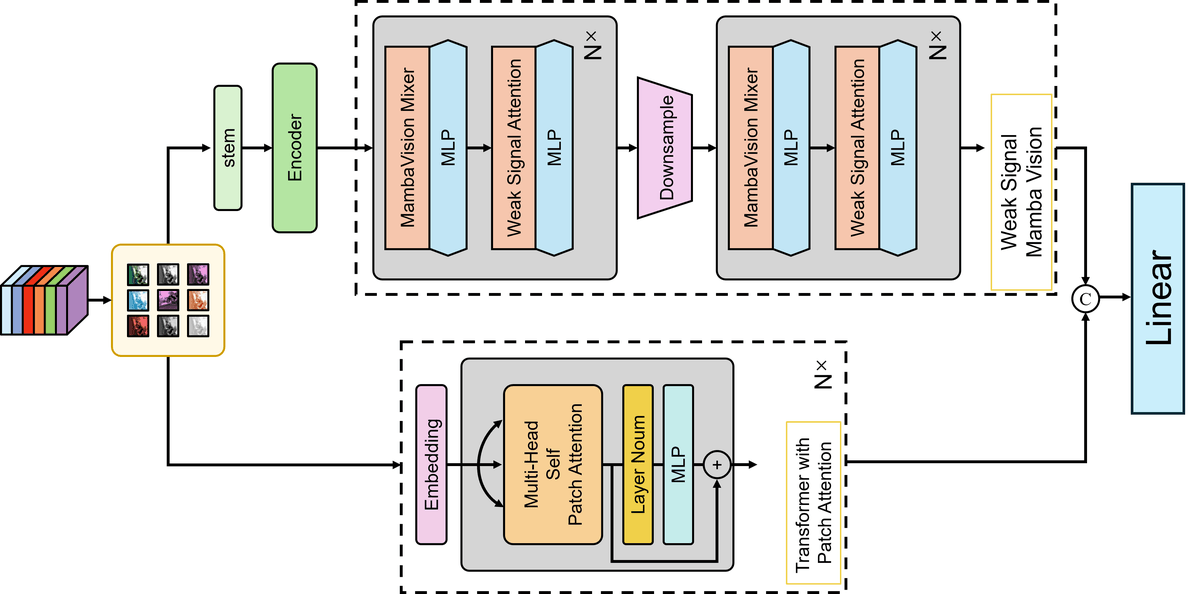
WS-Net's pipeline has three distinct stages, each targeting a different aspect of the weak-signal problem.

- Wavelet-Fused Feature Enhancer (WFFE): A dual-branch encoder combines wavelet-based frequency decomposition using Haar and Symlet-3 wavelets with convolutional spatial processing, enabling enhanced representation of low-magnitude spectral features while suppressing high-frequency noise. Wavelets are a signal-processing tool that decompose data into components at different scales -- useful for simultaneously capturing sharp spectral edges and smooth gradients.
- Mamba + Weak Signal Attention backbone: To efficiently capture long-range spectral-spatial dependencies without suppressing weak spectra, the model uses a weak-signal aware State Space Model and Transformer fusion module. It integrates a Mamba-based state-space branch that linearly propagates spectral context with a weak-signal attention branch that reweights low-similarity tokens through inverse attention, while a learnable gate adaptively fuses both branches for robust weak-endmember recovery. Mamba is a recently popularized alternative to Transformers that processes sequences with linear (not quadratic) complexity, making it efficient on long spectral sequences. The inverse attention trick is the key novelty: instead of amplifying the most prominent features (as standard attention does), it deliberately boosts the ones that look least like everything else -- precisely where weak signals hide.
- Sparsity-Aware Decoder: A learnable gating mechanism adaptively fuses both representations, while the decoder leverages KL-divergence-based regularisation to enforce separability between dominant and weak endmembers. KL-divergence here acts as a penalty that pushes the model to keep dominant and weak abundance maps distinct, preventing the network from lazily collapsing everything into the dominant class.
What it was tested on
To comprehensively evaluate the method, experiments were conducted on one synthetic and two widely used real-world hyperspectral datasets: Simulated, Samson, and Apex.
- Simulated dataset: A controlled synthetic scene with known ground truth, including minerals like olivine, montmorillonite, magnetite, and mirabilite -- several of which are weak-signal endmembers by design.
- Samson: The original image contains 952x952 pixels and 156 bands ranging from 0.401 to 0.889 micrometers. The most used scene is a 95x95 pixel crop. The dataset consists of three main endmembers: Soil, Tree, and Water.
- Apex: Hyperspectral data of size 110x110 pixels with 285 spectral bands and 4 different classes -- an urban scene including roof, road, tree, and water, where tree and water are typically weak endmembers.

WS-Net was compared against six baselines including FCLSU, CNNAEU, DeepTrans, EDAA, EndNet, and MiSiCNet. Experiments demonstrate consistent improvements over all six state-of-the-art baselines, achieving up to 55% and 63% reductions in RMSE and SAD, respectively. RMSE measures how far predicted abundances are from ground truth; SAD (Spectral Angle Distance) measures how accurately the model recovers the shape of each material's spectral curve.
The real breakthrough
The evaluation on the Samson dataset further demonstrates the generalization capability of the method, particularly its superior performance in modeling weak-signal endmembers. The gains aren't just average-case improvements -- they're largest precisely for the endmembers that all other methods fail on. That's the meaningful shift: previous work improved unmixing broadly; WS-Net improves it where it matters most.

Mamba architectures based on state space models have shown great potential in hyperspectral image processing due to their powerful long-range sequence modeling capabilities and the efficiency advantages of linear computing. WS-Net is one of the first frameworks to combine Mamba's efficiency with an explicit mechanism for weak-signal recovery in the unmixing task specifically -- not just classification.
Where it fits and where it doesn't
The applications for accurate hyperspectral unmixing are broad. Spectral unmixing plays a vital role in mineral exploration, agriculture and crop monitoring, environmental monitoring, urban planning, remote sensing of planetary surfaces, pollution monitoring, medical imaging, and water quality assessment. WS-Net's specific advantage -- recovering rare, low-abundance materials -- is most valuable in scenarios like:
- Geological surveys searching for trace minerals in rock formations
- Precision agriculture detecting early-stage crop stress or disease patches
- Environmental monitoring tracking trace pollutants or invasive species
- Urban mapping where small features like water bodies compete with dominant roof and road signals
Where WS-Net is less suited: scenes where all materials have roughly equal abundance and reflectance, or applications where computational budget is extremely tight (the dual-branch architecture adds overhead compared to simpler CNNs). The paper also notes that the framework's formal definition of a "weak signal" -- reflectance below 0.1 in 70% of bands or abundance below 10% in 60% of pixels -- means it's optimized for a specific regime and may not generalize to all unmixing scenarios out of the box.
Code is coming
The source code and trained models will be made publicly available at https://github.com/leolala/WS-Mamba.git. The repository is not yet live at time of writing, but the authors have committed to releasing it. The paper itself is available on arXiv, and the architecture builds on publicly available components including the WaveMamba line of work combining wavelets with state-space models for hyperspectral tasks.
For teams working on remote sensing pipelines where rare materials matter -- whether that's a geology startup, a precision agriculture platform, or a satellite data company -- WS-Net represents a meaningful step forward. The combination of Mamba's efficiency and purpose-built weak-signal attention gives it a profile that neither pure Transformer nor pure CNN approaches can match in this specific regime.