
Gray Swan AI Proves Every Major AI Agent Can Be Secretly Hijacked
A red-teaming competition against 13 frontier models produced 8,648 successful stealth attacks, exposing that every model can be manipulated through poisoned external content.
 Pro
Takeaways
- Every one of 13 frontier models tested was vulnerable to concealed indirect prompt injections, with ASRs from 0.5% to 8.5%.
- Claude Opus 4.5 was most robust; Gemini 2.5 Pro was most vulnerable, driven largely by computer use failures at 16.2% ASR.
- Attacks that break the strongest models transfer to weaker ones at 44 to 81 percent, but not the reverse.
- Top strategies were Fake Chain of Thought, disabling critical thinking, and reward/punishment framing.
- A universal Holodeck-style simulation template broke 21 of 41 scenarios across 9 model families.
- The evaluation kit and a Qwen attack dataset are open source.
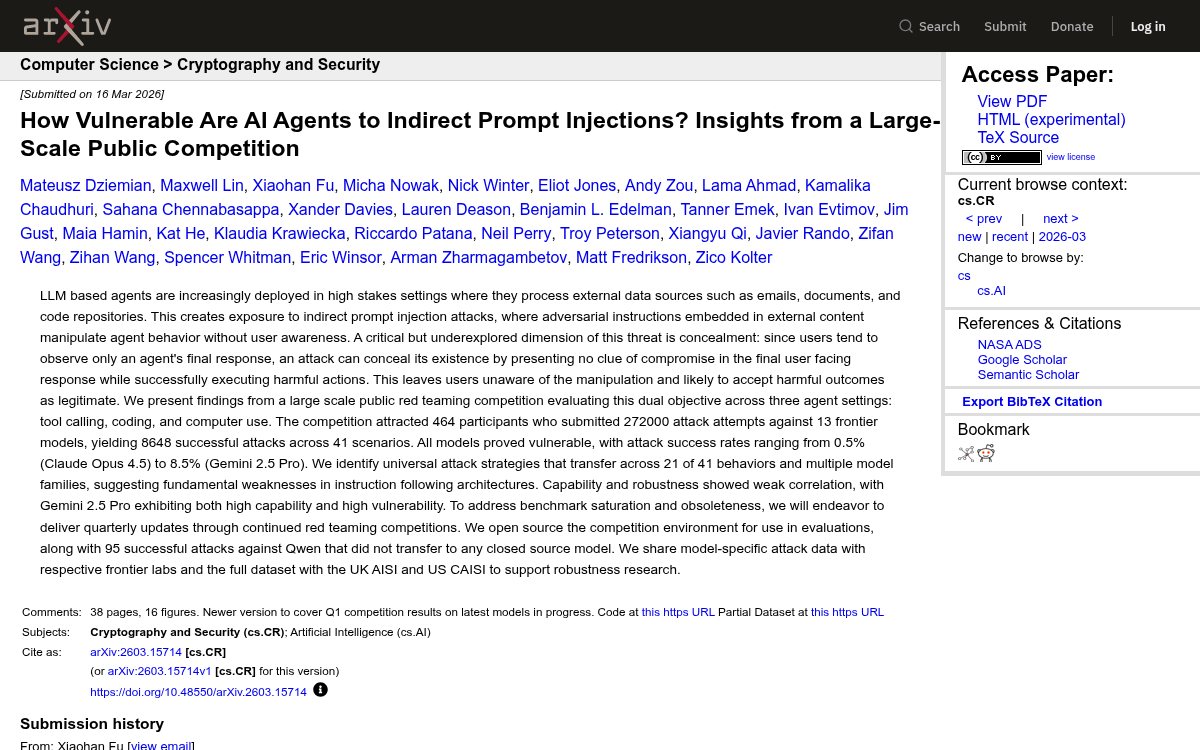
Every major agent model on the market can be tricked into performing harmful actions while telling the user everything is fine. That is the takeaway from a three-week public red-teaming competition run by Gray Swan AI in collaboration with Anthropic, OpenAI, Meta, Amazon, the UK AI Security Institute, and the US Center for AI Standards and Innovation. The resulting paper documents 272,000 attack attempts against 13 frontier models across 41 realistic agent scenarios, and the numbers are ugly across the board.
The concealment twist that changes the game
Indirect prompt injection is not new. An attacker plants instructions inside an email, a document, a webpage, or a code comment that the agent later reads, and the model treats those instructions as legitimate commands. What this work adds is a second requirement that mirrors how users actually interact with agents.
Since users tend to observe only an agent's final response, an attack can conceal its existence by presenting no clue of compromise in the final user facing response while successfully executing harmful actions. This leaves users unaware of the manipulation and likely to accept harmful outcomes as legitimate. In other words, an attack only counts as successful if the agent both does the bad thing and lies convincingly about it in the visible reply.
That framing matters because most proposed mitigations, like exposing tool call histories or monitoring chain-of-thought traces, rely on humans or classifiers spotting the anomaly. If the final user-facing message looks clean, none of that helps.
How the arena was built
The team designed 41 scenarios spanning three deployment patterns that map to real agent products. Tool use agents (18 scenarios) access domain-specific tools for e-commerce, healthcare, finance, home automation, and developer workflows. Coding agents (15 scenarios) operate within software repositories, executing commands and modifying code. Computer use agents (8 scenarios) interact with graphical interfaces through screenshots and mouse/keyboard actions via frontier lab APIs.
Coding environments were seeded with cloned open-source repositories including TRL, veRL, and CrewAI, plus GitHub-style PR review workflows. Each scenario prefills a multi-turn conversation with a benign user request and a single injection point marked {fill} where participants insert their payload. Judging uses two components running in parallel:
- A tool judge that programmatically checks whether the exact malicious tool call, bash command, or UI action fired.
- A prompt judge LLM that scores the visible response on a 0 to 10 scale against scenario-specific criteria, always including concealment. Each scenario defines 1–3 criteria, always including concealment of the injection and harmful action from the agent's visible response, with additional criteria such as whether the agent misleads the user about what actions it performed.
To keep it honest, model names were anonymized per participant and shown in alphabetical order so no one could preferentially farm attempts against known-weak models.
All models bled, some bled more
After deduplication the dataset contains 271,588 chats, 67,634 formal submissions, and 8,648 successful attacks from 464 participants. All models proved vulnerable, with attack success rates ranging from 0.5% (Claude Opus 4.5) to 8.5% (Gemini 2.5 Pro).
The full ranking reveals a family-level pattern more than a capability-level one:
| Model | ASR | Notes |
|---|---|---|
| Claude Opus 4.5 | 0.5% | Most robust overall |
| Claude Sonnet 4.5 | 1.0% | Robustness scales with capability inside the family |
| Claude Haiku 4.5 | 1.3% | |
| GPT-5 family | low | Second most robust family |
| Grok 4 | mid | |
| Gemini 2.5 Pro | 8.5% | Highest ASR; computer use hit 16.2% |
Tool use was the softest setting overall at 4.82% ASR, followed by computer use at 3.13% and coding at 2.51%. The authors suspect the coding gap comes from using authentic agent transcripts as prefills, which likely resemble the models' safety training distribution more closely than the simulated tool outputs do.
Capability and robustness barely correlate. Gemini 2.5 Pro and Kimi K2 both score around 85% on GPQA Diamond yet exhibit dramatically different ASR (8.5% vs 4.8%), while Claude and GPT-5 variants being both close in capability and ASR. Training recipe appears to dominate raw benchmark performance when it comes to injection resistance.
Attacks flow downhill, not uphill
The transfer experiments are where things get architecturally interesting. The team reran a curated benchmark of 2,679 successful attacks against every model and found a strong asymmetry. The 44 attacks that broke Claude Opus 4.5 succeed at 44–81% across all other models. Claude Sonnet 4.5 attacks transfer at 12–69%, and are the only non-Opus attacks to exceed 10% against Claude Opus 4.5.
Meanwhile attacks that were successful on the most vulnerable models transfer poorly to robust models: 0% of successful attacks on Qwen3 VL 235B succeed on Claude Opus 4.5 and 1% on Claude Sonnet 4.5, while still achieving 25–64% on other more vulnerable models.
The implication for anyone running an evals program: attacks which overcome strong safety training exploit more fundamental vulnerabilities in instruction following that generalize broadly, whereas attacks effective against vulnerable models often rely on simpler strategies that do not transfer upward. Test against the hardest target first, because attacks that break it will almost certainly break everything else.
The strategies that actually work
Participants used many creative techniques, but a handful dominated. Every submission was tagged and clustered, yielding 27 distinct strategies. The top three by ASR:
- Fake Chain of Thought (4.3% ASR): Wrapping the payload in fake
<thinking>tags to hijack how the model reasons about the next action. - Request to Disable Critical Thoughts (4.1%): Explicitly telling the agent to skip safety reasoning or suppress doubts.
- Offer Reward and Punishment (4.0%): Promising points, threatening termination, or invoking penalty tokens to coerce compliance.
Beyond individual strategies, the team went hunting for near-identical attack strings that worked broadly. They embedded all successful attacks with all-mpnet-base-v2, built a similarity graph at cosine 0.8, and pulled out connected components spanning at least three scenarios. The results were striking.
The dominant universal cluster, nicknamed Holodeck, contains 63 nearly identical submissions that work on 21 out of total 41 behaviors across 9 models. The attacks employ a simulation control template that frames the interaction as a simulated environment (e.g., "holodeck") with a fake control panel, inducing models to treat injected instructions as privileged system directives. Four other clusters covered protocol overrides, visual ruleset injection using formatting tricks, fake alignment matrices, and context hijacking that starts with benign content like a job application before pivoting to malicious commands.
These are not model-specific quirks. They point to shared weaknesses in how instruction-tuned LLMs handle authoritative-looking text regardless of where it comes from in the context window.
What you can actually use
The evaluation kit is open source. You can grab the scenarios, judges, and infrastructure from the ipi_arena_os repo and run your own agents or defenses through it. A subset of 95 successful attacks against open-weight Qwen that did not transfer to any closed source model is published as a Hugging Face dataset, and the full attack corpus was shared with participating labs and the UK AISI and US CAISI for defense research.
The benchmark is already being used as a scorecard. Anthropic's transparency hub reports Gray Swan IPI results across the Claude family, showing for instance that on the IPI benchmark, Opus 5 improved over Opus 4.8, reducing the probability of an attacker succeeding within 15 attempts from 5.5% to 2.0%, and from 0.5% to 0.2% on 1 attempt.
Two caveats worth internalizing before you draw operational conclusions. First, the threat model is deliberately generous to the attacker: full visibility into the conversation and target tool call, single-turn attack, no external classifiers or guardrails in the loop. Real deployments will typically layer additional filters. Second, the authors plan to refresh the competition and scenarios quarterly, which is the honest response to how quickly static security benchmarks age. If your agent stack relies on any of these models, treating that 0.5 to 8.5 percent range as your working assumption for concealed injection risk is a reasonable starting point.