
Graphical SLOPE Beats GLASSO at Recovering Grouped Edges in Heavy-Tailed Data
New asymptotic theory shows why sorted L1 penalties beat graphical Lasso when precision matrices have block structure or heavy-tailed data.
Takeaways
- New asymptotic theory derives the limiting distribution of Graphical SLOPE and TSLOPE precision matrix estimators.
- Sorted L1 penalty recovers both sparsity and clusters of edges with equal magnitude, unlike GLASSO.
- Heavy-tail analysis shows GSLOPE variance inflates by 2/(ν-4), while TSLOPE stays near Gaussian efficiency.
- New clustering RMSE diagnostic separates bias error from failure to recover equality patterns.
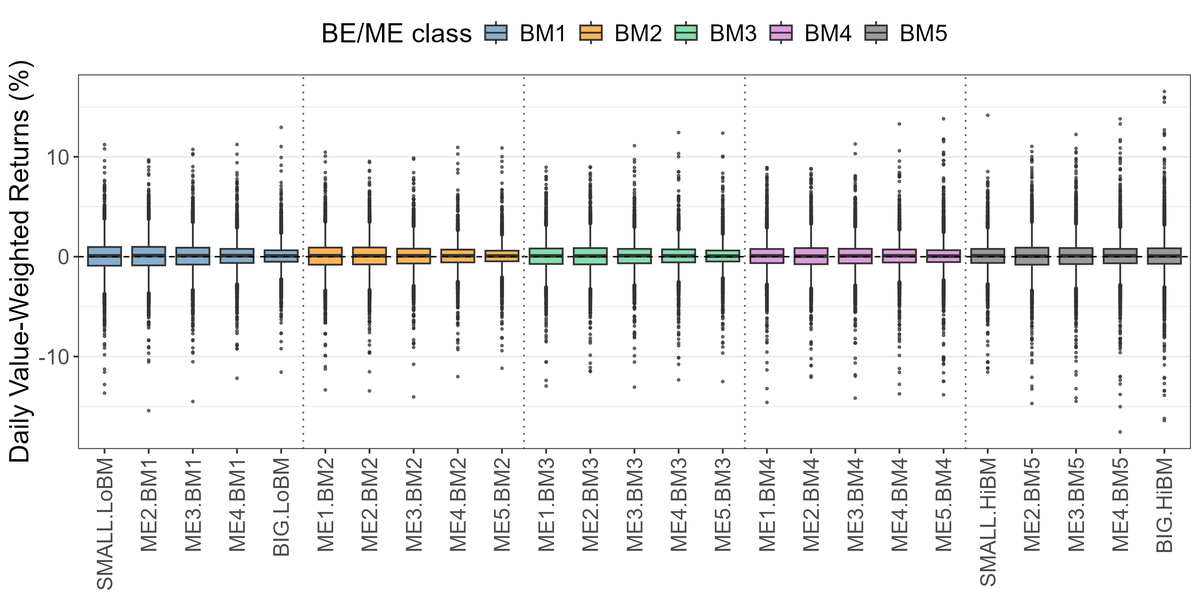
- Empirical Fama-French portfolio study: TSLOPE finds economically meaningful clusters that GLASSO misses.
- Open-source R implementation available: github.com/KrystynaGrzesiak/gslope.
Estimating a sparse precision matrix, the inverse of the covariance matrix, is one of those workhorse problems that quietly powers everything from gene network inference to portfolio construction. For nearly two decades the default tool has been the graphical Lasso (GLASSO), which zeros out weak edges with an entrywise L1 penalty. A new paper works out the asymptotic theory for a different regularizer, Graphical SLOPE, and shows it can do something GLASSO structurally cannot: recover groups of edges that share the same strength.
Why entrywise L1 falls short
In a Gaussian graphical model, zeros in the precision matrix correspond exactly to pairs of variables that are conditionally independent given the rest. GLASSO handles that by adding an entrywise L1 penalty to the Gaussian negative log-likelihood, producing a sparse estimate. The catch is that many real dependence structures, like block-structured factor models, hub networks, or the colored graphical models used in physics and finance, contain groups of edges with equal or nearly equal magnitudes.
In these settings an estimator can hit a small global error while still fragmenting genuinely homogeneous groups into slightly different magnitudes, which complicates interpretation. Graphical SLOPE replaces the entrywise L1 penalty with a sorted L1 (SLOPE) penalty on the off-diagonal precision entries, which encourages sparsity while allowing multiple edges to tie at the same magnitude. That grouping behavior comes for free from the geometry of the SLOPE norm, which penalizes ordered absolute values with a decreasing weight sequence.