
GRADE Benchmark Exposes How AI Image Editors Fail Basic Science at 46%
A new benchmark of 520 academic image-editing tasks exposes how badly frontier models reason about chemistry, physics, math, and other disciplines.
 Pro
Takeaways
- GRADE introduces 520 image-editing tasks across 10 academic disciplines to test domain reasoning, not just pixel quality.
- Best model Nano Banana Pro scores only 46.2% overall accuracy under strict all-three-criteria grading.
- Top open-source model Qwen-Edit-2511 hits just 2.7%, with several open models scoring near zero.
- Evaluation uses three axes: Discipline Reasoning, Visual Consistency, and Logical Readability, judged by Gemini-3-Flash.
- Making instructions explicit boosts reasoning scores by 20+ points, exposing weak implicit knowledge activation.
- Benchmark and evaluation code are public on GitHub and Hugging Face.
Image editing models can swap outfits and change backgrounds convincingly, but ask one to correctly complete a geometry proof, redraw a chemical reaction product, or shift an aggregate demand curve in the right direction, and things fall apart quickly. A new benchmark called GRADE makes this failure mode measurable, and the numbers are worse than you might expect.
GRADE (Grounded Reasoning Assessment for Discipline-informed Editing) is the first image editing benchmark explicitly designed to evaluate discipline-informed reasoning. It comprises 520 carefully curated samples spanning 10 academic domains, from natural sciences to humanities and applied fields: mathematics, physics, chemistry, biology, history, geography, sports, music, computer science, and economics.
Why existing benchmarks miss the point
Most image-editing benchmarks focus on natural photos where the hard part is parsing an ambiguous prompt, not knowing anything domain-specific. They are predominantly grounded in natural image domains, where reasoning difficulty mainly arises from the implicitness or linguistic complexity of prompts, and the underlying knowledge involved is typically shallow, relying largely on everyday commonsense. Recent efforts like RISEBench and KRISBench introduced implicit reasoning categories, but still stay in commonsense territory.
Discipline-informed editing is harder because it forces a model to do three things at once: understand structured domain knowledge, reason under its constraints, and modify pixels precisely without wrecking the surrounding structure. Think of asking a model to insert the correct missing entry in a historical timeline, or to draw the solid formed by rotating a given curve around an axis.

A three-axis scoring rig
The team scores each edit along three independent dimensions:
- Discipline Reasoning , whether the edit reflects correct domain knowledge. For each sample, they use GPT-5 to generate weighted binary questions aligned with required disciplinary knowledge, with all weights summing to one. Two human experts with relevant disciplinary knowledge independently examine all scoring points, and the results are cross-validated by a third expert.
- Visual Consistency , whether unchanged regions actually stayed unchanged, split into localized, style, and independence variants depending on the edit type.
- Logical Readability , whether labels, curves, annotations, and text are clear enough that a human can actually interpret the result.
A sample counts as correct only if the model earns the maximum score on all three axes. The automated judge is Gemini-3-Flash, which consistently achieves the lowest MAE across all three evaluation dimensions, indicating the strongest alignment with human judgments.

Frontier models still fail more than half the time
The team ran 20 models through the benchmark. The headline: Nano Banana Pro achieves the strongest overall performance, exhibiting clear advantages across all three dimensions with an accuracy of 46.2%. Nano Banana 2 hits 39.6%, Seedream 5.0 gets 24.7%, and GPT-Image-1.5 lands at just 16.0%.
What is striking is how much GRADE separates models that look comparable elsewhere. Models such as Nano Banana Pro, GPT-Image-1.5, and Seedream 5.0, which achieve comparable performance on existing benchmarks, exhibit substantial performance differences on GRADE (46.2% vs. 16.0% vs. 24.7%).
Open-source results are grim. The best-performing open-source model, Qwen-Edit-2511 (2.7%), remains lower than all closed-source models, and most open-source models like OmniGen, Bagel, and FLUX.2 dev only achieve near-zero or zero accuracy. Several open-source systems score 0.0% on entire disciplines.
Where models actually break
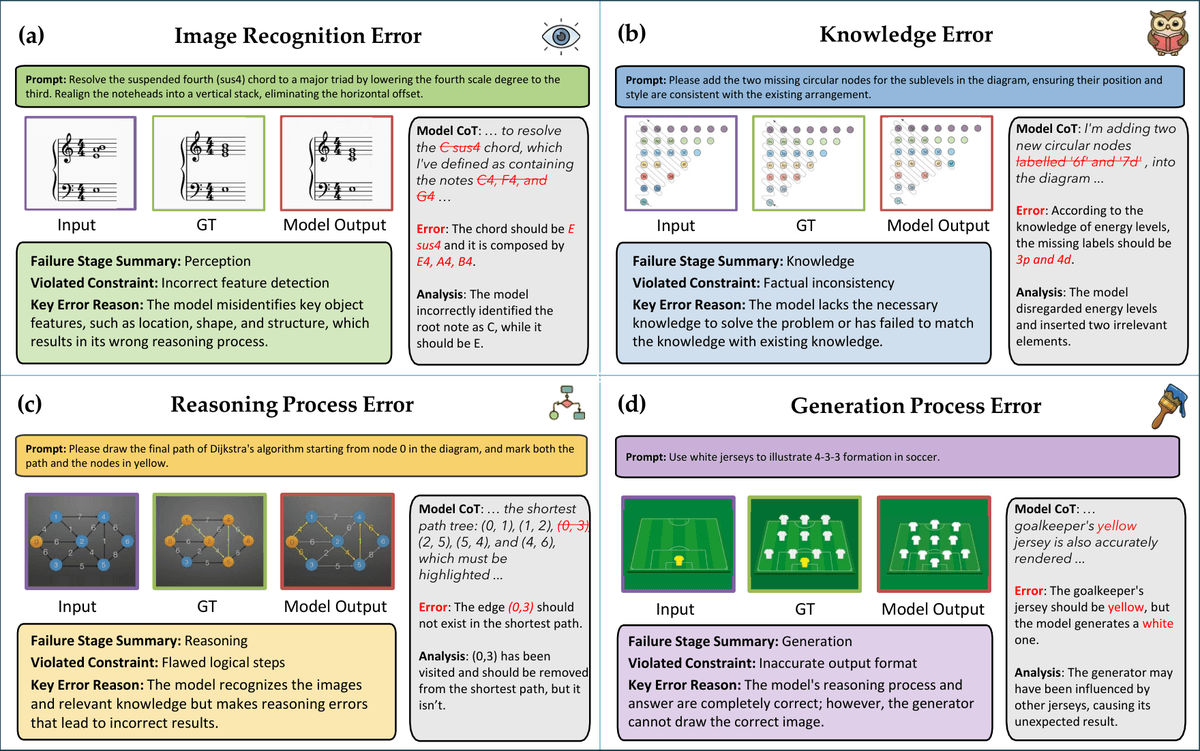
An error analysis of Nano Banana Pro sorts failures into four buckets:
- Image recognition errors , misreading symbols, positions, or connections in dense structured visuals.
- Knowledge errors , treating a domain-specific template (orbital diagrams, reaction arrows, anatomical labels) as generic shape completion.
- Reasoning process errors , right method, wrong multi-step execution.
- Generation process errors , correct plan, but low-level synthesis drifts and violates constraints during rendering.
An instruction-explicitness ablation is telling. When the team rewrote implicit prompts into step-by-step explicit ones ("reflect the polygon across y=x, the new vertices are..."), Nano Banana 2 improves from 67.9% to 89.7% and Qwen-Edit-2511 from 18.9% to 44.7% on Discipline Reasoning. In other words, models can execute domain knowledge when spoon-fed the steps; they just cannot generate those steps themselves.
Availability and what it is useful for
The benchmark and evaluation code are public. The dataset lives on Hugging Face and the evaluation harness on GitHub. If you are building or fine-tuning a unified multimodal model, GRADE is a stress test that discriminates between systems that current leaderboards call equivalent. If you are shipping an editing product, it is a reality check on domain-heavy use cases like scientific figure correction, textbook illustration, or diagram cleanup for research and teaching workflows. What it will not tell you is anything about aesthetic quality on natural photos, which existing benchmarks already cover well.