
GPT-4o Reads Your Car Posts and Guesses Your Political Party
A new study shows GPT-4o can infer Republican or Democrat alignment from Reddit posts about cars or music, hitting F1 scores up to 0.80.
 Pro
Takeaways
- GPT-4o infers Republican vs Democrat alignment from non-political Reddit posts with F1 up to 0.799.
- Study uses Debate.org and Reddit, comparing GPT-4o and Llama-3.1-8B against traditional ML baselines.
- Maximum-confidence aggregation across a user's texts outperforms majority voting in 10 of 12 test settings.
- Topics like Religion, Economics, and Science leak partisan signal almost as strongly as explicit politics.
- LLMs use associative cues like Tesla, Taylor Swift, and boomer, not just frequency imbalances.
- Data and code available at the project GitHub repo.
A team from Indiana University, the University of Virginia, and Ewha Womans University just published a study showing that off-the-shelf large language models can figure out whether someone is a Republican or a Democrat from posts that never mention politics. The signal leaks through discussions about cars, music, science, even entertainment, and the models pick it up without any task-specific fine-tuning.
The result matters because it collapses the technical barrier to political profiling. The barrier to inferring personal traits has been further reduced with the emergence of large language models, which natively encode socio-cultural correlates even without the bespoke training data that traditional machine learning systems required. What once needed a data team and labeled Facebook Likes is now a prompt away.
The problem: your latte gives you away
The premise draws on a well-established finding in social science: seemingly innocuous preferences correlate with private traits like political leaning. Facebook Likes, web browsing histories, personal website content, and music listening records have all been used to infer demographic and psychological traits. Yet, while offering benefits of more useful recommendations, the ability to infer sensitive attributes, including political leanings, creates substantial risks for misuse. The 2018 Cambridge Analytica scandal is the canonical example of how badly this can play out at scale.
The research question here is narrower and sharper: how good are current LLMs at doing this, natively, on general chatter?
How the experiment was built
The team pulled data from two very different platforms to check for robustness.
- Debate.org (DDO): 3,511 users who self-identified as Republican (n = 1,776) or Democrat (n = 1,735), who participated in 18,602 debates and posted 22,265 arguments across 23 topical categories.
- Reddit: users whose political alignment could be inferred with high certainty based on their activity in two major partisan communities, r/Conservative and r/democrats. Among users who consistently received positive feedback in these communities, 1,000 were randomly sampled from each subreddit and labeled accordingly. Human annotators independently validated this labeling with 92% majority-vote accuracy.
They then pulled up to 100 recent comments per Reddit user across all subreddits, and used GPT-4o to bin every subreddit into the same 23 categories as DDO. Two models did the actual inference work: GPT-4o and Llama-3.1-8B-Instruct. Each was asked, via a zero-shot prompt, to output a JSON object with a party label and a confidence score from 1 to 5.

Aggregation is where it gets scary
At the single-text level, both models beat chance but not by huge margins. GPT-4o and Llama-3.1-8B achieved F1 scores of 0.647 and 0.619 on DDO, and 0.624 and 0.534 on Reddit, respectively. That is already above every traditional ML baseline the authors benchmarked, but not alarming.
The interesting jump happens when you aggregate predictions per user. The team compared three strategies:
- Majority vote across all of a user's text-level predictions.
- Confidence-weighted average, summing predictions weighted by the model's self-reported certainty.
- Maximum-confidence average, keeping only the highest-confidence texts and taking a majority vote on that subset.
In 10 out of 12 model-dataset-text type combinations, the maximum-confidence method achieved the highest performance, followed by confidence-weighted. The most striking number: GPT-4o on Reddit achieves F1 = 0.799 for general (non-political) texts using the maximum-confidence method, a 0.193 improvement over the text-level F1 = 0.606. On explicitly political texts, F1 reaches roughly 0.75 on DDO and even higher on Reddit.
For comparison, the maximum performance at the text level by conventional supervised models reaches 0.612 on DDO and 0.579 on Reddit. And those baselines were trained on the task; the LLMs were not.
Which topics leak the most
Not every category is equally revealing. Politics itself is easiest, of course, but the interesting finding is what comes next. Beyond explicitly political discourse, several general categories such as Religion, Economics, Science, Society, and Health also enable strong inference. GPT-4o successfully infers a user's political alignment from their Religion texts in DDO with an F1 score of 0.742, and from Science and Health texts with scores of 0.698 and 0.687, respectively. Sports, music, fashion, and movies are much weaker signals.
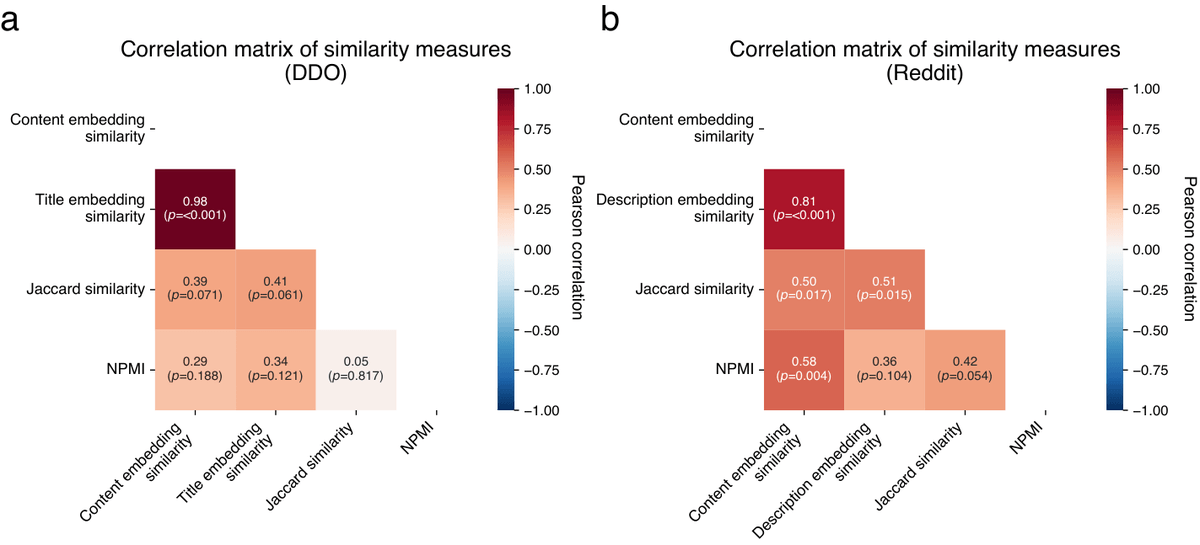
The authors then asked why. They correlated per-category inference accuracy with two things: semantic similarity to political discourse (via Sentence-BERT embeddings of category content) and user overlap with the Politics category (Jaccard similarity and normalized pointwise mutual information on user participation). Both correlate positively with inference accuracy across both datasets and both models. In plain terms: topics that either sound like politics or share their audience with politics leak more.
The lexical smoking gun
The most revealing part of the paper is the word-level analysis. For each word in a category, they computed the average model confidence on texts containing that word. Then they grouped words into quintiles and looked at what showed up in the high-confidence bucket.

High-confidence quintiles feature terms tied to ideological conflict or cultural polarization. Explicitly political or politicized words like tax, abortion, and climate cluster at the upper end, together with culturally loaded expressions like Tesla, boomer, and Taylor Swift, which often serve as cues of partisan leaning in online discourse.
Crucially, this is not just word-frequency arbitrage. Many of the most informative high-confidence words reflect balanced usage across partisan groups, such as abortion in Health or minimum wage in Economics. LLM predictions are not driven simply by lexical frequency differences between partisan groups. Rather, the models appear to leverage contextual and associative cues embedded in the contexts and associations through which words are deployed across partisan discourse. The model is doing something closer to reading tone than counting keywords.
What is useful, what is not
For research, this pipeline opens some interesting doors. The authors explicitly note it could be used to trace how a cultural topic becomes politicized over time by tracking partisan word-level confidence trajectories. That is a legitimate application for computational social science.
The caveats matter, though:
- Self-selection bias: the samples are people who chose to reveal their politics on Debate.org or who are active in partisan subreddits. These are not representative of a general population.
- US-English only: the study does not test other languages, cultures, or political systems.
- Binary framing: only Republican vs. Democrat, no independents, third parties, or gradient positions.
- Unknown training bias: because GPT-4o and Llama-3.1's training corpora are opaque, some of the signal may reflect memorized associations rather than genuine inference from the text.
Code and data
The processed, anonymized dataset and replication code are both available in the authors' GitHub repository. The prompts are simple enough to reproduce in a few lines:
system = "You are a helpful assistant."
user = ("Based on the following comments of a user, infer whether "
        "the user's position aligns more with the Republican Party "
        "or the Democratic Party. Respond only with 'Republican' "
        "or 'Democratic'. Also indicate your confidence on a scale "
        "from 1 to 5. Respond in JSON with 'party' and 'confidence'.")
That is essentially the whole attack surface. No fine-tuning, no labeled training data, no feature engineering. Anyone with an API key and a scraper can run this pipeline against public posts, which is exactly why the authors frame the paper as much as a privacy warning as a capability demonstration.