
GPT-2 Gets More Predictable as It Grows, Flipping AI Opacity Assumptions
A 32-dimensional linear approximation predicts GPT-2-large's steering behavior across depth with near-perfect fidelity, and the fit improves as models scale.
 Pro
Takeaways
- A 32-dimensional linear surrogate reproduces GPT-2-large's per-layer steering gain curves with Spearman 0.99 to 1.00.
- Agreement scales monotonically: mean Spearman rises from 0.77 (GPT-2) to 0.81 (medium) to 0.995 (large) at fixed reduced order.
- The surrogate captures full depth response shape, not just the best injection layer, across ten NLP tasks.
- Closed-form minimum-energy multi-layer control uses two to five times less energy than uniform-all-layer injection.
- Last-layer-only and random single-layer schedules can require an order of magnitude more energy than the LLV-optimal policy.
- Framework identifies dynamics locally per prompt using Jacobian-vector products and a reachability-informed Krylov basis.
Transformers are usually treated as tangled nonlinear machines where the only way to figure out where to inject a steering vector is to sweep every layer and see what happens. A new arXiv paper argues that this brute-force ritual is unnecessary, at least locally. The authors show that within a fixed prompt context, the depthwise response of a transformer can be captured by a linear system with just 32 internal dimensions, and that this compact surrogate predicts almost exactly how the model will react to activation edits at each layer.
Even more surprising is a scaling result buried in the experiments: as GPT-2 gets bigger, the linear approximation gets better, not worse. That flips a common assumption that scale means opacity.
The problem with layer sweeps
Activation steering, adding a concept vector into the residual stream to nudge a model toward or away from some behavior, has become a standard interpretability and control tool. But the paper points out that picking the right layer to inject at is still dominated by empirical sweeps, fixed schedules, and heuristics like "just do it at the last layer." There is no tractable model of how a perturbation introduced at layer k actually propagates through the remaining blocks to shift the final output.
Prior work established two useful facts: linear directions in activation space can encode concepts (the linear representation hypothesis), and injecting along them changes behavior. What has been missing is a description of the dynamics, meaning how those injections evolve across depth. This paper fills that gap by treating depth as discrete time and building a state-space model of it.
Linearizing depth, one prompt at a time
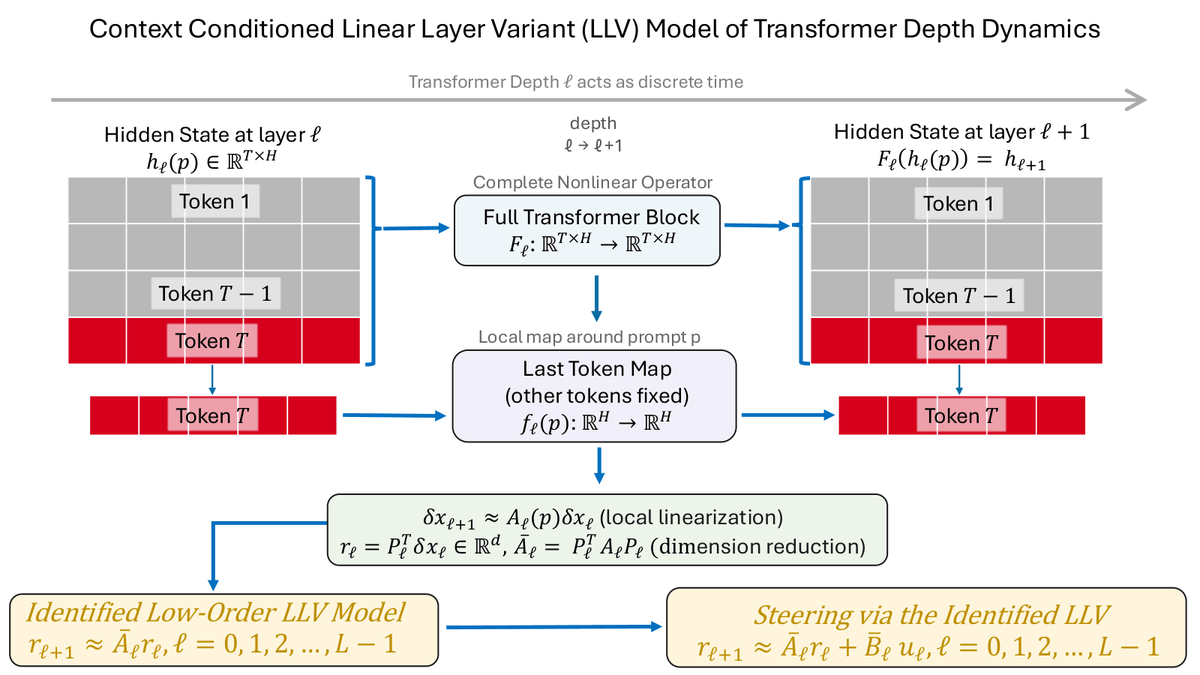
The core construction is what the authors call a Linear Layer Variant (LLV) surrogate. Think of it as system identification borrowed from control theory. For a given prompt:
- Run the model once to get the unperturbed hidden-state trajectory of the last non-padding token across all layers.
- At each layer, freeze everything except that last-token state and compute a local Jacobian of the block using JVPs or finite differences.
- Project that Jacobian onto a 32-dimensional basis whose first axis is the concept steering direction and whose remaining 31 axes come from a Krylov construction that follows the subspace actually excited by steering perturbations.
The result is a per-layer pair of small matrices Ā and B̄ that describe, in reduced coordinates, how a nudge at one layer propagates to the next. Chain them together, hit the output with the concept readout vector, and you get a predicted gain for injecting at any depth in closed form.
Predicting where the model listens
The first test is whether this surrogate can reproduce the empirical gain curve, the actual measured change in the concept score when you inject at each layer of the full transformer. Across ten binary classification tasks including Amazon Polarity, Yelp Polarity, SST-2, IMDB, BoolQ, GLUE MNLI, Civil Comments Toxicity, and the TweetEval irony, hate and offensive splits, the agreement in GPT-2-large is essentially perfect: Spearman correlations of 0.99 or 1.00 in every displayed dataset.

Crucially, the surrogate doesn't just pick the single best layer. It reproduces the full shape, including late-depth ramps, broad middle-plateau responses, and non-monotone landscapes where several bands of layers are effective. That matters because the optimal intervention depth is task-dependent, so the "always steer at the final block" heuristic is genuinely wrong for many tasks.
Bigger models, cleaner linear structure
The headline finding is a scaling regularity. Holding the reduced dimension fixed at 32, the authors run the same identification pipeline on GPT-2 (124M), GPT-2-medium (355M) and GPT-2-large (774M). Mean Spearman agreement between the surrogate and the real model climbs from roughly 0.77 to 0.81 to 0.995, and mean Pearson from about 0.68 to 0.74 to 0.997. By GPT-2-large the low-order surrogate is essentially saturated.

The interpretation is not just "bigger models are easier to steer." It is that under the same compression budget, the local depth dynamics of the larger model are more faithfully described by a compact linear abstraction. The authors speculate this comes from wider residual streams stabilizing local Jacobians and concept directions aligning with a small number of dominant reachable modes, but they don't claim to prove the mechanism. Either way, it opens the door to treating identifiability itself as a metric for comparing architectures.
Cheaper steering as a byproduct
Because the reduced model makes the final output shift linear in a stacked control vector across layers, the minimum-energy multi-layer control has a closed form. You just take the vector of predicted per-layer gains, normalize it, and scale to hit your target concept shift.
# Given predicted per-layer gains h and target shift delta_y
u_star = (delta_y / (h @ h)) * h  # closed-form min-energy control
When this LLV-optimal schedule is transferred back to the full nonlinear GPT-2-large and compared against uniform-all-layer, last-layer, middle-layer, early-layer and random single-layer baselines, it consistently uses the least energy. Uniform injection is the strongest baseline but still typically needs two to five times more energy than the model-derived schedule, and last-layer or random schedules are often an order of magnitude worse.
Where this helps and where it doesn't
The surrogate is deliberately local. It is identified around a specific prompt's operating trajectory, so it isn't a global linear law of transformer computation. If your workflow involves activation steering, probing, or any intervention that needs to know how internal edits reach the output, this gives you a principled tool to replace layer sweeps and hand-tuned schedules. If you were hoping for a compact global model of what a transformer does across all inputs, this isn't it.
A few practical caveats worth noting:
- The experiments are all on the GPT-2 family. Whether the scaling curve keeps improving on modern billion-parameter models is an open question the paper doesn't answer.
- Tasks are binary classification with concept directions estimated from class-conditional mean differences. Fuzzier generation-quality targets would need a different readout.
- The authors state that experimental configs, figure-generation scripts, and processed outputs for the main results will be released, but the paper doesn't ship a ready-to-use library.
The larger point is philosophical. If scaling makes local dynamics more linear and more compressible, then the interpretability community's tools may become sharper, not blunter, as models get larger. That is a nicer future than the one where every new frontier model is a bigger black box.