
Google's VQQA Fixes AI Video's Worst Flaw With a Self-Critiquing Loop
Google researchers turn vision-language critiques into semantic gradients, iteratively rewriting prompts to fix video artifacts without touching model weights.
 Pro
Takeaways
- Google's VQQA turns VLM critiques into semantic gradients that iteratively rewrite prompts for video generation.
- Three agents (Question Generation, Answering, Prompt Refinement) plus a Global Rater guard against semantic drift.
- Improves T2V-CompBench by +11.57% and VBench2 by +8.43% over vanilla generation using Gemini-3-Pro.
- Works black-box: no model weights needed, so compatible with proprietary APIs like Veo 3.1.
- Converges in about 4 iterations on T2V and 1.6 on I2V, roughly Best-of-5 compute cost.
- Full agent prompts in the paper appendix; no code release yet.
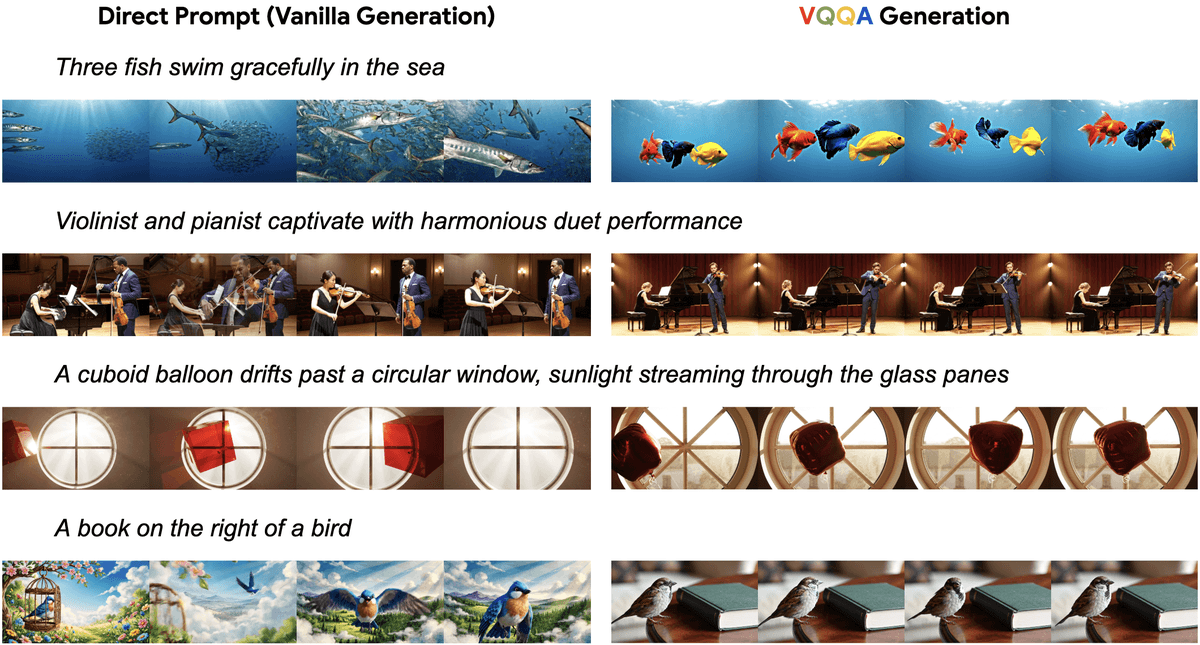
Text-to-video models can render stunning scenes, but ask for something compositional like "a book on the right of a bird" and you often get a mess: wrong counts, floating objects, melting limbs, or spatial relationships that ignore the prompt entirely. Fixing that today usually means either trial-and-error prompt engineering or expensive test-time optimization schemes. A team at Google is proposing a cleaner path with VQQA (Video Quality Question Answering), a multi-agent loop that critiques its own generations and rewrites the prompt in natural language until the video actually matches user intent.
The headline numbers are strong. Using Gemini-3-Pro, VQQA achieves the highest average score (53.46%) on T2V-CompBench, delivering an absolute improvement of +11.57% over vanilla generation and +4.76% over the strongest baseline (VQAScore). On VBench2, VQQA with Gemini-3-Pro provides a +8.43% absolute increase over the vanilla baseline and surpasses the best competing method (VQAScore) by +3.46%. And it does this while treating the video model as a pure black box.
Why passive metrics keep failing
The video evaluation stack has been stuck between two extremes. On one side, older reference metrics like FVD and Inception Score measure distributional similarity but correlate poorly with what humans actually care about. On the other, benchmark suites like VBench decompose quality into dozens of axes but need heavy specialized model ensembles. Newer VLM-based raters (VQAScore, VideoScore2) predict Mean Opinion Scores directly, but they are passive judges. They give you a number, not a fix.
Meanwhile, test-time optimization for video has its own problems. Gradient-based methods like Video-TTT and EvoSearch require white-box access to model internals, rendering them incompatible with commercial APIs. Conversely, agentic frameworks like VISTA incur massive computational costs by requiring large candidate pools to identify improvements. VQQA sidesteps both by treating the prompt itself as the optimization variable and using VLM critiques as what the authors call semantic gradients, an idea borrowed from TextGrad and Feedback Descent where natural language plays the role of backpropagation.
Three agents plus a referee
The framework decomposes into specialized roles, each running on a VLM like Gemini-3-Pro or GPT-4o:

- Question Generation (QG) Agent: Given the video, prompt, and any reference images, it dynamically generates 5 to 10 targeted questions across three axes: video-prompt alignment, visual quality, and condition fidelity. Not a fixed rubric, but questions written for this specific generation.
- Question Answering (QA) Agent: Watches the video and scores each question on a 0 to 100 scale, producing a diagnostic map of where things went wrong.
- Prompt Refinement (PR) Agent: Takes the low-scoring QA pairs as the semantic gradient and rewrites the prompt to fix those specific failures for the next iteration.
- Global VLM Rater: After candidates are generated, this separate rater scores each one against the original prompt to pick the winner, guarding against what the authors call semantic drift.
The update rule is essentially p_{t+1} = VLM(p_t, R_{f,t}), where R_{f,t} is the reasoning trace from the QA agent. That reasoning replaces the mathematical gradient you would compute in a differentiable setting.
Semantic drift and why the referee matters
Here is a subtle failure mode the paper hammers on. If you just accept the last iteration's output, the refinement agent tends to over-optimize for whatever local flaw it noticed most recently, drifting away from the user's actual intent. Omitting global selection decreases the overall average score by 1.02%, confirming that unanchored refinement drifts from primary constraints.
Interestingly, the ablation also found that incorporating GS during iterative refinement degrades average generation quality (53.11% vs. the standard 53.77%). Specifically, excluding GS from the PR context better resolves fine-grained compositional errors, outperforming the GS-in-the-loop variant in attribute consistency (84.01% vs. 82.85%), spatial understanding (66.01% vs. 65.76%), and numeracy (52.29% vs. 48.68%). The takeaway: keep granular feedback for refinement and global scoring for final selection. Mixing them makes the refinement agent chase the wrong target.
Convergence in four steps
The other worry with iterative loops is compute cost. VQQA uses an early-stopping rule based on running maximum global score with a patience window. In practice this triggers fast.

For a standard patience window k = 3, the algorithm converges within 3.80 to 4.22 iterations across various thresholds. On the image-to-video benchmark VBench-I2V the loop is even shorter: VQQA exhibits remarkable efficiency, requiring an average of only 1.6 iterations to satisfy the task's stopping criterion.
Total inference cost is comparable to a Best-of-5 baseline. On T2V-CompBench, VQQA averages roughly 7.23 VLM calls per prompt when Gemini-3-Pro converges after about 1.245 optimization rounds, versus 5 calls for Best-of-5 with VLM rating. You pay slightly more compute for a substantially better result.
Where the gains actually show up
Breaking down T2V-CompBench results, the iterative loop is most valuable exactly where vanilla generation struggles most:
| Category | Vanilla (CogVideoX-5B) | VQQA (Gemini-3-Pro) | Absolute gain |
|---|---|---|---|
| Consistent attributes | 61.64% | 84.58% | +22.94% |
| Spatial relationships | 51.72% | 66.03% | +14.31% |
| Numeracy | 37.06% | 50.91% | +13.85% |
| Dynamic attributes | 2.19% | 7.92% | +5.73% |
| Overall average | 41.89% | 53.46% | +11.57% |
Compositional errors (getting object counts right, placing things left or right correctly, keeping attributes bound to the right object) are exactly the problems that a VLM can articulate in natural language, which is why a language-based optimizer works so well on them.
The approach also generalizes across generators. On Google's proprietary Veo 3.1, which already runs its own internal prompt rewriter, after four rounds, VQQA improved the overall T2V-CompBench average score by an absolute margin of +5.88% (from 55.93% to 61.81%), outperforming the Best-of-N approaches using VQAScore (+3.58%) and Gemini-3-Pro (+3.08%).
How the questions themselves compare to direct VLM critique
One clever ablation asks whether generating explicit questions is actually better than just asking a VLM "what is wrong with this video." The answer is yes, and by a wide margin. While both methods maintain near-perfect precision (>99%), VQQA yields a significant 11.9% improvement in E2E-Recall over the baseline. Framing the critique as targeted yes/no questions with numeric scores forces the VLM to probe systematically rather than reporting whatever artifact happens to be most obvious.

Limitations worth knowing
The authors are upfront about the ceiling. As a black-box optimizer, it relies on Vision-Language Models (VLMs) for reasoning and base video models for generation. Consequently, it cannot rectify fundamental architectural flaws, synthesize out-of-distribution concepts, or entirely eliminate noisy semantic gradients from VLM hallucinations. If the underlying video model literally cannot render a concept, no amount of prompt rewriting will help. There is also latency: unlike Best-of-N which parallelizes trivially, VQQA is inherently sequential because each iteration depends on the previous video.
No code repository is mentioned in the paper. The authors point to a project page for additional materials, but there is no open-source release accompanying the announcement. For practitioners wanting to reproduce the approach, the appendix contains full prompts for every agent, which is genuinely enough to reimplement the pipeline on top of any VLM plus video model combination. The whole system is architected to be model-agnostic, so pairing it with an open video model like CogVideoX and a capable VLM should reproduce most of the gains reported here.