
Google's Navig-AI-tion Uses Gemini 2.0 to Guide You Without a Screen
Google researchers combined a vision-language model with directional 3D audio cues to guide walkers using landmarks instead of vague cardinal directions.
 Pro
Takeaways
- Google prototype Navig-AI-tion combines Gemini 2.0 Flash Exp with directional spatial audio for eyes-free walking navigation.
- Spatial audio cue triggers only when the user faces more than 25 degrees off the correct heading.
- VLM converts cardinal directions into landmark-anchored egocentric instructions from a head-mounted camera view.
- In a 12-person study, the full system reduced route deviations versus both AI-only and Google Maps audio baselines.
- Pointing accuracy did not improve, suggesting better path-following but no boost to spatial memory.
- Average prompt-to-response latency of 3.31 seconds limits use to pedestrian speeds for now.
Anyone who has walked a strange city with earbuds in knows the drill: a robotic voice says "head north for 200 feet," you guess, you guess wrong, and you end up circling the same block. A team at Google has built a prototype called Navig-AI-tion that tries to fix this by replacing cardinal directions with landmark-based instructions generated by a vision-language model, and by nudging you back on course with a spatial audio cue that sounds like it is coming from the exact direction you should be walking.
The setup targets a specific near-future scenario: display-less smart glasses (think Meta Ray-Bans) where you cannot glance at a map. The pervasive use of turn-by-turn navigation apps like Google Maps, Apple Maps, and Waze is a testament to their effectiveness for reaching destinations, but they were designed for phone screens, not for a world where the interface is entirely audio.
Why cardinal directions fail on foot
The core problem is that audio-only navigation strips out the environmental context a screen normally provides. The use of cardinal directions in Google Maps was widely perceived as unhelpful, especially without a map or compass at hand. Participants often did not know which direction was north, south, east, or west, leading them to guess. There is also mounting evidence that heavy GPS use may actually erode our own spatial memory of the places we move through.
Prior work explored spatial audio beacons (like Microsoft's Soundscape) that play a continuous directional tone. Navig-AI-tion's twist is to only play the cue when you are veering off, and to pair it with a VLM that describes the world in front of you.

How the system works
The prototype ran on an Android phone strapped to a helmet to simulate a head-worn camera. Five components run in sequence:
- Directions: pulled from the Google Maps Platform API as JSON walking steps.
- World tracking: AR Foundation plus AR Core Extensions handle camera capture, GPS anchoring, and orientation via Google's Visual Positioning System.
- Spatial audio: a repeating "waterfall" sound rendered with Head-Related Transfer Functions (HRTFs, which model how sound bends around your ears) via the Steam Audio SDK. The spatial audio cue activates when the user's facing direction deviates by more than 25 degrees off from the current turn waypoint and stops playing once the user is facing the current turn waypoint within 25 degrees.
- Prompting: fires when you look toward the next waypoint or walk within 30 meters of it, packaging a POV image plus orientation metadata.
- VLM: Gemini 2.0 Flash Exp is instructed to provide egocentric instructions instead of cardinal ones, detect potential landmarks and include their position relative to the user, and produce a bounding box to mitigate left/right reversal hallucinations. If the user is not facing the correct direction, the VLM is told to tell the user to turn and position the landmark on their side or behind them.
The user study
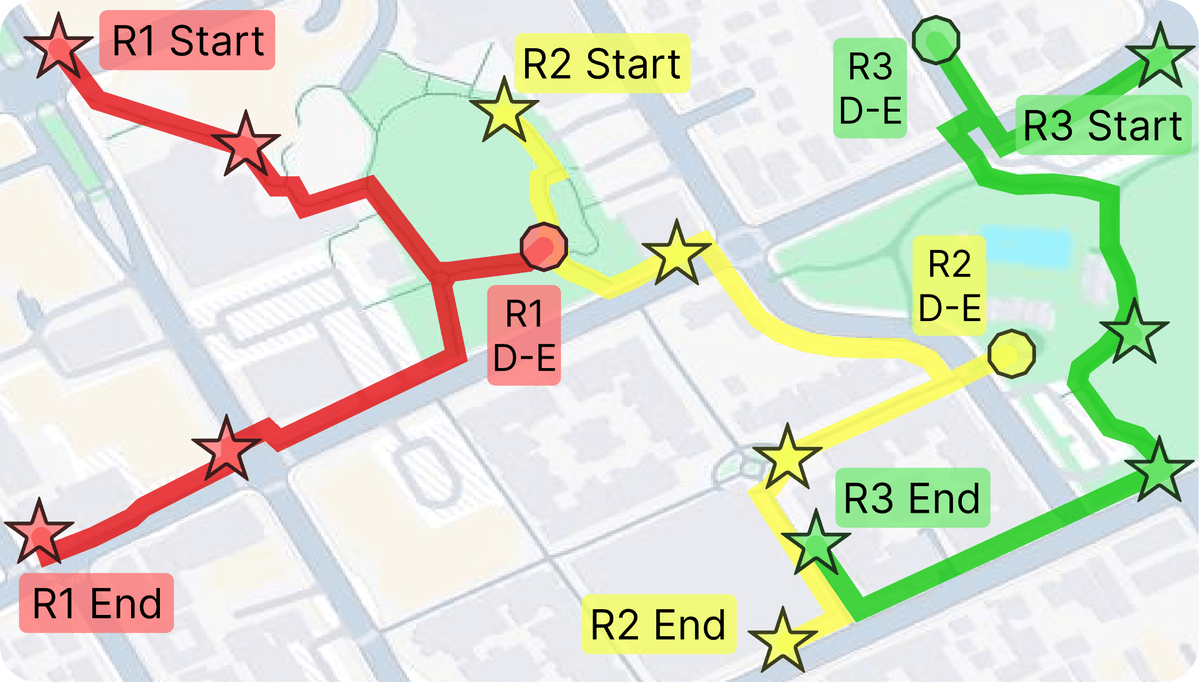
Twelve participants walked three counterbalanced routes of roughly 550-650 meters, each containing five points of interest and one dead end that forced backtracking. Three conditions were compared: Google Maps audio-only (GMaps), the VLM alone (AI-Only), and the full system (AI-SA).
The headline result: participants overall had fewer route deviations (more than 10 meters off-route) with AI-SA than the other conditions, and they also walked shorter total distances than with AI-Only. Interestingly, pointing accuracy showed no differences overall or on any of the routes, meaning the system helped people stay on the path but did not measurably improve their mental map of the area.

Subjectively, users ranked AI-SA highest almost every time. The spatial cue got described as reassuring background feedback, while the landmark descriptions were praised when the landmark was distinctive (a Wells Fargo sign, arches, a silver car) and criticized when it was generic ("turn at the tree" in a park full of trees).
The rough edges
Two limitations matter for anyone thinking of building on this. First, latency: prompt-to-response latency averaged 3.31 seconds. At an average walking speed of roughly 1.38 m/s, this equates to about 4.5 meters of travel, meaning landmarks closer than around 5 meters risk causing confusion rather than helping. The issue scales significantly at higher speeds: about 18.3 meters at 20 km/h biking and about 45.8 meters at 50 km/h city driving, so this approach is currently pedestrian-only.
Second, hallucinations. Despite the bounding-box trick to catch left/right flips, the VLM still occasionally misidentified objects or reversed sides, and others have found hallucinations inherent to LLMs.
Why this matters
There is no public code release, and the specific model used (Gemini 2.0 Flash Exp) has since been deprecated. But the design pattern is the interesting part: use the VLM sparingly, for preemptive semantic context, and let a cheap continuous spatial signal do the moment-to-moment correction. That split, expensive-but-slow language reasoning paired with fast perceptual feedback, is a useful blueprint for anyone building assistive systems on smart glasses, wearables for low-vision users, or any interface where a screen is not available.