
Google's 'Grow, Don't Overwrite' Beats Catastrophic Forgetting Without Losing General Intelligence
Google Research's new MLP-expansion technique lets you fine-tune a model on any task without erasing what it already knows, matching full fine-tuning performance at 30% of the parameter cost.
 Pro
Takeaways
- Zero-forgetting fine-tuning: Google Research's "Grow, Don't Overwrite" expands transformer MLP layers in a mathematically guaranteed function-preserving way.
- How it works: Up-projection weights are duplicated; down-projection weights are halved to compensate, keeping model output identical at initialization.
- Matches full fine-tuning: The method achieves the same downstream task performance as standard fine-tuning while preserving near-zero degradation on original capabilities.
- 30% parameter cost: Expanding only 9-10 targeted layers matches full-model expansion, reducing trainable parameters to ~30% of the original model.
- Mechanistic proof: Function Vector cosine similarity of 0.95 (vs. 0.28 for standard fine-tuning) confirms internal model circuits are preserved.
- No code released yet: Validated on Gemma3-1B and 4B; compatible with LoRA and other PEFT methods but no public implementation available.
Every time you fine-tune a large language model on a specialized task, you're gambling with its general intelligence. Train it hard enough on French translation and it may forget basic arithmetic. Specialize it for medical diagnosis and it might lose commonsense reasoning. This phenomenon, called catastrophic forgetting, has been a stubborn problem in machine learning since the late 1980s, and it forces practitioners into an uncomfortable compromise: expert skill versus general competence.
A new paper from Google Research and the University of Wisconsin-Madison, titled Grow, Don't Overwrite, proposes a surprisingly clean solution: instead of modifying a model's existing weights, grow new ones, and do it in a way that is mathematically guaranteed not to change the model's behavior at initialization.
Why the old fixes don't work
Fine-tuning foundational LLMs can have the negative effect of hurting the original ability of LLMs, which is widely known as catastrophic forgetting. The standard toolkit for fighting this has two main branches, and both have a fundamental flaw.
- Regularization: Add a penalty to the loss function that discourages the model from drifting too far from its original weights. The problem is this creates a zero-sum trade-off: within a fixed-capacity model, resources spent remembering the past are resources taken away from learning the future.
- Capacity growth: Add new parameters for new tasks while freezing the original model. This sounds promising, but existing methods either initialize new weights randomly (ignoring all the pre-trained knowledge) or copy entire transformer blocks (which breaks the mathematical guarantee that the model's output stays unchanged at initialization).
A method that can expand capacity using pre-trained knowledge while guaranteeing function-preservation has remained a critical gap in the literature. This paper closes that gap.
The core trick: duplicate and compensate
The method, which the authors call function-preserving expansion, targets the MLP submodules inside each transformer layer. Each MLP has two linear layers: an up-projection that expands the input to a wider hidden dimension, and a down-projection that squeezes it back. The expansion works in two steps:
- Duplicate the up-projection weights. The weight matrix is concatenated with itself horizontally, doubling the MLP's internal hidden dimension. The new model now has twice as many neurons to work with.
- Compensate in the down-projection. Each copy of the down-projection weights is scaled by 1/k (where k=2 for doubling). This scaling perfectly cancels out the effect of the duplication, so the expanded model produces exactly the same output as the original for any input.

The math is straightforward to verify: if the original output is Y * W2, after expansion it becomes [Y Y] * [W2/2; W2/2], which simplifies back to Y * W2. The model is literally identical at initialization, but now has room to grow.
Here is a simplified sketch of what this looks like in practice:
import torch
def grow_mlp(W_up, W_down, k=2):
    # Duplicate the up-projection k times
    W_up_expanded = torch.cat([W_up] * k, dim=1)  # shape: [h, k*p]
    # Scale down-projection copies by 1/k and stack them
    W_down_expanded = torch.cat([W_down / k] * k, dim=0)  # shape: [k*p, h]
    # Verify: output is identical to original
    # [Y, Y] @ [W2/2; W2/2] == Y @ W2  ✓
    return W_up_expanded, W_down_expanded
Two variants for different task types
After expansion, the original weights are frozen and only the new parameters are trained. The paper introduces two fine-tuning strategies depending on task complexity:
- G-Freeze: The default. Only the newly added weights in both the up- and down-projection are trained. The original parameters are completely frozen. This is the most conservative approach and works well for tasks with large domain shifts like translation or entailment.
- G-Train: The entire expanded up-projection matrix is trained (both old and new weights), while the down-projection is frozen. This is motivated by prior work showing that factual knowledge is localized in the down-projection layer, which is preserved. G-Train is better for cognitively demanding tasks like mathematical reasoning.

What the benchmarks show
Experiments were run on Gemma3-1B (and validated on Gemma3-4B) across four tasks chosen to cover a range of domain shifts from the pre-training distribution:
- MTNT (English-to-French translation) -- large domain shift
- SciTail (science entailment) -- large domain shift
- QASC (science question answering) -- moderate shift
- MathQA (mathematical reasoning) -- moderate but cognitively demanding shift
The proxy benchmark for measuring forgetting was WinoGrande, a commonsense reasoning challenge that reflects the kind of foundational knowledge a model builds during pre-training.
The G-Freeze variant achieves downstream performance comparable or superior to standard fine-tuning while almost perfectly preserving original domain knowledge. In stark contrast, the baseline suffers a complete collapse of prior knowledge, with its accuracy on the original domain plummeting to near-zero on tasks with large domain shifts.

Efficiency: you don't need to grow everything
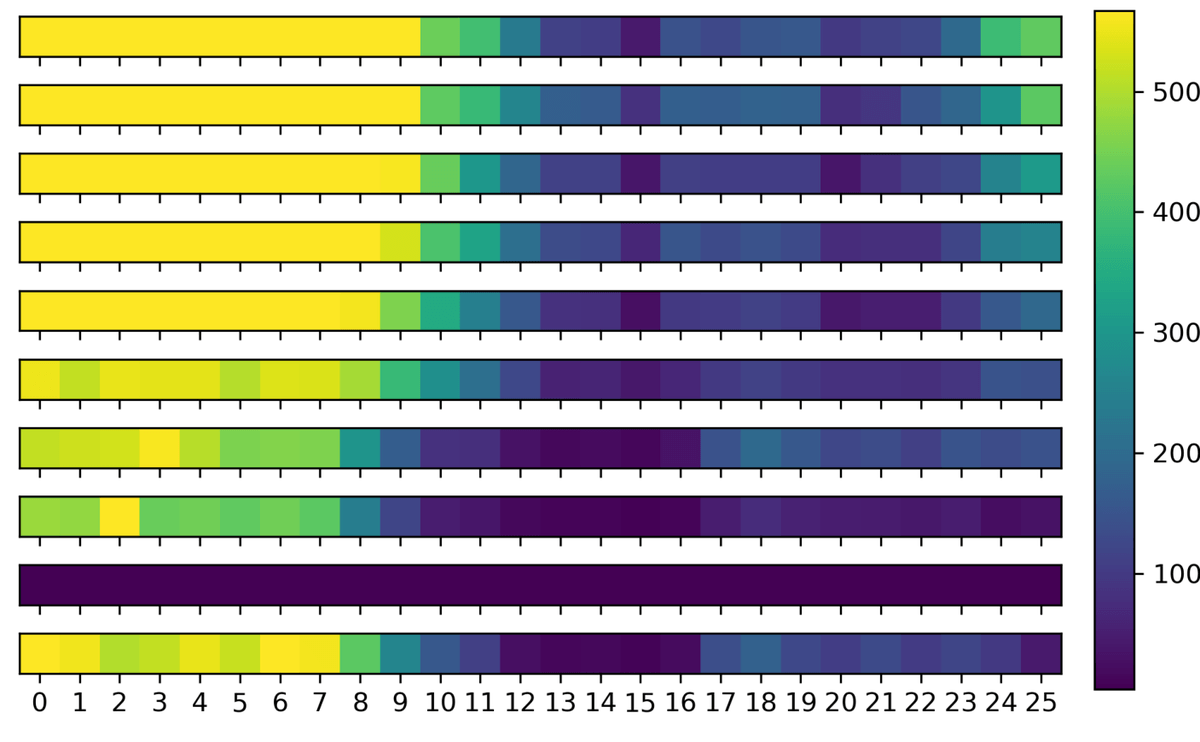
One of the most practical findings is that you don't need to expand every layer. The authors identify the most task-relevant layers with a simple heuristic: run a preliminary fine-tuning pass, rank layers by the magnitude of their weight updates, and expand only the top N.
Growing a targeted subset of 9-10 layers consistently matches the performance of growing all layers. This allows achieving full performance while nearly halving the number of trainable parameters, reducing them from ~60% of the full model to ~30%.
Even at full expansion (every layer), the method only trains the newly added MLP weights, which total about 60% of the original parameter count. Standard fine-tuning modifies 100%. Selective expansion of 10 layers brings this down to roughly 30%.
Why complex tasks need more capacity
The paper includes a compelling analysis of why some tasks need more layers expanded than others. The authors measure the effective rank of weight update matrices during standard fine-tuning and find a clear pattern: simpler tasks like entailment concentrate their high-rank updates in a small subset of layers, while complex tasks like MathQA spread high-rank updates broadly across nearly all layers. This explains why mathematical reasoning benefits from growing more layers -- the task genuinely requires more of the network to change.
The real breakthrough: preserving internal representations
Beyond benchmark numbers, the paper provides mechanistic evidence for why the method works. The authors use Function Vectors (FVs) -- compact vector representations extracted from a transformer's attention heads that encode how the model performs a specific task -- to measure whether the model's internal circuits survive fine-tuning.
The method achieved a high FV cosine similarity of 0.95 and retained 5 causal attention heads. In contrast, standard fine-tuning's similarity dropped to 0.28, with only 2-3 heads overlapping. In other words, the model's underlying neural circuits for its original tasks are almost entirely intact after fine-tuning with this method.
Limitations and what to watch
The method is not without caveats. It currently only grows MLP submodules; the authors tested growing attention components and found it consistently underperformed MLP expansion. The G-Train variant, used for math tasks, shows a minor forgetting trade-off when expanding many layers simultaneously. And while the approach is validated on Gemma3-1B and 4B, it has not yet been tested on the very largest frontier models. No code or model checkpoints have been released alongside the paper.
The approach is also orthogonal to existing parameter-efficient fine-tuning (PEFT) methods like LoRA. The authors note it can be combined with PEFT techniques to get both efficiency and knowledge preservation simultaneously -- a combination that could be particularly valuable for practitioners who need to deploy specialized models without sacrificing general capability.
Who should pay attention
This technique is most relevant if you are fine-tuning a general-purpose model for a domain-specific application and need to preserve its original capabilities -- think a coding assistant that must also remain a good general reasoner, or a medical model that should still handle everyday language tasks. The selective-layer expansion variant makes it practical even under tight compute budgets, and the mathematical guarantee of function preservation at initialization removes a major source of training instability that plagues other capacity-growth methods.