
Google's AMIE Passes Its First Real-World Patient Test With Zero Safety Stops
Google's AMIE AI matched doctor-level diagnostic accuracy in 100 real urgent care patients, with zero safety incidents and statistically significant gains in patient trust.
 Pro
Takeaways
- First prospective real-world trial: Google's AMIE conversational AI chatted with 100 real urgent care patients at Beth Israel Deaconess Medical Center, with zero safety stops across all interactions.
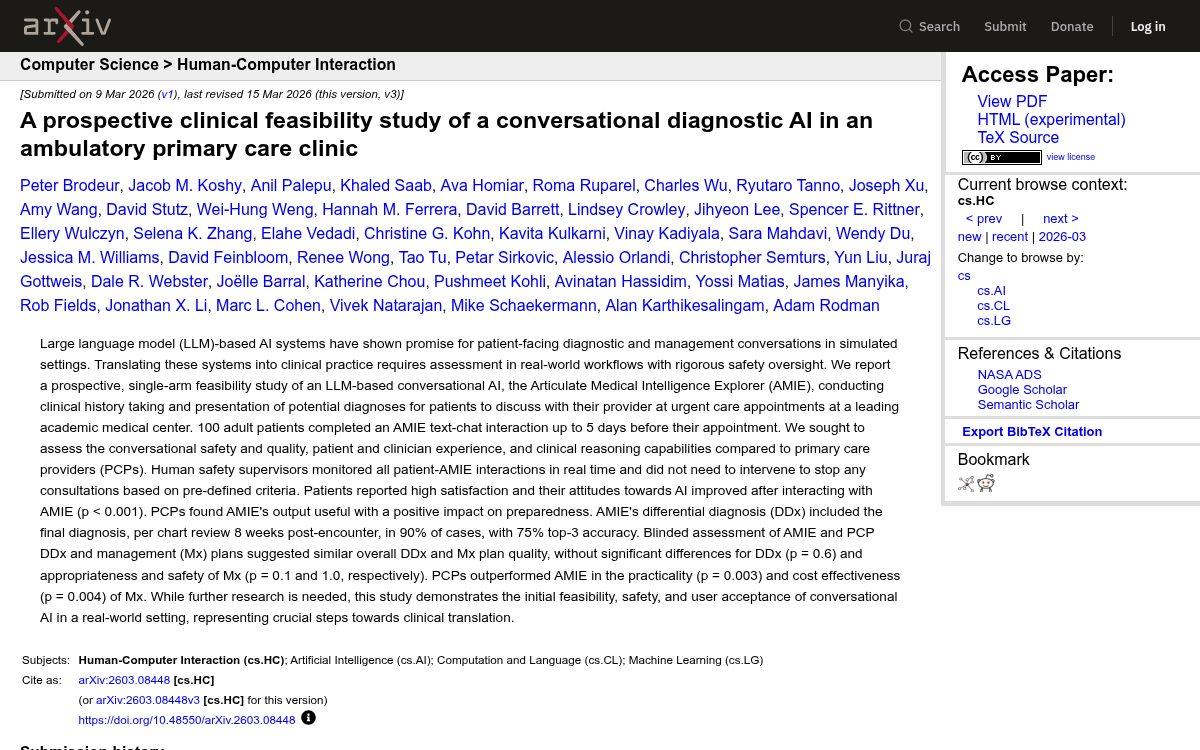
- Doctor-level diagnostics: AMIE's differential diagnosis included the correct final diagnosis in 90% of cases (top-7) and 75% top-3 accuracy, verified via 8-week chart review.
- On par with PCPs overall: Blinded evaluators found no significant difference between AMIE and physician differential diagnosis quality (p=0.6) or management plan safety (p=1.0).
- PCPs still win on practicality: Physicians significantly outperformed AMIE on cost-effectiveness (p=0.004) and practicality (p=0.003) of management plans, likely due to EHR access and physical exam.
- Patient trust increased: Attitudes toward AI improved significantly after using AMIE (p<0.001) and remained elevated after the follow-up PCP visit.
- No open-source release: Built on Gemini 2.5 Pro/Flash, but the codebase and prompts are not being released due to safety concerns around unmonitored medical AI use.
For years, medical AI benchmarks have lived inside controlled simulations: trained patient actors, scripted scenarios, and carefully curated test sets. Google's new study of AMIE (Articulate Medical Intelligence Explorer) breaks that mold. In a prospective, IRB-approved, pre-registered trial at Beth Israel Deaconess Medical Center in Boston, 100 real patients chatted with AMIE before their urgent care appointments. The result is the most rigorous real-world evaluation of a conversational diagnostic AI to date, and the numbers are striking.
Why this problem is hard
There is an ever-worsening shortage of primary care physicians affecting virtually every country in the world, and burnout rates have surged among PCPs tasked with a greater workload and an aging population. AI that can handle pre-visit history-taking could meaningfully extend physician capacity, but the gap between "works in simulation" and "works on real patients" has remained wide and largely untested.
Real-world patient interactions introduce complexities not fully captured by standardized actors or scenarios, including diverse communication styles, unpredictable clinical presentations, a spectrum of health and technology literacy, emotions such as anxiety, and varying levels of management urgency. These real-world complexities raise the bar for building conversational AI that remains consistently and reliably safe.
Emerging evidence also suggests that LLM care plans have the potential to cause harm, undertriage medical concerns, or unreliably address mental health issues, and that patients are not always able to distinguish between inadequate and adequate medical advice. That makes safety oversight, not just accuracy, the central challenge.
What AMIE actually does
AMIE is a conversational diagnostic AI system designed to interact with patients in a synchronous text-based interface. The system was built upon Gemini 2.5 Pro (knowledge cutoff January 2025) without any domain-specific fine-tuning. Rather than a static intake form, AMIE conducts a dynamic multi-turn clinical interview structured around five phases:
- Intake , establishes rapport and elicits the chief complaint
- History Taking , conducts adaptive inquiry to comprehensively understand the patient's symptoms and relevant history; questions are dynamically generated based on the agent's diagnostic hypotheses and information gaps
- Diagnostic Validation , anchors on provisional hypotheses, seeks to disambiguate the differential, and summarizes its understanding back to the patient for corrections
- Deliver Assessment , presents possible diagnoses and management options framed tentatively, accompanied by clear disclaimers, as possible diagnoses or next steps for the patient to discuss with a provider
- Consultation Wrap-up , confirms patient understanding and allows follow-up questions
Throughout the conversation, AMIE continuously maintains a rich internal state including an up-to-date patient summary, working differential diagnosis, pertinent information gaps, and a draft management plan to inform its reasoning. Thinking Mode was enabled, meaning the model reasons through intermediate steps before producing each response. After the chat, AMIE auto-generated a transcript and summary that was sent to the PCP before the appointment.
How the study worked
The study was performed at Healthcare Associates (HCA), part of Beth Israel Deaconess Medical Center in Boston, MA, an academic primary care practice with 56 attending physicians, 110 resident physicians, 15 nurse practitioners, and approximately 40,000 total patients. Patients were eligible if they were scheduled for a non-emergency urgent care visit with a single chief complaint. Mental health complaints and pregnancy were excluded, as AMIE has not been validated for those contexts.
The safety architecture was rigorous by design. Each patient-AMIE interaction was continuously monitored in real-time by a trained, board-certified internal medicine physician from BIDMC, designated as the AI supervisor, via a secure video call with screen sharing. Supervisors were trained to intervene under four pre-specified stop criteria: immediate concern for self-harm, significant emotional distress, potential for clinical harm, or an explicit patient request to stop.
To evaluate clinical reasoning quality, the final diagnosis was established through a retrospective chart review conducted eight weeks post-visit by a panel of three internists blinded to AMIE's output, who reviewed each patient's longitudinal EHR including follow-up laboratory results, imaging, and specialist notes. AMIE's differential diagnoses and management plans were then compared to those of the PCPs in a blinded, randomized evaluation by a separate panel of eight board-certified internists.
The numbers
Zero safety stops were required during patient-AI interactions. Across 100 conversations, supervisors made only three minor clarifying remarks , none of which triggered a formal stop. On the diagnostic side:
- AMIE included the final diagnosis in 88 of 98 cases (90%) within the first 7 candidates of its ranked differential, and in 73 of 98 cases (75%) within the first 3 candidates.
- AMIE's top diagnostic candidate matched the final diagnosis in 55 of 98 cases (56%).
- A statistically significant difference was not observed between AMIE and PCPs for the appropriateness (p = 0.1) and safety (p = 1.0) of their respective management plans, as well as the quality of their differential diagnoses (p = 0.6).
- Human clinicians significantly outperformed AMIE in designing management plans that were both practical (p = 0.003) and cost-effective (p = 0.004).
On the patient experience side, patient attitudes towards AI, as measured by mean GAAIS scores, shifted more positive after interacting with AMIE and remained at an elevated level after seeing the PCP. This change was statistically significant for the overall scale and both sub-scales (p < 0.001).
Where AMIE fell short , and why
The cost-effectiveness and practicality gaps are not surprising when you look at the information asymmetry. These differences likely reflect clinicians' greater access to contextual patient information and real-world healthcare constraints, including access to longitudinal medical records and workflow considerations that were not fully available to the AI during the study. AMIE had no EHR access, no physical exam capability, and no ability to read non-verbal cues.
Patient trust was also a nuanced finding. While overall attitudes improved, patients had persistent concerns about trust , less than half felt that the system would keep information confidential or that it appeared honest and trustworthy. Patients also flagged the need for clearer data transparency and safety guardrails for future deployments outside of a research context.
There were operational friction points too. Roughly 7% of enrolled patients could not complete the study due to device-related issues, and many patients required significant technology onboarding prior to commencement of the AMIE interaction. The study required a laptop or desktop (not a phone), which skewed the sample younger. PCPs also only reviewed the AMIE transcript before the visit 73% of the time.
The real breakthrough
The headline accuracy numbers are impressive, but the deeper finding is about workflow transformation. PCPs observed that patients who interacted with AMIE prior to the visit arrived prepared and organized, with their thoughts and questions presented in a coherent narrative. Unlike experiences with patients using other online tools to search their symptoms, patients who interacted with AMIE were described as having a more personalized understanding of their health concerns, which reduced anxiety and resulted in well-formed stories to describe their concerns to the provider.
This effect on patient preparedness enabled the healthcare visit to shift from information-gathering interviews to more collaborative conversations, thereby improving shared decision-making. PCPs reported being able to build rapport more quickly and to focus more of the visit on counseling and management. PCPs likened AMIE's summaries to those of a third-year medical student , often exceeding the detail of standard intake notes.
There is also an intriguing finding from the model's internal reasoning traces. Successful conversations had much higher diagnostic accuracy as early as the first conversational turn, which is concordant with findings that expert clinicians have much earlier hypothesis generation than novices. This mirrors how expert physicians actually think, generating strong hypotheses early and refining them, rather than deferring judgment until all information is gathered.
What's not available
The system utilizes variants of the Gemini 2.5 family of models as its base foundation models, which are generally available via Google Cloud APIs. However, specific implementation relies on internal Google infrastructure and tooling. The team is not open-sourcing the codebase or specific prompts, citing safety implications of unmonitored medical AI use. The official blog post notes they will work with research partners, regulators, and healthcare providers to explore safe onward uses.
This study is a single-arm feasibility trial, not a randomized controlled trial. It establishes that the deployment is safe and practically workable, but it does not prove that AMIE-assisted visits lead to better patient outcomes than standard care. That question, along with broader population coverage and EHR integration, is the work ahead. Google has already announced a nationwide randomized study as the next step in this evidence roadmap.