
Google DeepMind's LIMIT Benchmark Breaks Every Dense Embedding Model
A Google DeepMind proof shows single-vector retrieval has a hard ceiling tied to dimension, and a toy dataset breaks every top model.
 Pro
Takeaways
- Google DeepMind proves single-vector retrievers have a hard dimension-based ceiling on retrievable top-k combinations.
- LIMIT is a trivially simple who-likes-what benchmark that breaks every SOTA embedder.
- Even 4096-dim models like Gemini and Qwen3 Embedding score under 40% recall@2 on 46 documents.
- Free embedding optimization shows 4096d tops out around 250m documents at k=2.
- BM25 hits 97.8% and multi-vector ColBERT reaches 83.5% on the same task.
- Cross-encoder Gemini 2.5 Pro solves all 1000 queries with 100% accuracy in one pass.
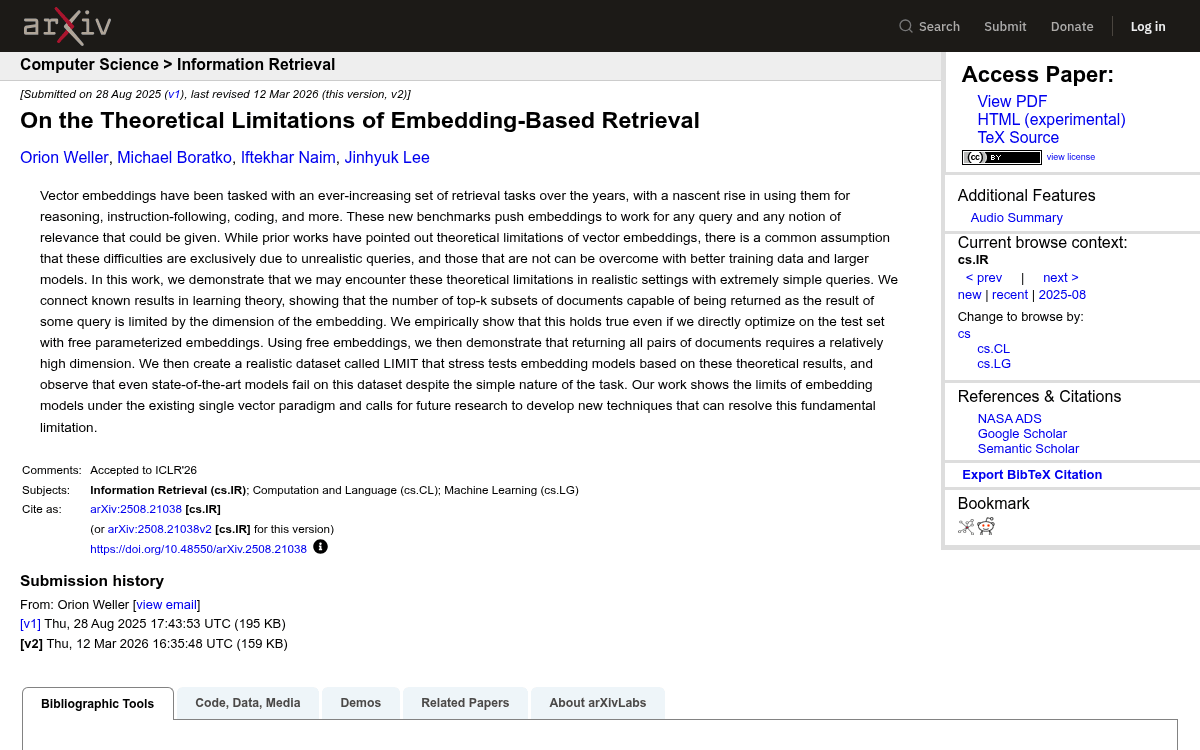
A team from Google DeepMind and Johns Hopkins has put a hard mathematical ceiling on what dense embedding retrievers can do, then built a stupidly simple dataset that state of the art models cannot solve. The paper connects classical geometry to modern retrieval, arguing that no matter how good your training data or how large your model is, a fixed embedding dimension can only represent so many combinations of relevant documents. The preprint and its companion LIMIT benchmark land as embedding models are being asked to handle instruction following, reasoning, and multi-modal search, all tasks where the number of valid top-k sets explodes.
The ceiling nobody was talking about
Dense retrievers work by mapping queries and documents into the same vector space and ranking by dot product. The authors connect known results in learning theory, showing that the number of top-k subsets of documents capable of being returned as the result of some query is limited by the dimension of the embedding. In other words, once you fix d (say 768 or 4096), there are combinations of relevant documents that literally no query vector can retrieve together, regardless of how the encoder was trained.
The proof uses a sphere-packing argument. If every k-subset of n documents must be realized as the top-k for some query with margin gamma, then all those query vectors have to be pairwise separated on the unit sphere. Volume math then forces a lower bound: the binomial coefficient of n choose k must be at most (1 + 1/gamma) raised to the d, giving d at least log(n choose k) divided by log(1 + 1/gamma).
With a modest margin of gamma = 0.1, the required dimensions grow fast. Here is what the bound looks like at web scale:
| Corpus size n | k=2 | k=10 | k=100 | k=1000 |
|---|---|---|---|---|
| 10^6 | 12 | 52 | 425 | 3296 |
| 10^8 | 16 | 71 | 617 | 5217 |
| 10^10 | 19 | 90 | 809 | 7137 |
Those are lower bounds under ideal conditions. Real models must also learn via gradient descent, tokenize natural language, and generalize, so the practical requirement is much higher.
Cheating on the test set and still failing
To show the bound is not just a theoretical curiosity, the authors run what they call free embedding optimization. Instead of training a real encoder, they treat every query and document vector as a directly learnable parameter and optimize them straight against the target relevance matrix using Adam and InfoNCE loss. This is the best case: no natural language, no generalization, just raw vectors overfitting the test set.
Even here, there is a critical n where the dimension d simply cannot encode all top-2 combinations anymore. The curve fits a cubic polynomial with an r-squared of 0.999, and extrapolating gives critical-n values of roughly 500k for 512 dimensions, 1.7m for 768, 4m for 1024, 107m for 3072, and 250m for 4096. Web-scale corpora blow past those numbers routinely.
LIMIT: a toy task that breaks everything
The empirical centerpiece is LIMIT, a benchmark designed to be as simple as possible while still hitting the theoretical wall. Documents describe what people like (Jon likes Apples, sports cars, etc.) and each query just asks who likes X. Two constraints keep it realistic: users have fewer than 50 attributes each, and queries only ask for one item.

The trick is the qrel matrix. The authors pick 46 documents so that all pairs of them (1035 combinations) become queries, exceeding 1000 queries at k=2. Every possible top-2 combination of those 46 documents is exercised by a query. That density is the pressure point predicted by the theory.
Results on the small 46-document version are brutal. Even at full 4096 dimensions:
- E5-Mistral 7B: 29.5 recall@2
- GritLM 7B: 38.4 recall@2
- Qwen3 Embedding: 19.0 recall@2
- Gemini Embedding (3072d): 33.7 recall@2
- Promptriever Llama3 8B: 54.3 recall@2, the best single-vector result
- BM25: 97.8 recall@2
- GTE-ModernColBERT (multi-vector): 83.5 recall@2
On the full 50k-document version, single-vector models cannot break 20% recall@100. Models trained with more diverse instructions, such as Promptriever, perform better, possibly because their training uses more of the embedding space compared to models trained with matryoshka representation learning on narrower task ranges.
Is it just domain shift?
A natural pushback: maybe the models just have not seen this kind of data. The authors ran the obvious ablation. They fine-tuned modernbert-embed-large on a training split built with disjoint attributes. The trained model still cannot solve the problem, moving from near zero recall@10 to at most 2.8 recall@10. Training directly on the test set does work, mirroring the free embedding experiments, but that is overfitting, not learning.
They also stress-tested the lexical winner. Replacing every attribute with a synonym (glasses becomes spectacles) crushes BM25. BM25 drops more than 89% while Qwen3 embedding drops only 38.9%. High dimensionality helps sparse retrievers dodge the combinatorial ceiling, but keyword matching is its own trap.
What actually works
The paper is not a nihilist argument against retrieval. It is a scoping argument against single-vector retrieval as a universal solution. The authors sketch three escape routes:
- Cross-encoders. Given all 46 documents and 1000 queries at once, Gemini 2.5 Pro solves 100% of the queries in a single forward pass. Not viable for first-stage retrieval at scale, but perfect for reranking.
- Multi-vector models. ColBERT-style late interaction with MaxSim gives GTE-ModernColBERT far better scores than any single-vector model, though still far from perfect.
- Sparse models. BM25 and neural sparse retrievers effectively have huge d and handle combinatorial density well, provided you can live with lexical or paraphrase overlap.
Why this matters for building retrieval systems
If you are building RAG over a small corpus with a narrow set of query patterns, a 1024 or 4096 dimensional embedder is still fine. The trouble starts when the product surface expands. Instruction-following retrieval, reasoning benchmarks like BRIGHT, and agent search queries with multiple operators all increase the number of top-k combinations a retriever must be able to represent. That is exactly the axis where the ceiling bites.
Concretely, the paper suggests three moves worth reconsidering in production:
- Do not assume a bigger single-vector model will fix combinatorial retrieval failures. The bound scales with log of combinations, not with model size.
- Use hybrid retrieval (dense plus BM25) or multi-vector retrievers when queries combine concepts via logical operators.
- Push complex relevance definitions into a cross-encoder reranking stage where a full LM can jointly attend to all candidates.
Code and data are on GitHub under google-deepmind/limit, and LIMIT is being folded into the MTEB evaluation suite so future embedding releases will be graded against it.