
Google DeepMind's GenBR Teaches AI to Bargain as Well as Humans
A team from DeepMind, Waterloo, and Michigan built a negotiation agent that trades with humans as effectively as humans trade with each other.
 Pro
Takeaways
- DeepMind, Waterloo, and Michigan introduce GenBR: MCTS with a learned generative world-state sampler for imperfect-information games
- Published at IJCAI 2025, the paper combines PSRO, generative belief models, and Nash bargaining theory
- New meta-strategy solvers based on log Nash product converge at O(T^-1/2) and select Pareto-optimal equilibria
- Trained without human data, agents matched human-human social welfare when negotiating Deal or No Deal with 346 participants
- The Fair agent achieved a Nash bargaining score of 44.23 against humans, versus 6.93 average return in human-human play
- Reproducible via OpenSpiel, which contains PSRO, DoND, and the benchmark games
Teaching a reinforcement learning agent to bargain with humans is harder than teaching it to win at Go. In negotiation you cannot see your opponent's preferences, you cannot always assume they are trying to crush you, and you have to decide whether to cooperate before you know who is on the other side of the table. A new paper from researchers at Google DeepMind, the University of Waterloo, and the University of Michigan, presented at IJCAI 2025, tackles this by welding three ideas together: Monte Carlo Tree Search, a learned generative world model, and Nash bargaining theory.
The system, called Generative Best Response (GenBR), trained agents that negotiate the Deal or No Deal game with human participants and reach outcomes as efficient as humans get when trading with each other. That is a first for game-theoretic RL in a general-sum, imperfect-information setting.
Why opponent modeling breaks in imperfect information
Classical opponent modeling has two steps: build a belief about what the other player is doing, then compute a best response. Existing approaches typically require domain-specific heuristics to come up with such a model, and algorithms for approximating best responses are hard to scale in large, imperfect information domains. Poker bots and negotiation agents historically leaned on hand-crafted opponent profiles built from human play logs, which does not transfer across domains.
The deeper problem is computing a posterior over hidden world state. Prior methods like Information Set MCTS enumerate every history consistent with what a player has observed and compute opponent reach probabilities for each one. In a game like Deal or No Deal, that is not remotely tractable: the authors estimate roughly 1.32 x 10^13 information states for player 1 and 5.69 x 10^11 information states for player 2 .
Replacing the belief calculation with a neural sampler
GenBR extends AlphaZero-style training in a specific way. Instead of the usual policy-and-value network, it uses what the authors call a policy-value-and-generative network (PVGN). The generative net is trained by supervised learning on trajectory data to sample plausible world states directly from an information-state description. During search, the agent skips the exact posterior entirely: it samples a hidden world state from the generative model, then applies Bayes rule on top to guess the opponent's specific pure strategy from a population.
The training loop mirrors AlphaZero self-play with a key twist. Only one player is learning; opponents are drawn from a fixed mixture. During each episode the agent runs an Information Set MCTS variant at every decision point, uses PUCT to select actions, and writes three data streams to disk: policy targets, value targets, and history samples for the generative model. All three networks improve, then guide the next round of search.

Bargaining theory as a meta-strategy solver
The outer loop is Policy Space Response Oracles (PSRO), which iteratively adds best-response policies to a population and picks a mixture over them to train against. The choice of that mixture, called a meta-strategy solver, matters a lot. The authors introduce solvers based on the Nash bargaining solution, which selects Pareto-optimal profiles satisfying axioms of invariance, symmetry, and independence of irrelevant alternatives.
Directly maximizing the Nash product is a non-concave quadratic program that scales poorly. The trick is to maximize the log Nash product instead, which has the same optimizers but is a sum of concave functions and therefore concave. They solve it with projected gradient ascent and prove a convergence rate of O(T^-1/2).
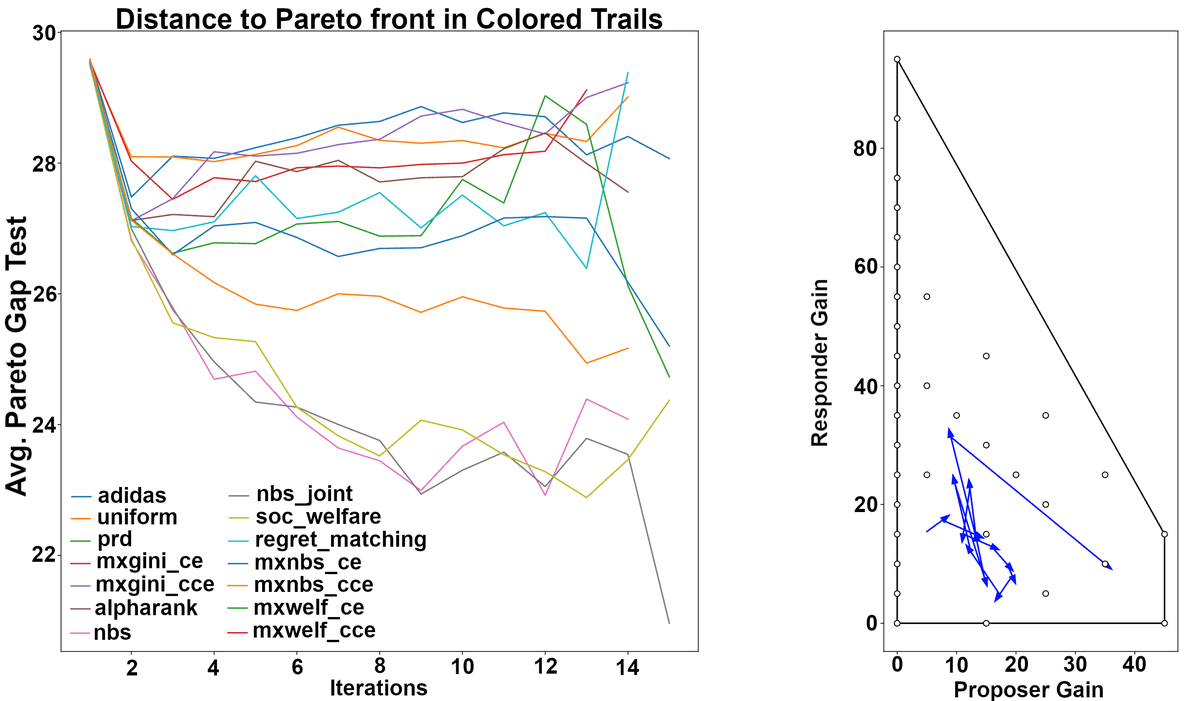
They also propose Nash-bargaining-based selection over correlated and coarse-correlated equilibria, giving several new solvers with different personalities. On the three-player Colored Trails negotiation benchmark, five of the six best meta-strategy solvers came from the Nash bargaining family, with the top performer beating the next best by three points on their Pareto Gap metric.
The human study
The centerpiece is a behavioral study recruiting 346 participants from Prolific to play Deal or No Deal for real monetary stakes. The team trained agents in five flavors:
- IndRL: a self-play DQN baseline with no search
- Comp1, Comp2: two competitive PSRO agents trained with max-Gini correlated equilibrium selection
- Coop: a cooperative agent using uniform meta-strategy and Nash-product backups
- Fair: an agent that back-propagates the product of utilities during search
Crucially, none of the agents saw human data during training. Human-versus-human games reached an average return of 6.93. The Fair agent playing humans produced a combined utility of 6.69 with a Nash bargaining score of 44.23, the highest of any human-agent pairing, essentially matching human-human welfare. The DQN baseline, by contrast, achieved high individual return by aggressively squeezing human reward down to 5.86 per game.
An interesting side finding: the Coop agent scored 44.51 in self-play but its Nash bargaining score dropped to 41.35 against humans, likely reflecting overfitting to agent-only conventions. The Fair agent, whose meta-strategy puts weight on many policies, adapted better because its Bayesian prior over opponents had wider support.
What is actually new here
The real advance is the generative-model replacement for exact belief computation, which is what lets AlphaZero-style search reach large imperfect-information domains at all. Everything else, PSRO, IS-MCTS, correlated-equilibrium selection, already existed. Combining them with a learned world sampler and bargaining-aware meta-strategies is what produces human-compatible negotiators.
Limitations are worth flagging. The domains are still small compared to real-world commerce; Deal or No Deal has three item types and a fixed pool. Training an agent that plays fairly required deliberately choosing the Nash-product backup, so the framework does not automatically produce prosocial behavior. And the paper's own ethics statement notes the obvious dual-use risk: the same techniques could produce agents that exploit humans in high-stakes negotiations.
Where to find it
The paper is available on arXiv and in the IJCAI 2025 proceedings. The benchmarks build on OpenSpiel, DeepMind's open framework for reinforcement learning in games, which already contains implementations of PSRO, Deal or No Deal, and most of the poker and bargaining environments used in the paper's Nash-equilibrium ablations. A dedicated release of GenBR-specific code is not mentioned in the paper, but the pieces needed to reproduce the outer loop and the meta-strategy solvers are all in OpenSpiel.