
Google DeepMind's Concordia Grows Luxury Status Symbols From AI Small Talk
Google DeepMind simulated 50 LLM agents going on dates and shopping, and watched Veblen goods, price bubbles, and subcultures emerge on their own.
 Pro
Takeaways
- Google DeepMind's new paper simulates status signaling using 50 LLM agents in the Concordia framework.
- Agents in a social condition spent 35% of purchases on luxury goods versus 21% when alone.
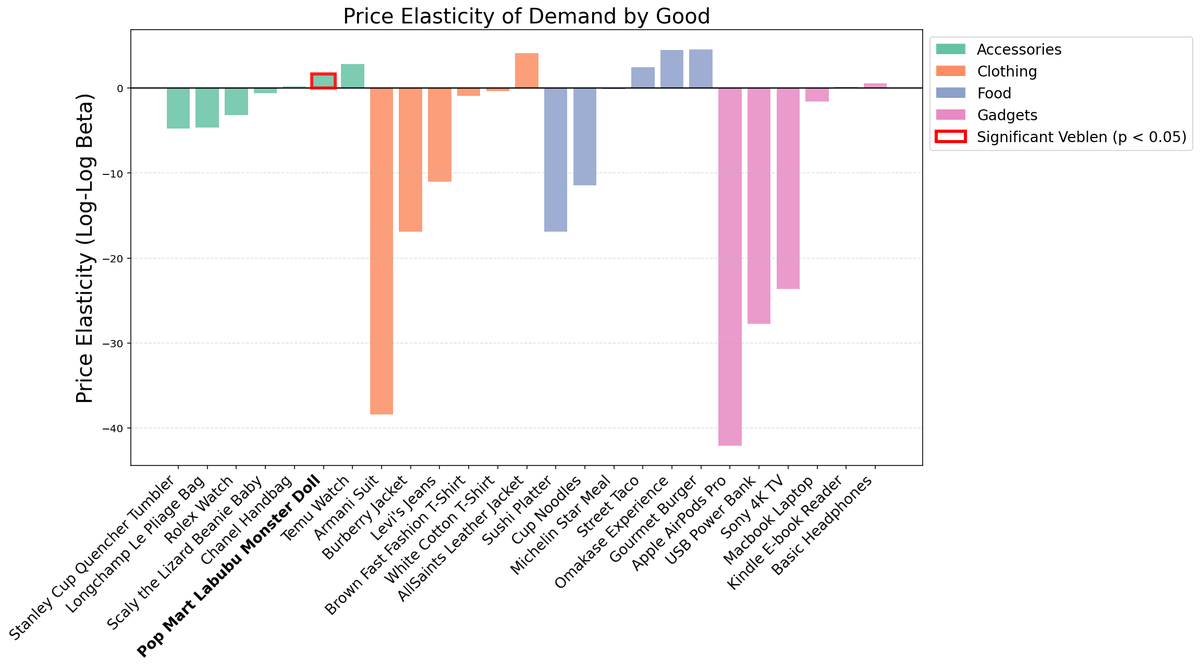
- A Pop Mart Labubu doll showed +1.45 price elasticity, becoming a textbook Veblen good endogenously.
- Fixed-price control proves social hype, not high cost, causally drives status demand.
- Synthetic invented brands also became status symbols, ruling out pretraining prestige bias.
- Code is open source at github.com/google-deepmind/concordia.
A team from Google DeepMind and the University of Toronto has built a multi-agent simulation that reproduces one of economics' most stubborn puzzles: why do certain goods become status symbols, and why does demand for them go up when their price does? Rather than hard-coding preferences into their agents, the researchers let a population of language-model personas go shopping, go on dates, and gossip. Luxury bidding wars, viral collectibles, and even distinct subcultures emerged on their own.
The work, titled A Generative Model of Conspicuous Consumption and Status Signaling, uses Google DeepMind's Concordia framework and Gemma-3-27B as the underlying model. The code lives in the signaling examples folder of the Concordia repo, so anyone with an LLM API budget can rerun the experiments.
Why the old theory keeps breaking
Classical economics has a hard time with status goods. The Law of Demand says quantity demanded should fall as prices rise, yet Rolexes, Chanel bags, and Labubu dolls do the opposite. The standard fix, Costly Signaling Theory, explains conspicuous consumption by treating expenditure as a credible signal of status because the cost is hard to fake for low status individuals. But that framing has holes. High production cost is neither necessary nor sufficient to create a status signal, and it can't explain why nearly free markers like slang, accents, or team colors work just as well as watches that cost as much as a car.
The authors argue the real binding constraint is semiotic appropriateness: what a signal means in a given social context. They ground this in what they call predictive pattern completion, which treats humans (and LLM agents) as culturally trained generative models that observe peers, update expectations about what "people like us" do, and imitate accordingly. In this view, status symbols are not chosen through rational cost-benefit calculation. They are pattern-matched from social memory.
The setup: 50 agents, a marketplace, and a lot of first dates

The simulation runs 50 buyer agents (drawn from a wealth distribution ranging from roughly $500 to over $100,000) and 25 seller agents for five simulated days. Each day has three phases:
- Marketplace: Five rounds of bidding on food, gadgets, clothing, and accessories, stratified into low, mid, and high quality tiers. Prices clear via a clearing-house mechanism.
- Daily life: The Game Master generates three events consistent with each agent's persona. Agents also consume food from inventory or receive a starvation observation, creating an implicit budget pressure.
- Social phase: Agents are paired into mixed-sex "first date" dyads. Each receives a textual description of one clothing or accessory item their partner is wearing, then they chat for 80 turns of open-ended dialogue.
The critical manipulation is whether the social phase happens at all. The control condition strips out dates and personal events, leaving only 25 rounds of solitary shopping. Everything else, including the persona backstories and initial cash, is held constant.
Veblen goods emerge from small talk

Turning the social layer on flips agent behavior. In the Social Life condition, about 35% of all purchases went to high-tier status goods, versus 21% in the no-social baseline (p < 0.001). Bidding volume for status items jumped from roughly 12% to 31% of all bids. Without an audience, demand for luxury essentially collapsed to whatever functional utility the agents could squeeze out.
The more striking result is what happened to prices. A Chanel handbag and a Pop Mart Labubu doll both saw dramatic price run-ups once agents started spotting them on their dates. The Labubu case is the standout: the authors computed a price elasticity of demand of +1.45 for it, meaning the doll became more desirable as it got more expensive. That is a textbook Veblen good, and it emerged with no prompting. For context, food came in at -3.08 PED and gadgets at -4.22, so the agents behave rationally when they need to eat.
Labubu also serves as an elegant control against pretraining contamination. The doll went viral internationally in 2025, which is after Gemma-3-27B's primary training cutoff, so the model had little prior knowledge of it as a prestige item. The prestige emerged inside the simulation.
Hype drives price, not the other way around
Costly Signaling Theory predicts that if you fix prices, agents should stop wanting the goods, because the expensive signal has been neutered. The authors ran that experiment. They kept everything about the social condition identical but pinned marketplace prices at their initial baselines.
Demand did not collapse. It went up. Bids for status goods surged to about 45% of all bids in the fixed-price condition, and purchases hit 48%, higher than either the dynamic-price social condition (35%) or the no-social baseline (21%). In other words, agents wanted the Chanel bag because they saw it on a date and talked about it, not because the price tag was climbing. Rising prices in the main experiment turned out to be an epiphenomenon of the socially constructed demand, and actually acted as a budget constraint that dampened total consumption.
Made-up brands, invented subcultures, and Kerala vs. LA

To rule out any lingering "the LLM already knows Rolex is fancy" objection, the team reran the experiment with procedurally generated brands like "Serrurier Juliette Handbag" and "Auric Meridian Watch." Purchases of these synthetic status goods still hit 29% in the social condition versus 18% in the control. Prestige can be built from scratch in silico.
They then poked at the simulation harder:
- Influencer agents: On day 6, confederate "influencer" agents were introduced who negatively sanctioned mainstream luxury goods and hyped new hipster or streetwear items. In the hipster condition, a Vintage Film Camera drew 54 bids on day 10 at clearing prices of $3,150 to $6,100. In the streetwear condition, a Collab Sneaker traded up to $3,400. Old status leaders like Chanel kept most of their value, suggesting new subcultures form alongside, not on top of, existing ones.
- Non-monetary signaling: When given the choice to repost politically charged content or ignore it, agents chose to share moral outrage 42% of the time with an audience versus 29% alone. Conspicuous public donations rose from 26% to 35% with social visibility.
- Cultural priors: Populations instantiated as Los Angeles residents converged on oat milk and black coffee, with visibility pushing them further toward black. Kerala-instantiated agents defaulted overwhelmingly to cow milk, mirroring the traditional Indian preference for filter kaapi. Same social mechanism, opposite equilibria.
What this is actually useful for
The headline claim is a computational theory of status. The quieter contribution is a working methodology for simulating endogenous preference formation, the process where desires are shaped by interaction rather than fixed in a utility function. If you care about forecasting how viral trends form, how consumer tastes drift, or how in-group markers propagate, this gives you a controllable sandbox where you can toggle visibility, seed influencers, and swap cultural priors.
Limitations are real. LLM outputs are biased by training data and lack the diversity of real populations. The memory system is thin compared to human episodic recall, which likely explains why equilibrium selection here happens over five simulated days instead of the months or years it takes in the real world. And the underlying model, Gemma-3-27B, will produce different results from GPT-class or Claude-class backbones, which the authors flag as an open issue for the field. Still, the fact that a controlled toggle between "they went on a date" and "they didn't" moves aggregate demand for luxury by more than 60% is a striking demonstration that macro-level economic weirdness can be reconstructed from micro-level social observation.