
Google DeepMind's AlphaQubit 2 Breaks the Speed Barrier for Quantum Error Correction
Google DeepMind's AlphaQubit 2 hits sub-microsecond decoding on surface and color codes, clearing a major bottleneck for fault-tolerant quantum computing.
 Pro
Takeaways
- Google DeepMind's AlphaQubit 2 hits sub-microsecond decoding on surface code d=11 and color code d=9.
- Achieves near-optimal logical error rates around 10^-10 per cycle up to distance 23 (surface) and 27 (color).
- First neural decoder to meet real-time, accuracy, and scalability requirements together.
- Interleaved recurrent and transformer layers with temporal compression enable streaming inference on commercial TPUs.
- Runs orders of magnitude faster than high-accuracy color code decoders like Tesseract.
- Generalizes from 168-cycle training to million-cycle evaluations without retraining.
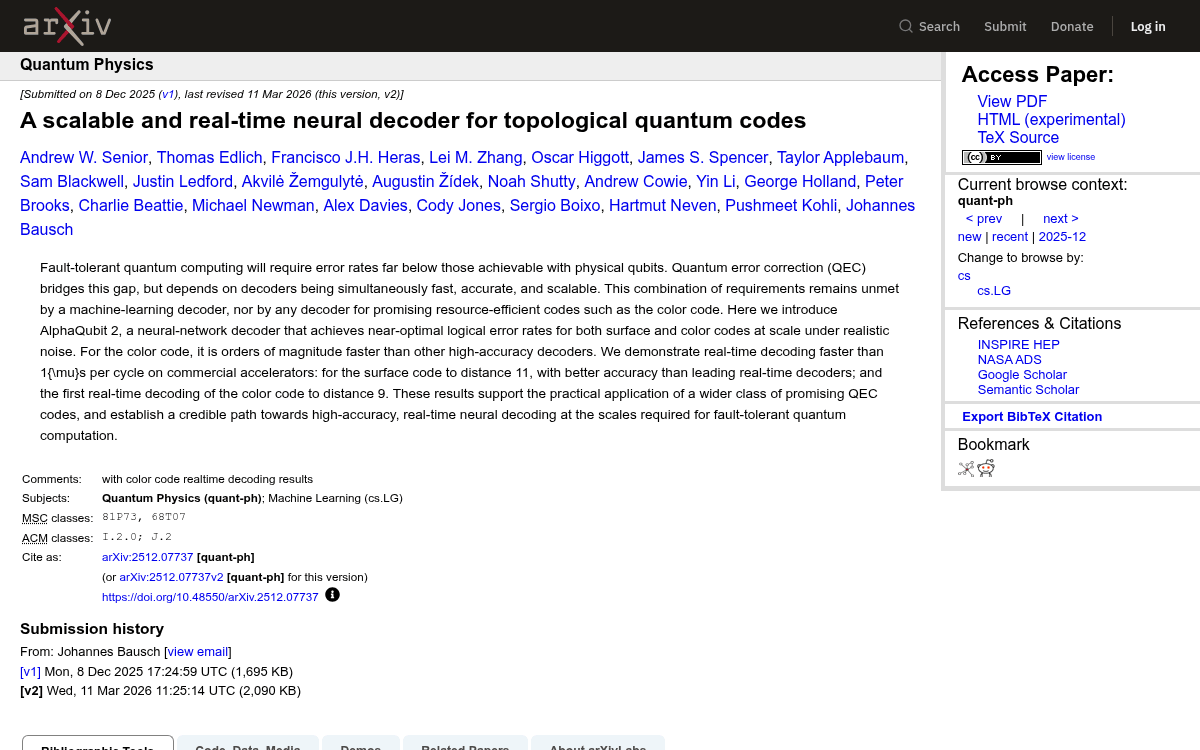
Quantum error correction has a speed problem. The classical decoder that reads syndrome measurements and decides which qubits to fix has to be simultaneously fast, accurate, and scalable, and until now no machine-learning decoder had cleared all three bars, especially for the notoriously hard-to-decode color code. Google DeepMind and Google Quantum AI's AlphaQubit 2 (AQ2) is a neural network decoder that finally does.
The headline result: AlphaQubit 2 achieves per-cycle decode latency below the QEC cycle time (under 1 microsecond on TPU/GPU) for the surface code to distance 11 and the color code to distance 9. That is the first time a machine-learning decoder has met the real-time budget of superconducting qubits at these scales, and the first real-time decoding of the color code, period.
Why decoding is the hidden bottleneck
Physical qubits are noisy. Quantum error correction hides one logical qubit inside a lattice of many physical qubits and repeatedly measures parity checks called stabilizers. When two consecutive checks disagree, that is a detection event. A decoder ingests the whole stream of detection events and outputs a correction. Get it wrong and the logical qubit flips.
To run a useful algorithm like factoring a 2048-bit number, you need logical error rates around 10 to the minus 10 per operation, which is roughly seven orders of magnitude below current superconducting hardware. The way to close that gap is to make the code bigger (larger code distance) and let redundancy exponentially suppress errors. But that only works if the decoder keeps up. If it falls behind the roughly 1 microsecond superconducting clock cycle, syndrome data piles up exponentially and correction becomes impossible.
The field has lived with a painful trade-off. Fast matching-based decoders like PyMatching are only approximate. Search-based decoders like Tesseract get near-optimal accuracy but are far too slow. And color codes, which are attractive because they need fewer physical qubits and support cheaper logical operations, have been especially stubborn.
What is new in AlphaQubit 2
The original AlphaQubit was a recurrent transformer that beat classical decoders on Google's Sycamore data but had inference latency around 24 microseconds per cycle, far above the real-time budget. AQ2 rebuilds the architecture from scratch around three ideas:
- Interleaved spatial and temporal layers. Instead of wrapping transformers inside a big recurrent core, AQ2 alternates lightweight recurrent layers (which propagate information forward in time per stabilizer) with attention-based transformer layers (which mix information across stabilizers at a single instant).
- Temporal compression. Rather than processing one cycle at a time, AQ2 groups 3 to 6 consecutive cycles, letting the accelerator batch spatial attention across many time steps in parallel.
- Streaming inference. The recurrent state carries syndrome history forward, so blocks can be processed as new measurements stream in from the quantum computer. Computational cost per cycle is fixed and independent of the error pattern.
Two model variants exist. Full AQ2 is optimized for accuracy. AQ2-RT is a compact version with fewer layers, smaller representations, and a faster element-wise gated recurrence borrowed from the Griffin architecture. The RT variant is what hits the sub-microsecond target on Trillium TPUs, without any custom FPGAs or ASICs.
The accuracy numbers
Under the standard SI1000 superconducting noise model at 0.15 percent physical error rate, AlphaQubit 2 achieves near-optimal logical error rates for both surface and color codes at scale under realistic noise, and for the color code is orders of magnitude faster than other high-accuracy decoders.
Concretely, on 120-cycle memory experiments:
- Surface code at distance 23: logical error per cycle of 7.3 x 10 to the minus 11, matching the near-optimal but much slower Libra decoder and beating PyMatching variants.
- Bell-flagged color code at distance 27: an ensemble of 3 models reaches 8.0 x 10 to the minus 11, tracking an extrapolation of the ideal Tesseract accuracy up through distance 23.
- Willow experimental data: AQ2 matches or beats the original AlphaQubit and the Libra baseline on real hardware data from Google's 105-qubit chip at distances 3, 5, and 7.
The real-time variant pays a modest accuracy tax. At surface code distance 11 it reaches 3.73 x 10 to the minus 6 versus 1.89 x 10 to the minus 6 for full AQ2, still more accurate than any other decoder that can hit the same throughput.
How the model is trained
Data comes from Stim, the standard stabilizer circuit simulator, generating billions of examples across a range of code distances and noise levels. Several training tricks made the scaling work:
- Code distance curriculum. Start on small codes with short experiments, gradually shift the training distribution toward larger, harder examples.
- Auxiliary losses. The network is trained to predict noise-free versions of the logical observable at every cycle, using privileged simulator information that would be inaccessible on a real device. This gives dense supervision signals beyond the single end-of-experiment label.
- Input masking. Fifty percent of stabilizer representations are dropped and replaced with zeros on 80 percent of training examples, a BERT-style regularizer.
- Fine-tuning and ensembling. At the highest distances the base model is fine-tuned on a single distance and multiple variants are ensembled to squeeze out the last bit of accuracy.
Generalization that actually holds up
A subtle worry with learned decoders is that they might only work on the noise distribution they were trained on. AQ2 was stress-tested on two axes:
- Experiment length. A model trained on experiments of at most 168 cycles was evaluated on experiments up to one million cycles. Logical error per cycle stayed stable, with only mild degradation at the largest distances.
- Noise strength. Both surface and color code decoders held up across a sixteen-fold variation in circuit noise, including values above and below the training range, without retraining.
The real breakthrough
Beyond the raw numbers, three things stand out. First, this is the first neural decoder that is simultaneously on the Pareto frontier of accuracy and throughput at scale. Second, it is code-agnostic, meaning the same architecture handles the surface code, the Bell-flagged color code, and the superdense color code with no code-specific engineering. Third, running on commercial TPUs matters. Prior real-time decoding proposals have leaned on custom FPGAs or ASICs, which are expensive to develop and inflexible.
The color code result is the sharper win. As recent Willow experiments from Google Quantum AI showed, color codes can suppress logical errors on superconducting hardware, but their broader adoption has been held back by the lack of a fast, accurate decoder. AQ2 removes that barrier and opens the door to codes with lower physical qubit overhead and cheaper logical gates.
What is still missing
The paper is honest about limits. Real-time throughput only reaches distance 11 for the surface code, not the distances of several tens that full fault tolerance will require. Training becomes harder and less sample-efficient at the largest distances, with visible deviations from ideal scaling at color code distance 27. Latency between the final measurement and the decoding result, which matters for many quantum algorithms, has not yet been optimized. And decoding logical gate operations at scale, not just memory experiments, is still future work.
The authors sketch a plausible route forward: lower-precision arithmetic, kernel-level optimizations, next-generation TPUs, and possibly windowed decoding or hardware acceleration on FPGAs. No model weights or code appear to be released with the paper, which is standard for Google Quantum AI's decoder work, though Stim and baseline decoders like PyMatching and Tesseract are open source.
What AQ2 establishes is that neural decoders are no longer a research curiosity waiting for the physics to catch up. They are now the fastest known accurate option for color codes and competitive with the best matching-based decoders for surface codes, running on hardware you can rent by the hour. The classical bottleneck in the quantum stack just got a lot smaller.