
Google DeepMind Cracks Differential Privacy for Black-Box AI Models
A new algorithm from Google DeepMind lets you apply differential privacy to any black-box function, navigating the tradeoff between data efficiency and computation cost.
 Pro
Takeaways
- A new algorithm from Google DeepMind enables differentially private estimation of any black-box function without needing to know its sensitivity.
- The method navigates a fundamental tradeoff: more data per evaluation requires more function calls, and vice versa -- with a near-optimal lower bound proven.
- The core technique uses covering designs (combinatorial structures) to select overlapping data subsets, ensuring at least one evaluation is always "clean" of corrupted data.
- Compared to classic sample-and-aggregate, the algorithm can use 2x more data per evaluation at the cost of only a quadratic increase in function calls.
- Key practical use case: PATE-style ML pipelines where each function call trains a model and sensitivity analysis is infeasible.
- Main limitation: the aggregation step is NP-hard in general; a computationally efficient implementation remains an open problem.
Differential privacy (DP) is the gold standard for releasing statistics about sensitive data without leaking information about individuals. The classic recipe is simple: compute your statistic, measure how much a single person's data could change the result (the "sensitivity"), and add noise proportional to that sensitivity. But that recipe breaks down the moment your function is a black box, like a trained ML model or a complex legacy pipeline, where the sensitivity is either enormous or simply impossible to compute.
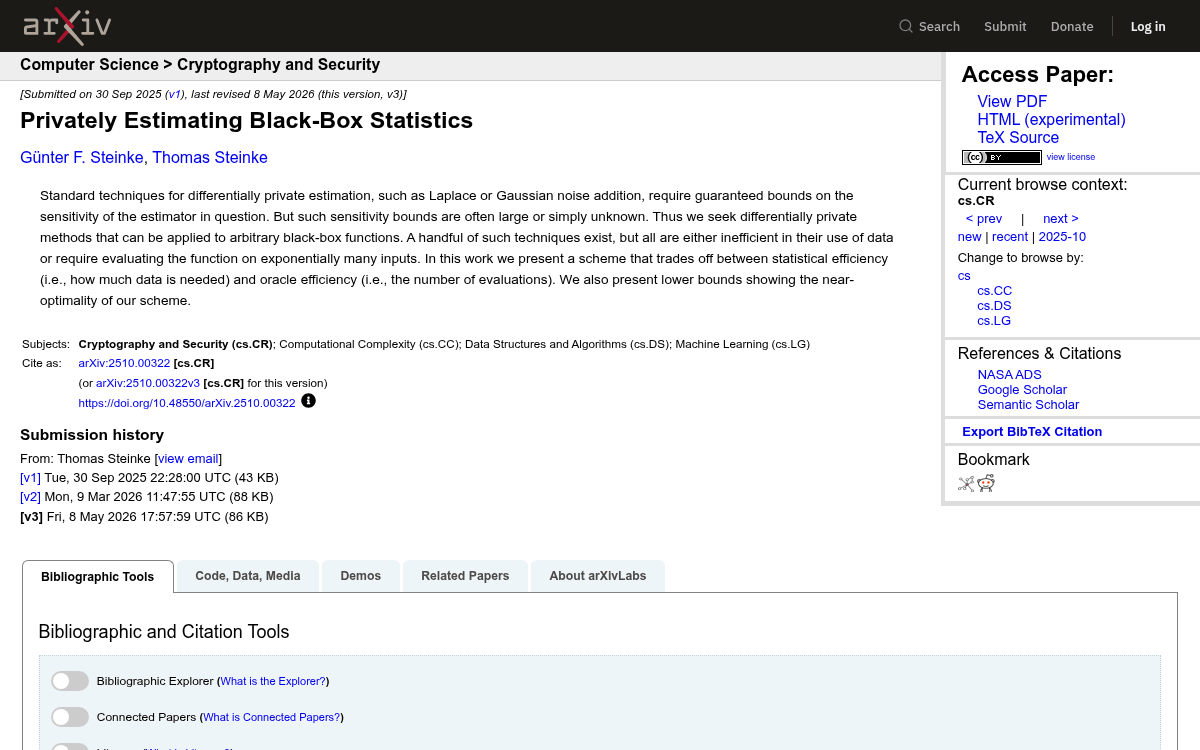
A new paper accepted at COLT 2026, "Privately Estimating Black-Box Statistics," by Günter Steinke (University of Canterbury) and Thomas Steinke (Google DeepMind), directly attacks this problem. The work presents a scheme that trades off between statistical efficiency (how much data is needed) and oracle efficiency (the number of evaluations of the function). Crucially, it comes with matching lower bounds proving the scheme is near-optimal.
Why sensitivity is the bottleneck
Standard DP mechanisms like Laplace or Gaussian noise addition require you to know the global sensitivity of your function: the maximum change in output when you add or remove one person's record. Standard techniques for differentially private estimation require guaranteed bounds on the sensitivity of the estimator in question, but such sensitivity bounds are often large or simply unknown. In practice, the function may be given as a "black box" -- we can only evaluate it as an oracle and not inspect its inner workings, or it may be presented as a piece of untrusted code that is too complicated to analyze.
A motivating real-world example from the paper: in the PATE framework for private ML, each function evaluation corresponds to training a full ML model on a subset of the training data. You cannot analytically derive sensitivity for an arbitrary neural network, and you certainly cannot afford to enumerate exponentially many input variants to measure it empirically.
The existing options and their problems
Before this work, the landscape of black-box-friendly DP methods looked roughly like this:
- Sample-and-aggregate (Nissim et al., 2007): Split the dataset into
O(1/ε)equal parts, evaluate the function on each part, and aggregate privately. Computationally cheap -- onlyO(1/ε)function calls -- but statistically expensive. The final accuracy given a dataset of size n is only as good as a non-private estimate on a dataset of sizeO(εn). Thus, if the privacy parameter ε is small, sample-and-aggregate suffers a significant cost in terms of statistical accuracy. - Smooth sensitivity / propose-test-release: Better accuracy, but require analyzing the function's behavior across its entire domain -- not feasible for a true black box.
- Down-local algorithms (e.g., Linder et al., 2025): Evaluate only on subsets of the actual input data (avoiding the "breaking" problem), but require exponentially many evaluations.
The core tension: you can be data-efficient (use most of your data for each evaluation) or compute-efficient (make few function calls), but not both. Most down-local algorithms still require evaluating a black-box function on exponentially many subsets of the input.
The key insight: covering designs
The paper's algorithm is an extension of sample-and-aggregate, but with a smarter way to pick which subsets to evaluate. Instead of partitioning the data into disjoint chunks, it uses a combinatorial object called a covering design (also known as a Turán system) to select k overlapping subsets.
A covering design has a specific guarantee: if t out of the n input datapoints are corrupted, then at least one of the k subsets will not contain any corrupted datapoints. This is the key robustness property needed for differential privacy. Intuitively, (ε, δ)-DP requires robustness to roughly t = O(log(1/δ)/ε) corruptions, and the covering design guarantees that at least one evaluation will be clean.
The second ingredient is the shifted inverse mechanism, which aggregates the k function values into a single differentially private output. The trick is to transform the aggregation problem into one with sensitivity 1, regardless of what the original function does. Concretely, it asks: "how many data points would I need to remove so that all remaining outputs fall below a threshold y?" This count has sensitivity 1 by construction, so it can be privatized with standard Laplace or Gaussian noise.
Here is a sketch of the algorithm:
# Pseudocode for the black-box DP estimator
# Inputs:
#   f       -- black-box function (oracle)
#   x       -- private dataset of size n
#   eps, delta -- privacy parameters
#   S_1..S_k  -- a (n, m, t)-covering design (k subsets of [n], each of size m)
t = (1/eps) * log(1/delta) * exp(O(log_star(|Y|)))  # privacy robustness threshold
# Step 1: Evaluate f on each subset complement
values = [f(x[complement(S_i)]) for i in range(k)]  # k evaluations total
# Step 2: Monotonize: g(x') = max over subsets that are fully present in x'
g = lambda x_prime: max(values[i] for i in range(k) if subset_intact(x_prime, S_i))
# Step 3: Apply shifted inverse mechanism to g
# Finds y such that: min{g(x'): x' subset of x, |x'| >= n-t} <= y <= g(x)
return shifted_inverse_mechanism(g, x, eps, delta)
The tradeoff curve, made concrete
The key parameter is m: the size of each subset that gets excluded from an evaluation. Smaller m means each evaluation sees more data (better accuracy), but requires more evaluations (higher cost). The paper maps out the full tradeoff:
| Subset size used | Number of evaluations k | Corresponds to |
|---|---|---|
n / (t+1) | t+1 | Classic sample-and-aggregate |
2n / (t+2) | O(t²) | 2x data, quadratic cost |
cn / (t+c) | O(t^c) | c-fold data, polynomial cost |
n - t | O((n/t)^t) | Near-full data, exponential cost |
The sweet spot for most practitioners is the middle rows: we can roughly double the amount of data available in each evaluation at the expense of only a quadratic blowup in the number of evaluations. If each evaluation is a full model training run, quadratic in t ≈ O(1/ε) is very manageable.
The lower bound: this is essentially optimal
The paper also proves that no algorithm can do better. The lower bound shows that the number of evaluations must be impractically large in many parameter regimes. The message is that working in the black-box setting inherently incurs a high cost either in terms of statistical efficiency or oracle efficiency. The combinatorial term k ≈ C(n, m, t) -- the size of the minimum covering design -- appears in both the upper and lower bounds, confirming the algorithm is near-optimal.
The proof strategy is elegant: it shows that any DP algorithm in the black-box setting must implicitly construct something like a covering design in its query pattern, or else it can be fooled by a carefully crafted adversarial function.
What it's good for -- and where it falls short
This method shines when:
- Your statistic is a black-box or untrusted piece of code (e.g., a third-party ML pipeline).
- You cannot analytically bound the sensitivity of your function.
- Each function evaluation is expensive (e.g., training a model), so you want to minimize calls while retaining accuracy.
- You are working in the PATE-style framework, where each evaluation trains a teacher model on a data subset.
The main limitation is computational: while the paper bounds the oracle complexity (the number of evaluations of the function), it does not account for the computational cost of choosing the subsets and processing the values returned by the function. Specifically, the aggregation step reduces to a hitting set problem, which is NP-complete in general. The paper leaves constructing a computationally efficient version as an open problem.
There is also a statistical gap: when applied to well-studied problems like Gaussian mean estimation, the method is suboptimal compared to tailored algorithms. The accuracy scales as O(σ/√(εn)) rather than the optimal O(σ/√n + σ/(εn)). The method is designed for generality, not for squeezing out the last bit of accuracy on problems where you already know the structure.
What's now possible
The practical upshot is a principled way to apply differential privacy to any function you can evaluate, without needing to understand its internals. For ML practitioners, this means you can wrap a complex model training procedure in a DP guarantee without modifying the training code at all -- just call it on carefully chosen data subsets and aggregate the results. The paper demonstrates an asymptotic separation from sample-and-aggregate on learning parities, showing that the algorithm can achieve n = O(d) sample complexity where sample-and-aggregate requires n = Ω(d/ε).
No code implementation is currently available, but the algorithm is described precisely enough to implement. The main practical challenge is generating a good covering design -- the paper notes that a near-optimal one can be constructed with high probability by simply drawing enough random subsets of the right size, making a practical implementation feasible even without optimal combinatorial constructions.