
GOODFormer Beats Graph AI's Biggest Blind Spot With an 11-Point Jump
GOODFormer teaches graph transformers to separate causal structure from spurious patterns, delivering double-digit accuracy gains when test graphs differ from training data.
 Pro
Takeaways
- GOODFormer is the first graph transformer designed for out-of-distribution generalization, accepted to KDD 2026.
- Proves classical softmax attention loses sharpness under distribution shifts, degrading invariant subgraph disentanglement.
- Introduces entropy-guided sharp attention with temperature-based test-time training to keep attention decisive.
- Learns positional encodings for dynamically evolving subgraphs via an MPNN trained against Laplacian eigenvectors.
- Beats state-of-the-art baselines by up to 11 points on GOOD-Motif and wins on GOOD-HIV, DrugOOD, and SST2.
- Code and reproducibility artifacts published on GitHub and Zenodo.
Graph transformers keep winning benchmarks, but they share an awkward secret with most deep learning models: they collapse when the test data does not look like the training data. A new paper accepted to KDD 2026 introduces GOODFormer, a graph transformer architecture built from the ground up for out-of-distribution generalization, along with open-source code and a Zenodo release.
The distribution shift blind spot
Graph Transformers adapt the Transformer architecture to capture graph structures, allowing nodes to interact with all other nodes and modeling long-range dependencies, which sidesteps well-known GNN limitations like oversmoothing and over-squashing. The catch: existing GTs assume training and testing graphs come from the same distribution, and without careful design they exploit statistical correlations that easily break under distribution shifts.
That fragility matters for anything that leaves the lab. Think molecular property prediction where new scaffolds arrive constantly, drug affinity models facing unseen assay types, or fraud detection graphs that change shape over time. Prior work on graph invariant learning attacked this problem for message-passing GNNs, but plugging those tricks into a transformer runs into two specific walls.
Why softmax betrays you under shift
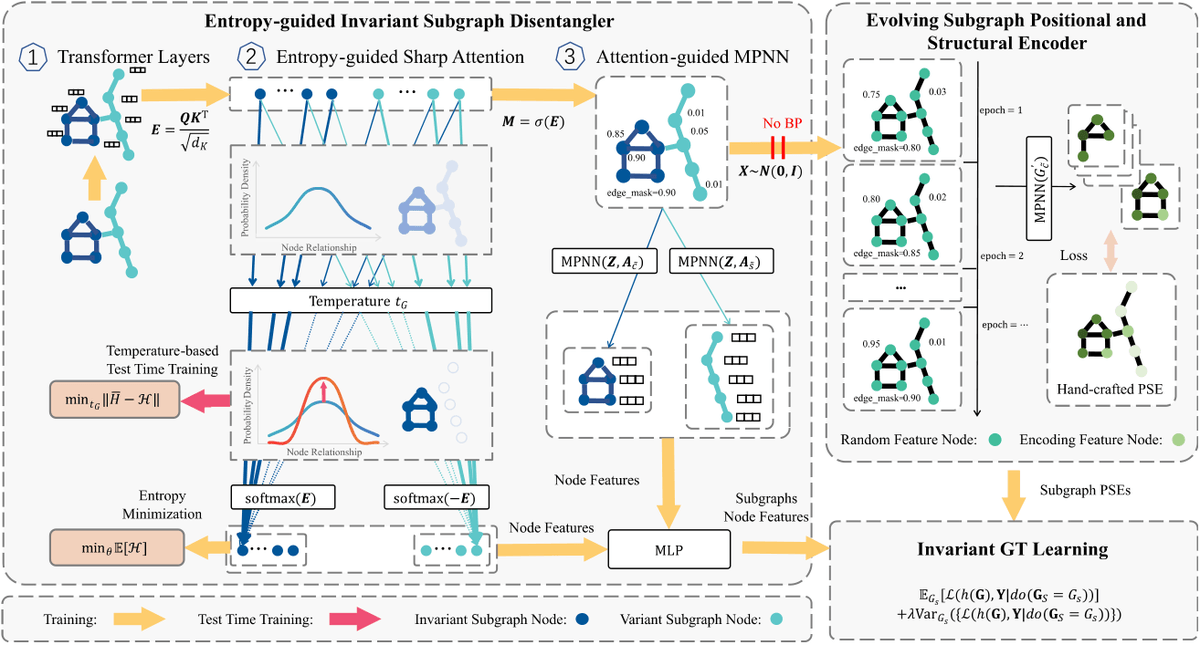
The first wall is the attention function itself. GOODFormer separates each input graph into an invariant subgraph (the causal structure that predicts the label) and a variant subgraph (spurious context). It does this by computing complementary attentions with softmax and its negation, then thresholding. The problem is theoretical, and the authors prove it: when dealing with distribution shifts, classical self-attention cannot guarantee sharpness, so if the number of variant subgraph nodes in test data greatly exceeds that in training data, the attention coefficients disperse and the margin between invariant and variant subgraph nodes shrinks.
The second wall is positional encoding. Existing GTs adopt hand-crafted encoding methods during pre-processing due to high computational complexity, but in invariant learning the invariant subgraph dynamically evolves as the model is optimized, which makes precomputing encodings infeasible.
Three modules working in lockstep
GOODFormer jointly optimizes three components that address both walls:
- Entropy-guided invariant subgraph disentangler. Uses complementary softmax attentions to split the graph, then adds an entropy regularizer during training plus a temperature-scaled softmax at test time. The theorem they prove is intuitive: as temperature t decreases, the Shannon entropy of the softmax output monotonically decreases, so lowering temperature sharpens the attention without changing the ranking of scores.
- Evolving subgraph positional and structural encoder. A learnable MPNN with random Gaussian node features trained to approximate hand-crafted Laplacian eigenvector encodings. Crucially, back-propagation from this encoder to the disentangler is severed to avoid leaking spurious correlations back into subgraph selection.
- Invariant learning module. Combines an interventional loss that minimizes expected risk across variant subgraph interventions with a variance penalty, following the intervention-based invariant learning recipe from causal theory.
The test-time training loop is lightweight. For each graph, GOODFormer optimizes the temperature t_G to match the average training-time entropy, keeping the attention sharp even when input distributions drift. The overall time complexity remains on the same scale as existing GT methods.
The numbers
The team evaluates on the GOOD benchmark plus DrugOOD, covering synthetic structural shifts, molecular scaffold and size shifts, sentence-length shifts on graph-encoded NLP data, and assay-type shifts in drug discovery. GOODFormer wins across the board, with the biggest gaps on the synthetic stress tests:
| Dataset / Split | Best baseline | GOODFormer |
|---|---|---|
| GOOD-Motif basis | 71.02 (iMoLD) | 81.97 |
| GOOD-Motif size | 72.22 (CAL+) | 80.02 |
| GOOD-HIV scaffold | 70.17 (IRM) | 70.38 |
| GOOD-SST2 length | 82.76 (EXPHORMER) | 83.07 |
| DrugOOD assay | 71.75 (GSAT) | 71.75 |
On the synthetic basis split, that is an 11 point jump. The subgraph identification metric is even more striking: GOODFormer reaches 0.698 Precision@10 for discovering ground-truth invariant subgraphs, versus 0.396 for GSAT and 0.247 for CIGA. In other words, it does not just predict better, it actually finds the right causal structure.
What ablations reveal
The ablation study is unusually clean. Removing entropy loss and test-time training drops GOOD-Motif basis accuracy from 81.97 to 40.40. Swapping in a hand-crafted LapPE on the original graph, rather than the learned subgraph PSE, drops it to 59.29. Simply incorporating hand-crafted encodings of the original graphs can introduce spurious correlations between the graph structure and the labels, thereby reducing OOD generalization capabilities. The evolving encoder is doing real work, not just decoration.
When to reach for it
GOODFormer is a fit if you are doing graph-level classification and your test distribution genuinely differs from training, especially in molecular property prediction, drug discovery, or any domain where scaffold, size, or environment shifts are the norm. Training cost is roughly 2 to 3x a vanilla graph transformer on the GOOD-Motif benchmark, driven by the auxiliary losses and test-time temperature optimization.
The authors acknowledge limits: performance degrades under extreme distribution shifts because invariant subgraph discovery gets noisy, and the method targets simple graphs. Dynamic graphs, heterogeneous graphs, and hypergraphs are listed as future work. The code, hyperparameter settings per dataset, and full appendix with proofs are all in the public repository, which lowers the barrier to trying it on your own graph OOD problems.