
GoldenStart Rewires Robot AI to Skip Meaningless Noise and Hit 51.3%
A new distillation method gives one-step flow policies a smarter starting point and tunable exploration, beating prior methods on OGBench and D4RL.
 Pro
Takeaways
- GoldenStart (GS-flow) distills flow-matching RL policies using a Q-guided prior instead of Gaussian noise. Paper
- A conditional VAE learns to sample noise that maps to high-Q actions for each state.
- The student actor outputs a mean and variance with entropy regularization for principled exploration.
- Achieves 51.3% offline score on OGBench Cube Double Play, beating all baselines on multi-modal tasks.
- Also excels on Puzzle-3x3, Puzzle-4x4, and HumanoidMaze; matches FQL on simpler unimodal tasks.
- Code to be released at github.com/ZhHe11/GSFlow-RL as an ICLR 2026 paper.
Flow-matching policies are attractive for reinforcement learning because they can capture the messy, multi-modal action distributions that real robotic tasks demand. The catch is that they are slow to sample from and awkward to explore with, which has pushed researchers toward one-step distillation. A new ICLR 2026 paper argues that everyone has been ignoring the most obvious lever: the noise you start the generation from.
The method, called GoldenStart (GS-flow), replaces the standard Gaussian noise used to seed a distilled flow policy with a learned, state-conditioned prior that points toward high-value actions, then adds entropy control on top so the policy can still explore. Code is promised on GitHub.
Why a Gaussian noise seed is a bad idea in RL
Flow matching learns a vector field that transports samples from a simple source distribution (usually a standard Gaussian) to a target distribution. In generative modeling this is fine. In RL, the target is a set of good actions for a given state, and current methods transform a general unimodal noise distribution to a specific mode of the target data distribution, so every point in the initial source distribution can be mapped to every point in the target distribution, resulting in long average paths.
When you then distill that multi-step flow into a one-step student for fast inference, you inherit a fundamental mismatch: the student has to learn a shortcut from meaningless noise to a promising action, and it has to do this from scratch for every state. The structure of the initial noise distribution remains an overlooked factor with significant untapped potential, and this along with the challenge of controlling policy stochasticity constitutes two critical areas for advancing distilled flow-matching policies.
The "golden start" trick
GS-flow builds a state-conditioned prior with a conditional VAE (C-VAE) that concentrates its mass in regions the critic already thinks are valuable. This state-conditioned prior repositions the starting points of the one-step generation process into high-Q regions, effectively providing a golden start that shortcuts the policy to promising actions. For online exploration, the distilled actor outputs a stochastic distribution instead of a deterministic point, governed by entropy regularization, allowing the policy to shift from pure exploitation to principled exploration.

The training pipeline runs in two phases:
- Q-guided prior learning. An Advantage Noise Selection module samples
Ncandcandidate noises per state, scores them with the critic, and keeps the one leading to the highest-Q action. A Conditional VAE is then trained to model the state-conditioned distribution of these advantageous priors, with an encoder that maps a prior-state pair to a latent distribution and a decoder that reconstructs the prior from a latent sample. - Entropy-regularized distillation. A student policy is distilled from the multi-step flow teacher, but instead of outputting a single action it outputs a mean and variance, with an entropy bonus that keeps the distribution wide enough to explore.
At deployment the flow teacher is thrown away. GS-flow operates with high efficiency using only the VAE decoder and the student policy: given the current state, the VAE decoder generates an advantage prior, which is fed into the student actor to produce an action distribution. For online exploration an action is sampled from this distribution with its learned mean and variance; for evaluation only the mean is used to maximize exploitation.
Results on OGBench and D4RL
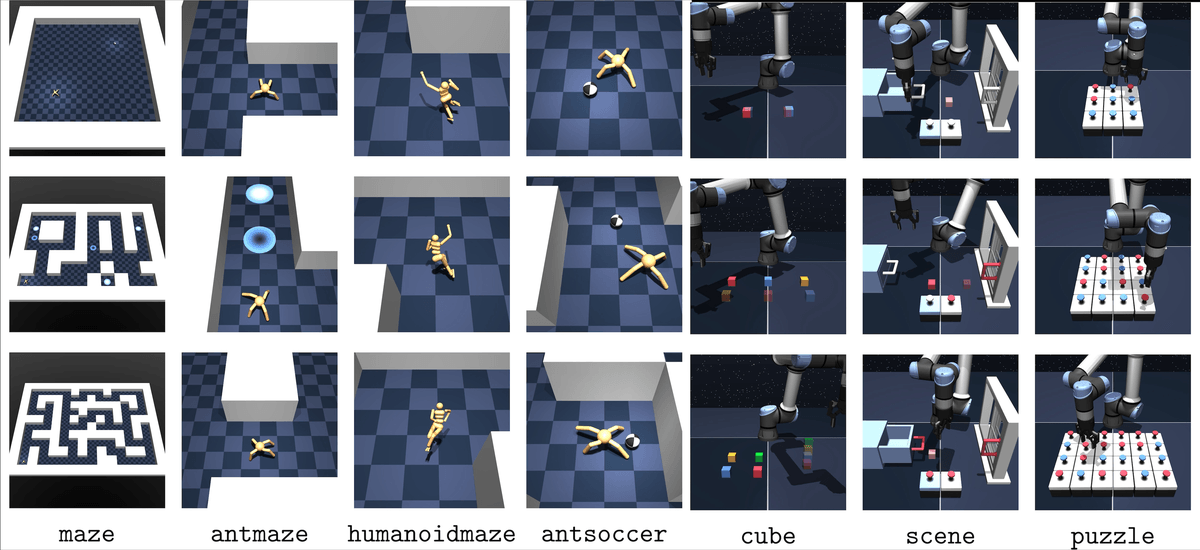
The team tested on OGBench, a benchmark suite for offline goal-conditioned reinforcement learning covering locomotion, manipulation, drawing, and puzzles, with 85 datasets across 8 environments, plus D4RL. The most telling number is on the Cube Double Play task, which requires manipulating two objects and has a strongly multi-modal Q landscape: on the simpler Cube Single Play, GS-flow performs comparably to the strong FQL baseline, but on Cube Double Play the offline score of GS-flow reaches 51.3%, dramatically outperforming all competing methods. The advantage extends to Puzzle-3x3, Puzzle-4x4, and challenging locomotion environments such as HumanoidMaze.

Ablations show the prior itself matters: varying the number of candidate actions Ncand used in the Advantage Noise Selection module reveals a clear trend, with increasing candidates improving both sample efficiency and final performance. In other words, the more aggressively you filter noise toward high-Q regions before the C-VAE learns from it, the better the resulting policy.
Where it fits, and where it does not
GS-flow sits in a growing family of methods trying to make flow policies usable for RL without the inference-time cost. Alternatives like Q-Guided Flow Q-Learning attack the same problem by injecting a critic-gradient term at inference instead of distilling, and Guided Flow Policy pushes value-awareness into the flow training itself. GS-flow's bet is that fixing the noise distribution is a cleaner win than either.
Practically, this is most useful if you already build multi-modal continuous control agents (robotic manipulation, multi-object tasks, long-horizon locomotion) and need a fast one-step actor that still explores. On single-mode tasks the extra machinery buys you very little over FQL, and the method still needs a reliable critic to bootstrap the prior. If your dataset is too narrow or your Q estimates are unreliable, the golden start could just push the student toward bad but confidently-scored actions faster.