
Golden Ticket Method Boosts Frozen Robot Policies From 40% to 100%
Researchers find that swapping the random noise input of a diffusion robot policy for one fixed, well-chosen vector lifts success rates by up to 55 percent.
 Pro
Takeaways
- A single fixed noise vector, called a golden ticket, can replace Gaussian sampling in diffusion and flow matching robot policies.
- Improves performance on 46 of 51 tasks, with gains up to +55% absolute success rate on simulated tasks.
- Requires no weight updates, no extra networks, and works on any diffusion or flow matching policy including VLAs.
- On real Franka hardware, cup pushing jumped from 40% to 100% success after only 50 search episodes.
- Roughly 15x faster wall-clock than DSRL while matching or beating its performance on several tasks.
- Code, checkpoints, and precomputed golden tickets are released for three simulation benchmarks.
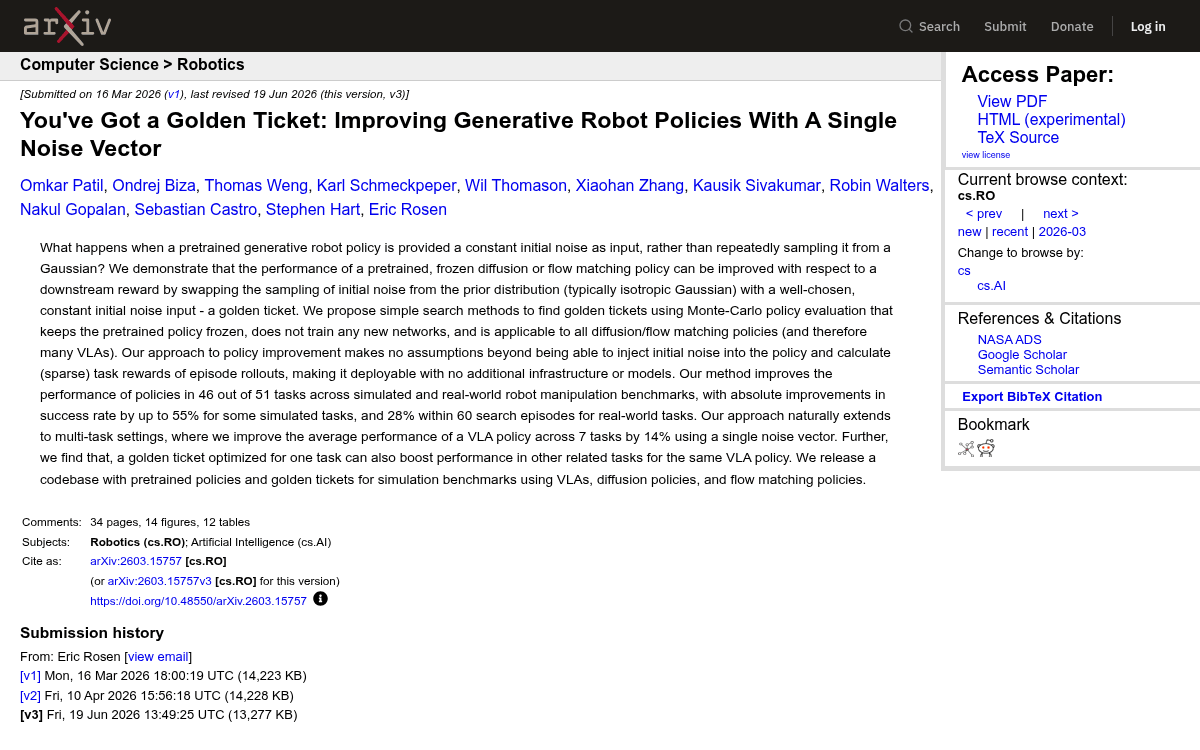
Diffusion and flow matching policies have become the default way to teach robots dexterous behaviors, but improving one after training is painful. You either fine-tune the weights (expensive, risks catastrophic forgetting), train a helper network to steer the model, or bolt on a critic. A team from the Robotics and AI Institute, Arizona State, and Northeastern just published a paper arguing that most of these gains can be recovered by changing exactly one thing at inference time: the initial noise vector fed into the denoiser.
They call this vector a golden ticket. Instead of resampling Gaussian noise every time the policy generates an action chunk, you keep a single frozen noise tensor and reuse it forever. Search for the right one, and the same neural network suddenly becomes much better at the task.
The lottery ticket idea, applied to robot control
The lottery ticket framing comes from image generation, where prior work showed that randomly initialized Gaussian noise images contain special pixel blocks that naturally tend to be denoised into specific content. This paper tests whether the same phenomenon holds when the thing being denoised is an action chunk conditioned on robot observations, and when the reward comes from rolling out episodes in an environment rather than a differentiable image metric.
The setup is deliberately minimal. Given a pretrained, frozen diffusion or flow matching policy and an MDP for a downstream task, the goal is to adapt the policy's behavior to maximize rewards while keeping the parameters frozen. No new networks. No gradient updates. No assumptions beyond being able to inject a noise vector and read a sparse reward signal at the end of a rollout.

How the search works
Finding a golden ticket is posed as black-box optimization over the noise vector, using Monte-Carlo estimates of episode return as the objective. The authors try three search strategies:
- Random Search (RS): sample N candidate tickets, evaluate each across M environments, keep the best.
- Cross-Entropy Method (CEM): iteratively refit a Gaussian over the noise space to the top-scoring elites.
- Zeroth-Order Search (ZOS): a local random walk on the L2-sphere around a pivot noise vector.
They also add a sequential halving variant of CEM that evaluates the population in tiers and eliminates weak candidates early, cutting the per-iteration rollout cost by roughly a factor of T_tier/2. CEM generally wins, though random search alone is surprisingly strong.
The numbers
Across 51 task-policy pairs spanning simulation and hardware, golden tickets outperform Gaussian noise in 46 out of 51 tasks, and at least match it in 49. Some highlights:
- franka_sim cube picking (flow matching MLP): base 38.5% success, golden ticket 96%.
- robomimic Can (DPPO diffusion): 42.8% to 80.8%.
- SimplerEnv put_eggplant_in_sink (GR00T N1.5 VLA): 21% to 76.3%.
- LIBERO with SmolVLA: +13%, +12.8%, +8% on Spatial, Goal, Object suites.
- Real Franka cup pushing: 40% to 100% after only 50 search episodes.
The hardware results are the practical eye-catcher. Block pick went from 80% to 98% after 150 search episodes (~30 minutes), piston assembly from 60% to 88%, banana pick from 50% to 68%, and cup push from 40% to 100%. That is faster than fine-tuning and requires no differentiable reward.
How it compares to the alternatives
The closest prior method is DSRL, which trains an observation-conditioned noise policy with reinforcement learning on top of a frozen diffusion backbone. Golden tickets are simpler: no extra network, no RL hyperparameters, no critic. On robomimic Lift and Can, a single fixed noise vector recovers most of DSRL's gains. On DexMimicGen Box Cleanup, it beats DSRL outright across DDIM step counts.
Wall-clock costs are also dramatically different. On the same hardware for 1M environment steps on Lift, plain CEM finishes about 15 times faster than DSRL, and CEM with racing is about 5 times faster. The gap widens on visuomotor tasks where DSRL needs multiple critic networks to control overestimation.
Multi-task and Pareto behavior
Two findings stand out beyond raw success rates. First, a ticket optimized for one LIBERO task frequently helps on other tasks in the same suite. In LIBERO-GOAL, a single ticket matches or exceeds the base policy on 7 out of 10 tasks. Second, when you search jointly across the 7 SimplerEnv WidowX tasks with a VLA, one ticket lifts the multi-task average by 14%.
The team also shows that different tickets trade off differently on the same task. On franka_sim block picking, evaluating 400 tickets across success rate and episode length produces a clean Pareto frontier between speed and reliability. You can literally swap tickets at runtime to change the robot's personality without touching a weight.
What it is bad at
Golden tickets require the pretrained policy to be steerable in the first place. If the base model has not learned the underlying skill, a lucky noise vector will not conjure it. The method also makes DDIM sampling deterministic, which can hurt multimodal action coverage, though the authors show that uniformly sampling from the top-k tickets recovers stochasticity without losing performance. And when the base policy is already very good (LIBERO-OBJECT was already at 92%), the headroom is naturally small.
Availability
The authors released a codebase with pretrained policies and golden tickets for franka_sim, robomimic, and LIBERO, covering VLAs, diffusion policies, and flow matching policies. If you already have a frozen policy sitting on disk and access to an environment or a reward signal, this is roughly the cheapest policy improvement tool currently available: a few dozen to a few thousand rollouts, no gradients, no new parameters.