
GM3 Beats Autonomous Driving's Broken Bicycle Model by 5x on Sharp Turns
A new arXiv paper introduces GM3, a tire-level physics model that unifies bicycles, skateboards, carts, and hoverboards under one simulator to replace the aging Kinematic Bicycle Model.
 Pro
Takeaways
- New arXiv paper introduces GM3, a tire-level brush model for micro-mobility vehicles: arxiv.org/abs/2510.07807
- Unifies bicycles, scooters, skateboards, carts, hoverboards, and multi-wheel platforms under one physics formulation
- Captures tire slip, load transfer, and rider lean that the Kinematic Bicycle Model ignores
- Cuts average displacement error by 5-9% on Stanford Drone Dataset roundabout trajectories versus KBM
- Wins decisively on aggressive S-curves, turns, and U-turns where KBM overshoots or understeers
- Ships with a model-agnostic simulator supporting interactive and scripted control, RK4 integration, and CSV export
A new research paper on arXiv proposes a replacement for one of the most quietly overworked pieces of code in autonomous driving stacks: the Kinematic Bicycle Model. Titled GM3, the preprint from Grace Cai, Nithin Parepally, Laura Zheng, and Ming C. Lin argues that current simulators handle bicycles, scooters, skateboards, and low-speed carts with physics that were never designed for them, and offers a single tire-level formulation to cover all of them.
The motivation is a mismatch that anyone building traffic simulators will recognize. In 2023, people took 133 million trips on shared micro-mobility across the US and 24 million in Canada, driven by dockless and station-based systems. Yet current Analysis, Modeling, and Simulation tools remain largely vehicle-centric, with limited support for multimodal interactions and thin representation of pedestrians, cyclists, and other micro-mobility modes. Autonomous vehicles training in these simulators are effectively rehearsing against ghosts.
Why the bicycle model keeps breaking
The Kinematic Bicycle Model (KBM) treats a vehicle as two wheels connected by a rigid axle, with no notion of tire deformation, weight shifting, or a rider leaning into a turn. It works when things move slowly and turn gently. Push it harder and the trajectories go unrealistic: sharp turns, hard braking, and rapid lane changes all break the assumptions. The model does not capture tire slip, load transfer, or rider lean, and its single-track geometry does not generalize to other wheel configurations.
Prior work has patched around this with mode-specific rigs, such as vehicle-versus-e-scooter interaction setups or dedicated bicycle simulators, none of which speak a common language. Heavyweight options exist too. Project Chrono provides a Vehicle class with templates for subsystems, including suspension, steering, and braking, along with three classes of tire models: rigid, semi-empirical, and finite element. A user can define a vehicle as a list of axles, each consisting of a set of tires with their own parameters. The catch is that Chrono targets complex military vehicles, ignores rider dynamics, and carries computational overhead that is excessive for micro-mobility.
A brush of bristles under every wheel
GM3's core move is to work one tire at a time using the brush tire model, a classical formulation from vehicle dynamics that represents the tread as independent bristles, each of which deflects under slip and friction. A bristle sticks to the road until forces exceed friction, then slides. Integrating across the contact patch gives longitudinal force, lateral force, and an aligning moment, and reproduces the nonlinear saturation that happens when a tire is asked to do more than physics allows.
The pipeline for a single simulation step:
- Compute load transfer between axles and between left and right wheels, and convert rider lean to steer for skateboard-style trucks.
- Assign control inputs (steering angle, wheel angular velocity) to each individual tire.
- Run the brush model per tire to get longitudinal force, lateral force, and aligning moment.
- Transform every tire force back into the vehicle body frame, sum them, and integrate with fourth-order Runge-Kutta.

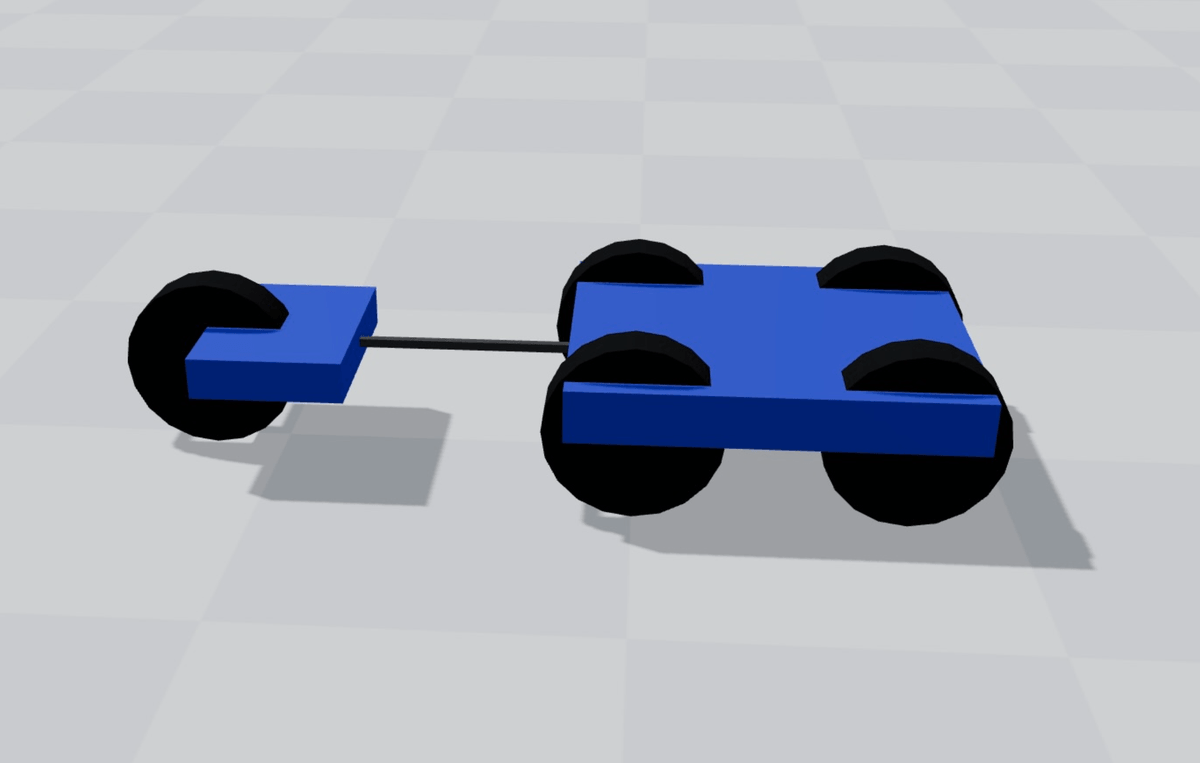
Because the dynamics operate at the tire level rather than the vehicle level, the model does not care whether a platform has one wheel or five. The paper covers bicycle, scooter, skateboard, cart/LSV, unicycle, hoverboard, delta 3-wheeler, tadpole 3-wheeler, 5-wheeled circular platform, and drawn carriage. Skateboards get special handling for their kingpin geometry, where leaning steers the front and rear trucks in opposite directions, and hoverboards are supported through a differential-drive control interface.
What the numbers show
The authors validated GM3 against KBM on two fronts. The first uses the Stanford Drone Dataset, a large collection of aerial videos recorded over the Stanford campus, specifically the deathCircle roundabout scene, filtered to biker, skater, and cart trajectories. The second is a synthetic set of aggressive maneuvers: S-curves, left and right turns, and U-turns.
On the real-world roundabout data, GM3 reduces Average Displacement Error relative to KBM across all modes (Biker: -5.16%, Skater: -8.77%, Cart: -6.82%), indicating better step-by-step alignment. Discrete Fréchet distance, which measures how similar two paths are as whole shapes, was more mixed: better for skaters and carts, worse for bikers, which the authors attribute to accumulated lean-induced lateral bias at the tracked bottom-midpoint of the bounding box.
The synthetic aggressive maneuvers are where GM3 pulls decisively ahead:
| Maneuver | GM3 ADE (m) | KBM ADE (m) | GM3 DFD (m) | KBM DFD (m) |
|---|---|---|---|---|
| S-curve | 0.74 | 2.75 | 4.09 | 4.48 |
| Turn (Left) | 0.21 | 5.09 | 0.40 | 15.52 |
| Turn (Right) | 0.28 | 5.09 | 0.50 | 15.52 |
| U-turn (Left) | 2.91 | 6.79 | 5.17 | 26.08 |
| U-turn (Right) | 2.81 | 6.79 | 4.86 | 26.08 |
GM3 closely follows the ground-truth paths while KBM tends to overshoot or understeer in high-speed, high-curvature segments. That is precisely the failure mode that matters for training perception and planning stacks that need to anticipate a cyclist swerving or a scooter cutting across a lane.

The framework wrapped around it
Alongside the model itself, the paper describes an interactive evaluation harness that decouples vehicle geometry from dynamics. Control can be provided in two modes: interactive and script. In interactive mode, a user drives the agent from the keyboard, with steering, speed, and braking intents mapped to model-specific inputs. Steering is consistent across models, while longitudinal controls differ: KBM takes acceleration commands, GM3 takes wheel-speed commands, and runs can be exported to CSV for offline analysis.
Practically, the same chassis (say a delta three-wheeler) can be run under KBM and GM3 side by side to see how the trajectory diverges under identical controls. New dynamics models can also be dropped in without rewriting the visualization or control mapping code.
Caveats and what is not there yet
A few limitations are worth flagging. The paper does not link to a public code release, so anyone wanting to try GM3 will need to reimplement from the equations or wait for the authors to publish source. The empirical validation is against a single dataset dominated by low-speed cooperative campus traffic, which the authors concede tends to understate GM3's advantage. The DFD regression on bikers indicates the lean model still introduces a consistent lateral offset when compared to bounding-box-derived ground truth. Every added parameter (contact length, tread stiffness, camber angle, friction coefficient) is another thing to calibrate per vehicle mode.
The authors point to future work extending GM3 to be differentiable for learning, control, and parameter identification. That would open the door to fitting the model's physical parameters directly from observed trajectory data rather than looking them up on manufacturer spec sheets. Combined with the modular control interface, that direction would make GM3 genuinely useful as the physics layer under a learned policy for micro-mobility agents in mixed traffic.