
Glasgow Researchers Find Self-Driving Car Signals Fail Runners at Crosswalks
A CHI 2026 study finds runners lean harder on external car signals than walkers, and prefer simple color changes over animated light patterns.
 Pro
Takeaways
- CHI 2026 study tests how runners versus walkers respond to external displays on autonomous vehicles.
- Runners rely more on the eHMI signal and less on the car's actual driving behavior.
- Simple red/green color changes outperform animated light patterns when pedestrians are moving fast.
- Walkers handle both animation and color signals well because they can stop and verify.
- Study used an outdoor augmented reality simulator instead of a VR lab setup.
- Authors call for eHMI designs that account for diverse pedestrian movement, not just walking.
Self-driving cars are learning to talk to pedestrians through lights, symbols, and animations mounted on the vehicle itself. A new study from researchers at the University of Glasgow, published at CHI 2026, argues that these signals have been designed almost exclusively around one type of pedestrian: the walker. When you introduce runners into the picture, the interface assumptions start to break down.
The paper, Running into Traffic, investigates how joggers and walkers respond to different external Human-Machine Interfaces (eHMIs) on an approaching autonomous vehicle. The short version: runners rely on the signal more heavily than walkers do, have less time to decode it, and prefer a plain red/green color change over more elaborate animated patterns.
Why pedestrian signals are an unsolved problem
When a human driver approaches a crosswalk, they can nod, wave, or make eye contact to let a pedestrian know they are yielding. Remove the driver, and that channel disappears. According to SAE levels of driving automation, the removal of the human driver's role in higher-level AVs leads to the reconfiguration or replacement of traditional interaction cues such as hand gestures, eye contact, and facial expressions.
The industry response has been eHMIs: on-vehicle displays such as light bars, text panels, or projected symbols that broadcast the car's intent. More than 70 eHMI concepts have been proposed, with most found to be beneficial for road users. But there is no standard, and existing eHMI evaluations have predominantly been conducted in laboratories, utilizing virtual reality and monitor-based simulations, focusing on simple one-to-one traffic scenarios such as a single pedestrian interacting with a single vehicle. Almost all of that testing assumes the pedestrian is walking.
Taking the test outside
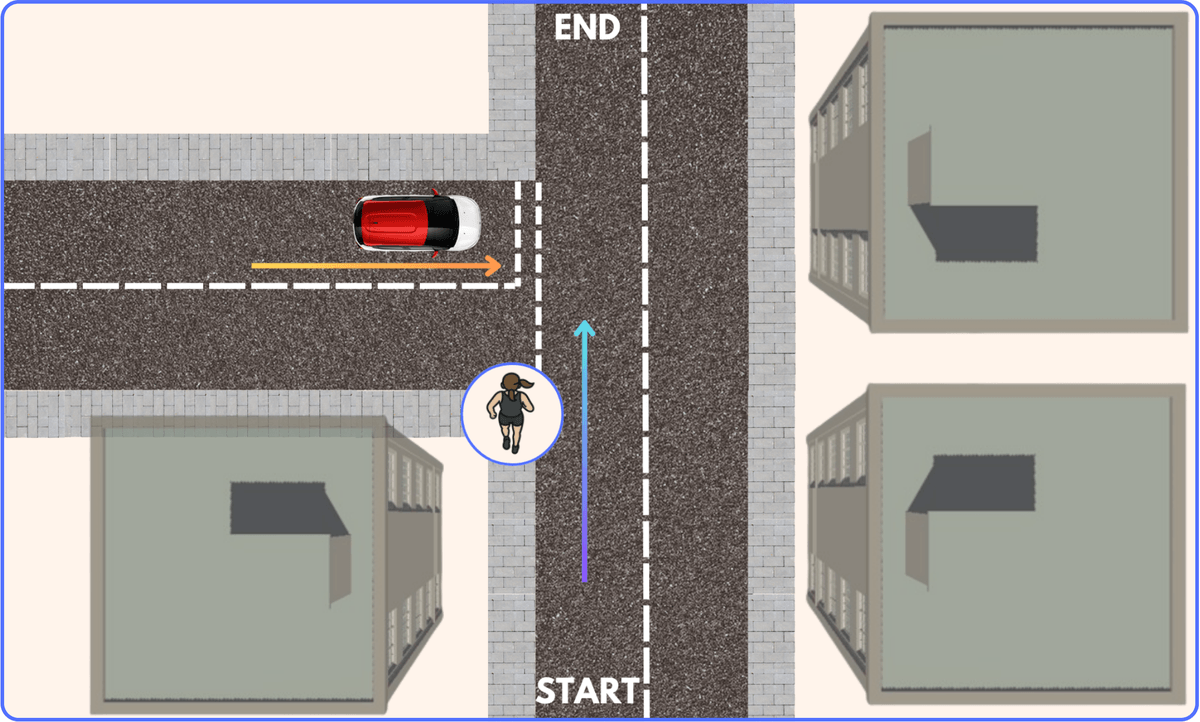
Rather than run yet another VR lab study, the team built an outdoor augmented reality simulator. Participants physically walked or ran across a real outdoor path while an AR headset overlaid a virtual crossing and an approaching automated vehicle. The car displayed one of three interfaces:
- A red/green color-changing light bar that flips green when the vehicle is yielding
- An animated cyan light pattern that signals intent through motion
- No eHMI at all, forcing pedestrians to infer intent from vehicle behavior alone
Each participant completed the crossing task under both movement conditions, which let the authors compare how the same person handled the same signal at two different paces.
Walkers verify, runners commit
The behavioral split was the headline finding. Walkers mostly stopped and validated eHMI signals with vehicle behaviour; they processed both eHMI animations and colour changes effectively. They had time to look, cross-check the light against whether the car was actually slowing, and then decide.
Runners could not afford that luxury. Running was framed as an exercise activity with specific performance goals. Participants found it physically costly to slow down and preferred to maintain their pace, resulting in fast and mobile AV interactions. The consequence: runners relied heavily on the eHMI to make rapid crossing decisions, often without considering the AV's implicit driving cues. This resulted in higher perceived risk, lower perceived safety, and more collision-prone behaviours.
And when the signal itself was complicated, things got worse. Runners preferred colour-changing eHMIs, as animation-based displays demanded more processing time than their running pace allowed. The no-eHMI baseline was the weakest condition across the board, confirming that some signal is meaningfully better than none.
What this actually means for interface design
The deeper contribution here is not a ranking of light patterns. It is evidence that pedestrian activity, not just pedestrian presence, should be a first-class variable when designing AV communication. A light show that a walking commuter finds informative can be actively worse for a jogger who has three seconds to parse it and a heart rate that discourages stopping.
Some practical implications the authors draw out:
- Discrete state changes (red to green) beat continuous animations when decision windows are short
- Runners under-weight implicit cues like deceleration, so the explicit signal carries more responsibility for safety
- Inclusive eHMI design should account for cyclists, wheelchair users, and other faster or non-standard movement patterns, not just able-bodied walkers
This is a Human-Computer Interaction paper, so there is no model checkpoint or repo to download. The full CHI 2026 proceedings entry is available through the ACM Digital Library, and the preprint is on arXiv. For anyone building perception or planning stacks that will eventually need to signal intent to real humans on real streets, the takeaway is worth internalizing: the person you are signaling to might be moving twice as fast as your interface assumes.