
GLANCE Cuts AR Glasses Vision Power 65% by Watching Where Eyes Look
A two-stage pipeline uses lookup-table gaze tracking to steer a tiny YOLO detector at only attended regions, cutting energy 65% on an Arduino Nano.
 Pro
Takeaways
- GLANCE pairs a lookup-table gaze estimator with a YOLOv12n detector triggered only on gaze-driven ROIs.
- Gaze runs in 393 MACs and 2.2 KiB per frame with 8.32 degree angular error on MPIIGaze.
- System hits 48.1% mAP on COCO, 51.8% on attended objects, at sub-10 ms latency.
- Cuts compute 40-50%, energy 65%, and communication time 177x on Arduino Nano 33 BLE.
- Small object accuracy jumps from 39.2% to 51.3% versus global YOLOv12n baseline.
- Built on Differentiable Weightless Neural Networks (ICML 2024), first use for real-time gaze.
Running real-time object detection on AR/VR glasses is brutal. You need sub-10 millisecond latency, single-digit-watt power budgets, and enough accuracy to be useful, all while a full-frame detector burns compute on pixels the wearer is not even looking at. A team from the University of Nebraska-Lincoln, NJIT, UT Austin, and Samsung proposes a different approach: skip the pixels the eye ignores, and do the gaze tracking itself with memory lookups instead of neural network math.
Their system, called GLANCE (Gaze-Led Attention Network for Compressed Edge-inference), borrows from biological foveal vision. Human eyes only see sharp detail in a tiny central region, and the brain routes attention there. GLANCE pairs differentiable weightless neural networks for gaze estimation with attention-guided region-of-interest object detection, replacing multiply-accumulate operations with memory lookups. It reaches 8.32° angular error using only 393 MACs and 2.2 KiB of memory per frame.

The wearable vision bottleneck
Most edge detectors process every pixel uniformly, wasting power in scenarios where the user's attention is highly localized. Redundant visual tokens drag down inference efficiency and block real-time use on VR headsets and AR glasses. Existing efficiency methods prune tokens using learned saliency, sparse attention schedules, or controller policies, but they typically require architectural surgery or access to intermediate activations, adding modules that increase compute and memory.
Gaze is a cleaner attention signal than any learned saliency map, because it directly reflects what the user cares about. The catch: a gaze estimator running on a microcontroller cannot afford a CNN of its own, or the whole point of saving compute disappears. GLANCE sidesteps that by ditching the multiply-accumulate paradigm entirely for the gaze stage.
Neural networks without arithmetic
The gaze estimator is built on Differentiable Weightless Neural Networks (DWNs), a recent idea from an ICML 2024 paper. DWNs are models based on interconnected lookup tables, with training enabled by an Extended Finite Difference technique for approximate differentiation of binary values, along with Learnable Mapping, Learnable Reduction, and Spectral Regularization to improve accuracy and efficiency.
In practice, a DWN replaces the classic "multiply weights by inputs and sum" with something closer to a hash table. Real-valued image features get quantized into binary patterns, those patterns form addresses, and the addresses index into small trainable lookup tables whose output values get combined into the final prediction. There are no MACs in the traditional sense, only memory reads.
The classical WiSARD weightless model works for early pattern recognition but is constrained by binary inputs and nondifferentiable operations. Later work eased those constraints by enabling continuous inputs and gradient-based optimization. Fuzzy, thermometer, and probabilistic encodings quantize real-valued features into ordered binary patterns compatible with LUT addressing. DWNs replace static counters with trainable LUT tensors and relax discrete lookups into differentiable operators, allowing end-to-end optimization with modern regularizers.

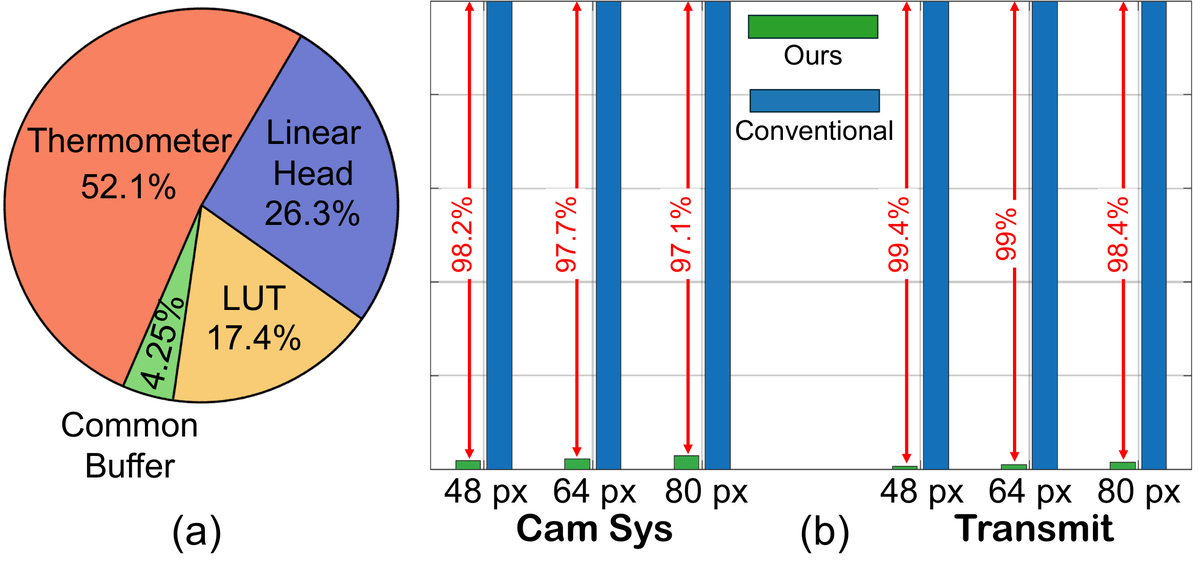
The full gaze pipeline takes a 56x56 eye image, downsamples with average pooling, applies a tanh activation, encodes into binary via thermometer encoding, hits the lookup tables, and finishes with a small linear head that outputs a 3D gaze vector. The entire estimator weighs in at around 9.6K parameters and 131 LUTs, running on the nRF52840 microcontroller in the Arduino Nano 33 BLE.
Union-of-ROIs mosaic
The gaze vector alone is not enough. Something has to translate "the user is looking here" into "send this specific crop to the detector." GLANCE handles that with a spatial fusion trick.
The DWN-based gaze estimator drives union-of-ROIs attention, and a periodic or conditional policy ships a single mosaic crop to the detector. The host forms a per-frame spatial union to produce one union-of-ROIs mosaic and maintains a temporal state to trigger YOLO under a periodic or budget policy. Rather than firing the detector on every frame, the system accumulates gaze-driven ROIs into a temporal buffer and only triggers full detection when the attention state changes meaningfully or a periodic budget window elapses.
The actual detector is YOLOv12n, the nano variant of a recent YOLO family. It stays unmodified. GLANCE acts as an attention front-end that decides when and where to invoke it.
Numbers on the board
Deployed on hardware, the results tilt the efficiency-accuracy tradeoff hard. Gaze predictions guide selective object detection on attended regions, cutting computational burden by 40-50% and energy consumption by 65%. On the Arduino Nano 33 BLE, the system achieves 48.1% mAP on COCO and 51.8% on attended objects while maintaining sub-10 ms latency, improving communication time by 177x.
Focusing on ROIs actually beats full-frame detection on accuracy, not just efficiency. Against the global YOLOv12n baseline, which achieves 39.2%, 63.4%, and 83.1% accuracy for small, medium, and large objects respectively, the ROI-based method yields 51.3%, 72.1%, and 88.1% under the same settings. The biggest gains are on small objects, where cropping effectively zooms into the detector's more favorable input scale.
| Object size | Global YOLOv12n | GLANCE ROI |
|---|---|---|
| Small | 39.2% | 51.3% |
| Medium | 63.4% | 72.1% |
| Large | 83.1% | 88.1% |

What is actually new here
The individual pieces (DWNs, YOLO, ROI cropping, gaze estimation) are not new. The contribution is the composition and the deployment target. To the authors' knowledge, this is the first application of weightless neural networks to real-time gaze estimation for attention-guided vision, demonstrating LUT-based inference as a viable, low-energy alternative to MAC-centric models. They also integrate explicit gaze with a memory-light ROI fusion mechanism that forms a single detector-ready mosaic, yielding a clearer efficiency-accuracy trade-off than learned-attention or saliency-only baselines.
A few things stand out for anyone building wearable vision systems:
- Gaze does not need a neural network in the traditional sense. Lookup-table models can hit useful angular error at kilobyte memory footprints.
- Attention front-ends deserve evaluation on whether they improve small-object accuracy through implicit zoom, not only on how much compute they save.
- The MCU-plus-host split is a viable pattern. Do gaze on the wearable, ship one small mosaic over BLE, and run the heavy detector where the power budget is looser.
Where it falls short
The 8.32 degree angular error is decent for a lookup-table model but well behind full CNN gaze estimators. It works here because the ROI is generous enough to tolerate that error. In tasks that need pixel-precise gaze, such as text reading or fine UI selection, the DWN estimator would not be enough on its own.
The detector is also still standard YOLOv12n running on a host, not on the microcontroller. GLANCE reduces how often and how much you send to it, but a heavier compute tier still sits somewhere in the loop. The paper does not appear to include a public code release, though the DWN framework it builds on is described in detail in the ICML 2024 paper for anyone who wants to reproduce the gaze pipeline.
For teams building smart glasses, AR headsets, or any always-on wearable camera, the direction is worth watching. Uniform processing of every frame pixel is a habit inherited from server-side vision. On a battery-powered device staring at a scene the user is only partially attending to, letting the eye pick the crop is both cheaper and, at least for small objects, more accurate.