
GigaAI's EMMA Boosts Robot Training Success by 92% Without Extra Data
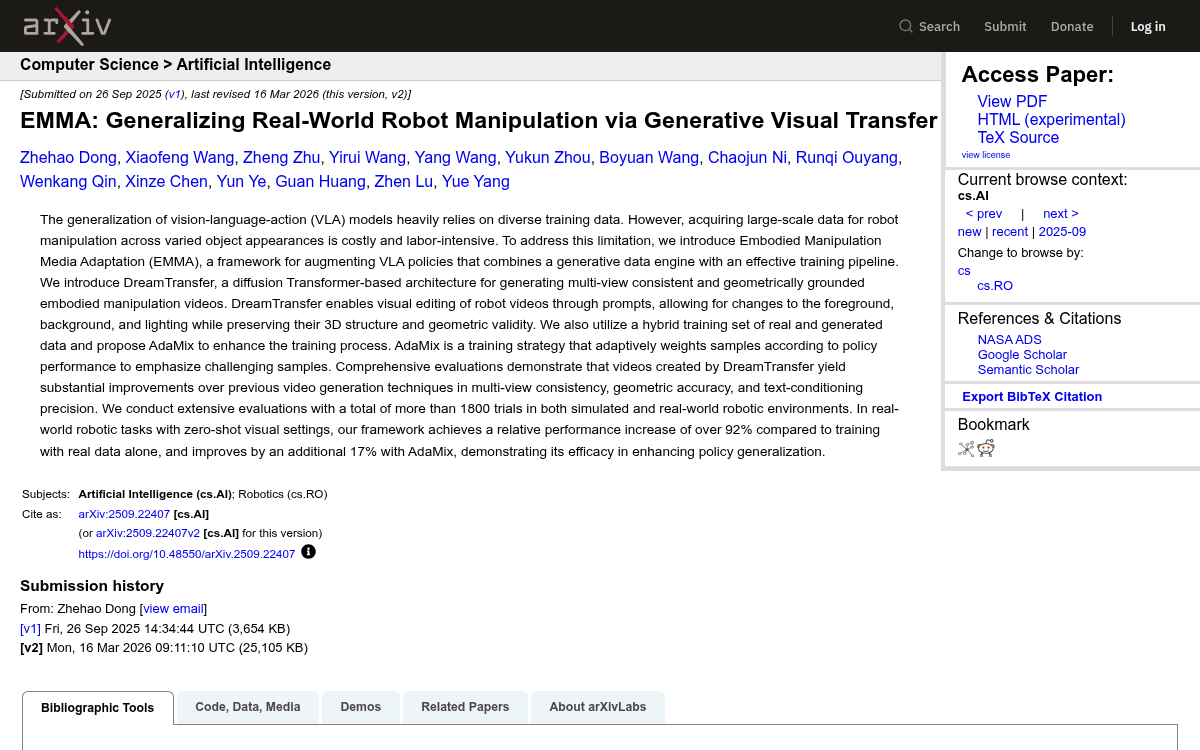
A new framework uses text-guided diffusion video generation and adaptive sampling to boost robot policy generalization by over 92 percent on zero-shot appearances.
 Pro
Takeaways
- EMMA framework pairs a diffusion video generator with adaptive sampling to boost VLA robot policy generalization.
- DreamTransfer edits robot videos via text while preserving multi-view 3D geometry.
- Achieves 42% better multi-view consistency and 24% better depth than prior SOTA models.
- Real-world zero-shot performance jumps over 92% versus training on real data alone.
- AdaMix reweights training toward hard samples using action MSE, smoothness, and joint limits.
- Trained in 131 hours on 4 H20 GPUs; validated across 1800+ real and simulated trials.
Training a robot to fold a white shirt is one thing. Getting it to fold a red plaid shirt it has never seen, in a different room, under different lighting, is another. Vision-language-action (VLA) models generally solve this with brute-force data collection through teleoperation, which is slow and expensive. A team from GigaAI, Peking University, Tsinghua, and CASIA is proposing a different route: generate the visual diversity synthetically, then teach the policy to focus on the hard cases.
Their framework, called EMMA (Embodied Manipulation Media Adaptation), combines two components. DreamTransfer is a diffusion transformer that rewrites the appearance of robot demonstration videos through text prompts while keeping the underlying 3D geometry intact. AdaMix is a training strategy that adaptively re-weights samples based on how badly the policy is currently failing on them. Together, the framework achieves a relative performance increase of over 92% compared to training with real data alone, and improves by an additional 17% with AdaMix on zero-shot visual settings.
The data bottleneck nobody has cracked
Vision-language-action models increasingly rely on diverse training data to achieve robust generalization, but collecting large-scale real-world robot manipulation data across varied object appearances and environmental conditions remains prohibitively time-consuming and expensive. Simulation helps but introduces its own gap: photorealism and asset diversity in simulators lag behind the real world, so policies trained purely on sim tend to fall apart when deployed.
Prior generative approaches have chipped away at this. Cosmos-Transfer1 generates realistic scenes conditioned on segmentation and depth, but only in a single view. RoboTransfer handles multi-view generation using depth and surface normals, but is conditioned on images rather than text, which limits how easily you can request specific edits. The gap EMMA targets is a system that is simultaneously multi-view consistent, geometrically grounded, and controllable through natural language.
Inside DreamTransfer
DreamTransfer is built on a dual-branch diffusion transformer architecture. The main branch denoises latent video tokens, while a parallel ControlNet branch injects depth-based structural guidance to enforce geometric consistency. To handle multiple cameras, the team concatenates synchronized depth videos from different viewpoints along the width dimension before encoding them into a unified latent through a VAE. A T5 text encoder produces prompt embeddings that are fused via cross-attention, giving fine-grained control over object appearance.
The pipeline works roughly like this:
- Take a real or simulated robot demo recorded from three synchronized cameras at 640x480.
- Concatenate views into a single 1920x480 frame and extract per-frame depth using Video Depth Anything.
- Feed the depth stack plus a text prompt describing the desired foreground, background, and lighting into the DiT.
- Generate a 121-frame multi-view video where 3D structure matches the original but the appearance follows the prompt.
- Filter outputs using multi-view consistency, depth error, and CLIP similarity thresholds before training.
Training data came from 50k multi-view clips built on top of the Agibot World dataset covering 36 scenes, with captions auto-generated by Qwen2.5-VL following a structured template that separately describes foreground, background, and lighting. A two-stage fine-tuning recipe first learns multi-view geometry at 576x128, then adapts to 1920x480 for high-fidelity output. The full run takes 131 hours on 4 NVIDIA H20 GPUs, compared to 336 hours on 1024 H100s for Cosmos-Transfer1.
AdaMix: teaching the policy to focus on what it's bad at
Generating diverse videos is only half the story. The authors observed that even after extensive fine-tuning on real plus generated data, VLA models still produced errors on their own training set, suggesting uniform sampling wasn't giving enough attention to long-tail cases.
AdaMix scores every sample using three trajectory-quality signals:
- Action MSE: squared error between the predicted and ground-truth action chunk.
- Smoothness: penalizes abrupt joint motions via the second-order difference of joint angles.
- Joint limitation: a binary flag that goes to zero if any joint exceeds safe angle thresholds.
These are min-max normalized, combined with equal weights into a per-sample score, and then plugged into a sampling probability of the form p(i) ∝ γ + λ·(1 - s_i). Hard samples get up-weighted while γ keeps every sample in the running. Ablations settled on γ=1, λ=10. A video quality filter runs first, dropping around 5 to 8 percent of generated clips that fail thresholds on pixel matching, depth error, or CLIP similarity, so garbage never enters the mix.
The numbers
Evaluation covered more than 1800 trials across three real-world tasks (Fold Clothes, Clean Desk, Throw Bottle) and one simulated task (Stack Bowls Two), running on an Agilex CobotMagic platform with two PiPER arms and three Intel RealSense D435i cameras. Base policies were π0 and π0.5, fine-tuned from open-source weights.
On generation quality, DreamTransfer beat both baselines across almost every metric:
| Model | Pixel Match | Sq.Rel. Depth | CLIP Sim. |
|---|---|---|---|
| RoboTransfer | 2298 | 1.30 | 23.94 |
| Cosmos-Transfer1 | 2097 | 0.71 | 24.61 |
| DreamTransfer | 3270 | 0.54 | 24.68 |
That's a 42 percent improvement in multi-view pixel matching and a 24 percent reduction in squared relative depth error over the next best model. On downstream policy performance, Fold Clothes success under π0 jumped from 10 percent (real data only) to 65 percent with DreamTransfer augmentation, then to 77.5 percent with AdaMix layered on top. Averaged across all three real tasks, AdaMix delivered an additional 10.9 percent success rate over uniform sampling for π0, plus faster execution and fewer joint-limit violations.
The team also tested whether the gains came from more data or better data. Adding real demonstrations up to 100 samples on Clean Desk did not match the improvement from mixing 20 real with 20 generated samples, indicating the diversity itself is what matters, not the count.
Where it actually helps and where it doesn't
The sweet spot for the real-to-generated mixing ratio was 50/50. Push past that toward 90 percent generated and precision-critical tasks like Throw Bottle regress, likely because subtle physical inaccuracies in synthesized frames start to bleed into the policy. This is where the quality filter earns its place.
The main limitation is depth estimation. DreamTransfer depends on off-the-shelf video depth estimation, which struggles with fast-moving objects, reflective materials, transparent surfaces, and large uniform-color regions. When depth is wrong, the generated video inherits artifacts. The quality filter catches most of these cases, but the ceiling on what can be generated is tied to the ceiling of the depth model.
What is different here
The real breakthrough is bringing three properties into one system that had previously been achievable only in pairs: multi-view consistency, geometric grounding, and text-driven appearance control. Combined with an adaptive sampler that treats generated data as training curriculum rather than static augmentation, this shifts the economics of VLA training. Instead of collecting thousands of demonstrations for each new object color, texture, or background, a lab can record a small set of demos and let a diffusion model spin them into visually diverse variants that still respect the physics of the original trajectory.
Code has not been released as of the current preprint, though the project page hosts qualitative results and generated videos. For teams already invested in π0-style architectures or working with limited teleoperation budgets, this is a template worth studying, particularly the combination of quality filtering plus difficulty-aware reweighting, which is orthogonal to whichever video generator you happen to use.