
Ghent University's BenDFM Gives AI 20,000 CAD Parts It Can't Build
A new 20,000-part synthetic CAD benchmark tackles a gap in deep learning for Design for Manufacturing, focused specifically on sheet metal bending feasibility.
 Pro
Takeaways
- BenDFM releases 20,000 synthetic sheet metal bending parts with both feasible and infeasible designs, on Zenodo.
- A new taxonomy splits manufacturability labels along configuration dependence and discrete-versus-continuous measurement axes.
- Two subsets: 14,000 parts for tooling collision tasks, 6,000 for unfolding overlap tasks, each balanced 50/50.
- UV-Net beats PointNeXt across all four tasks, reaching 81.80% accuracy on unfolding overlap detection.
- Configurational metrics tied to specific tooling remain harder to predict than pure geometric ones.
- Code, precomputed graphs and point clouds available on GitHub under MIT license.
Deep learning for CAD has mostly focused on classifying what a part looks like or which manufacturing family it belongs to. A much harder question, whether a given design can actually be built on a specific machine, and how much effort it will take, has stayed out of reach because the field lacks agreed-upon labels and datasets that include failed designs. A new paper from Ghent University tries to fix both problems at once with BenDFM, a synthetic dataset built specifically for sheet metal bending.
Why manufacturability prediction has been stuck
Predicting the manufacturability of CAD designs early, in terms of both feasibility and required effort, is a key goal of Design for Manufacturing. Despite advances in deep learning for CAD and its widespread use in manufacturing process selection, learning-based approaches for predicting manufacturability within a specific process remain limited. The authors point to two structural problems that keep the area small.
The first is definitional. Existing labels vary significantly: they may reflect intrinsic design constraints or depend on specific manufacturing capabilities (such as available tools), and they range from discrete feasibility checks to continuous complexity measures. The second is data. Industrial datasets typically contain only manufacturable parts, offering little signal for infeasible cases, while existing synthetic datasets focus on simple geometries and subtractive processes. A model that never sees a broken design cannot learn to recognize one.
A taxonomy that untangles the labels
Before shipping data, the authors propose a two-axis taxonomy for manufacturability metrics:
- Configuration dependence: does the label depend on the specific shop setup (tools, dies, machine reach), or only on the geometry of the part itself?
- Measurement type: is the label a discrete feasibility check (can it be made, yes or no), or a continuous complexity measure (how much effort)?
That gives four quadrants. A part that self-collides when unfolded is a geometric feasibility failure; a part that a specific press brake cannot reach around is a configurational feasibility failure. The unfolded bounding area is a geometric complexity signal; the number of part flips a worker must perform is a configurational complexity signal. Each of these ends up as a separate learning target in the dataset.
How the dataset is built
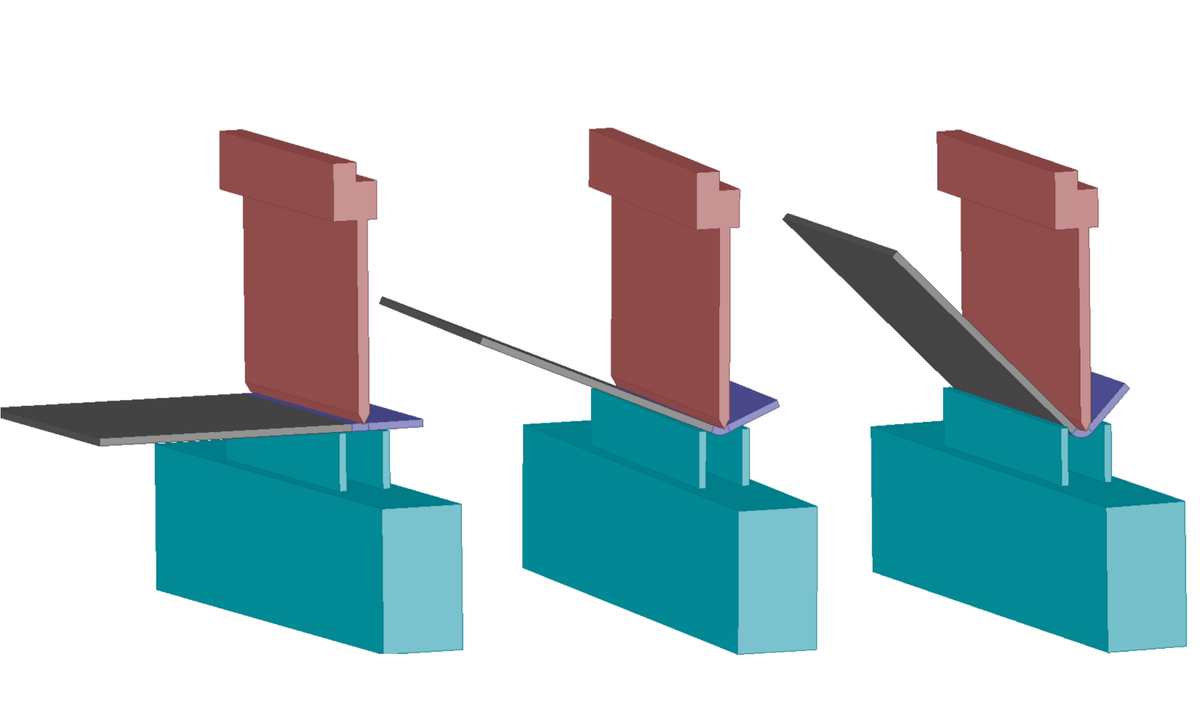
Dataset creation is based on emulating sheet metal bending operations through parametric CAD modeling using PythonOCC. The generation process is guided by two main objectives. The first is to produce a geometrically diverse set of designs that represent the practical design space in sheet metal bending. The second is to provide accurate manufacturability labels, including both feasible and infeasible designs, that span the four quadrants of our taxonomy. Geometric diversity is achieved by stochastic sampling of parameters such as bend angles, radii, and bend sequences. Manufacturability labeling is accomplished by logging geometric metrics and simulating bend operations with parametrically defined tooling.

The public release ships 20,000 unique bent parts in STEP format, split into two subsets tuned for different tasks:
- BenDFM: 14,000 parts with 2 to 8 bends, balanced 50/50 for tooling collisions, all guaranteed free of unfolding overlaps.
- BenDFM-U: 6,000 parts with 7 to 10 bends, balanced 50/50 for unfolding overlaps.
Generation parameters cover sheet dimensions of 150 to 300 mm, thicknesses of 2 to 6 mm, bend angles drawn from a set biased toward 90 degrees, and bend radii of 1.0 to 1.5 times the sheet thickness. Each part ships with the folded STEP, the unfolded STEP, a JSON bend sequence, and a JSON label file. Precomputed point clouds and UV-grid DGL graphs are included so you can go straight to training.
Benchmarks: graphs beat point clouds
The authors evaluate two representative architectures. UV-Net, a foundational architecture for B-rep learning that has inspired many subsequent models in manufacturing applications, operates by sampling points on each face and edge within their native parametric domains. Faces become nodes in a graph, adjacencies become edges, and surface properties become attributes. PointNeXt, the other baseline, works on point clouds sampled from the same geometry and ignores that topology.
Across every task, the graph representation wins:
| Task | Metric | UV-Net | PointNeXt |
|---|---|---|---|
| Tooling collision (configurational feasibility) | AUC / Acc | 0.840 / 76.07% | 0.827 / 73.83% |
| Unfolding overlap (geometric feasibility) | AUC / Acc | 0.896 / 81.80% | 0.844 / 76.13% |
| Part flips (configurational complexity) | MAE / MAPE | 0.54 / 35.52% | 0.59 / 39.33% |
| Unfolded bounding area (geometric complexity) | MAE / MAPE | 14.60 / 5.90% | 20.24 / 8.28% |
Two patterns show up consistently. Both models exhibit stronger performance on geometric feasibility compared to configurational feasibility. And graph-based methods that preserve which faces touch which other faces beat point-cloud methods that throw that information away. The takeaway for anyone building DFM tooling: if you already have B-rep data from a CAD kernel, discretizing it to a point cloud is leaving accuracy on the table.
What it is good for, and where it falls short
BenDFM is useful if you are building a manufacturability screen for a CAD tool, a quoting system that needs an effort estimate for bent parts, or a research baseline for B-rep learning that goes beyond feature recognition. Because it includes infeasible parts and both folded and unfolded geometries, it supports tasks that industrial datasets cannot, notably learning to reject a design and learning to predict complexity from the flat pattern alone.
The limits are equally clear. The dataset is synthetic and covers a single process. The bend angles are drawn from a discrete set biased toward 90 degrees, and the tooling model is parametric rather than tied to a real machine catalog. Configurational metrics remain the harder learning target, so any model trained here still has to be validated on real shop data before it is trusted to price jobs. A companion paper introducing FoV-Net has already used BenDFM to show both B-rep learning architectures substantially outperform the baseline, demonstrating that geometric representations extracted from CAD models provide strong signals for detecting bending collisions. Consistent with the regression results, FoV-Net achieves higher accuracy than UV-Net, highlighting the advantages of rotation-invariant representations when learning directly from CAD geometry.
Code, sample files, and training scripts for both UV-Net and PointNeXt live on GitHub under an MIT license, with the full dataset hosted on Zenodo. The journal version is out in the Journal of Intelligent Manufacturing.