
German Researchers' C3TL Beats Billion-Parameter AI Models at Predicting Drug Responses 30x Faster
A compact autoencoder rivals billion-parameter foundation models at predicting how cells respond to drugs and gene edits, using only bulk RNA data.
 Pro
Takeaways
- C3TL predicts cell responses to unseen perturbations using bulk RNA data instead of single-cell atlases (paper).
- Matches or beats the State foundation model on Tahoe-100, Replogle and Parse benchmarks.
- Runs roughly 30 times faster per epoch and uses about 9 times less GPU memory than State.
- Built on a Causal Manifold Assumption: additive latent vectors for perturbation and context.
- Strongest advantage appears in low-data regimes with only 10 to 100 perturbations per new context.
- No public code release yet, and it targets pseudo-bulk profiles rather than single-cell heterogeneity.
Predicting how a cell will respond to a drug or a gene knockout is one of the most valuable open problems in computational biology. The dominant approach lately has been to throw ever-larger transformers at ever-larger single-cell atlases. A new paper from researchers at the German Center for Neurodegenerative Diseases argues that a much smaller, theoretically-motivated architecture can match those foundation models, using bulk gene expression data that most labs already have.
The system is called Causal Cellular Context Transfer Learning, or C3TL. It runs roughly 30 times faster per epoch than the current state-of-the-art foundation model, uses about 9 times less GPU memory, and can be trained without a GPU at all in reasonable time.
The context problem
The same perturbation, such as knockout of a specific gene or treatment with a specific chemical compound, may induce quite different changes in cells of type A or B, or in different genetic backgrounds. That context-dependence is what makes brute-force experimentation infeasible: you cannot screen every drug against every cell line in every disease state.
Recent work has tried to solve this with massive models. Prominent examples include scGPT and the State model, based on transformers and related architectures, trained on comprehensive single-cell atlases to predict responses across diverse biological contexts. These models rely on architectures with over a billion parameters and extensive GPU clusters. They also depend on single-cell RNA sequencing data, which is high in technical noise, sparse, and significantly more expensive than traditional bulk RNA sequencing.
The authors bet on the opposite direction: bulk expression profiles averaged across cell populations, combined with an architecture that bakes in the structure of the problem.
A causal manifold, not a giant transformer
The theoretical core is what the paper calls the Causal Manifold Assumption. The idea is that every perturbation has a general position in a low-dimensional latent space, and each cellular context shifts that position by a linear vector. The observable gene expression change is then a non-linear function of the sum of those two latent vectors.
That structure suggests a clean encoder-decoder recipe:
- An encoder for the perturbation that pools information across all the contexts where that perturbation has been observed.
- An encoder for the context that pools information across all perturbations observed in that context.
- A decoder that adds the two latent vectors and maps the sum back to gene expression space.
Crucially, the perturbation encoder is forced to be context-invariant: its output for perturbation p must be identical whether it looks at data from cell line A or cell line B. This is the inductive bias that lets the model generalize to a novel context where it has never seen a specific perturbation before.
How training actually works
Concretely, the architecture uses one-hot encodings for perturbation and cell line identities, then builds latent representations by averaging over contexts (or perturbations) with a shared neural network. In pseudocode-ish form:
z_p   = mean over contexts gamma of Theta_z(x_p^gamma, psi_gamma)
psi_c = mean over perts pi   of Theta_psi(x_pi^c, z_pi)
x_hat = Gamma(z_p + psi_c)
The whole thing is trained end-to-end with plain L2 loss against observed bulk expression differences (perturbed minus unperturbed). No adversarial alignment, no massive pretraining, no transformer stacks.
Benchmarks against the heavy hitters
The authors evaluated on three recent large-scale perturbation datasets covering different intervention types:
- Tahoe-100: compound perturbations across 48 cell lines with 1138 perturbations each.
- Replogle: genetic perturbations, 1677 perturbations but only 4 contexts.
- Parse: signaling perturbations across 24 contexts with 90 perturbations each.
Although these are single-cell datasets, the authors pseudo-bulk the data by computing the mean gene expression profile across all single cells for each perturbation and cell line combination. Metrics are computed only on perturbations that the model has never seen in the target context.
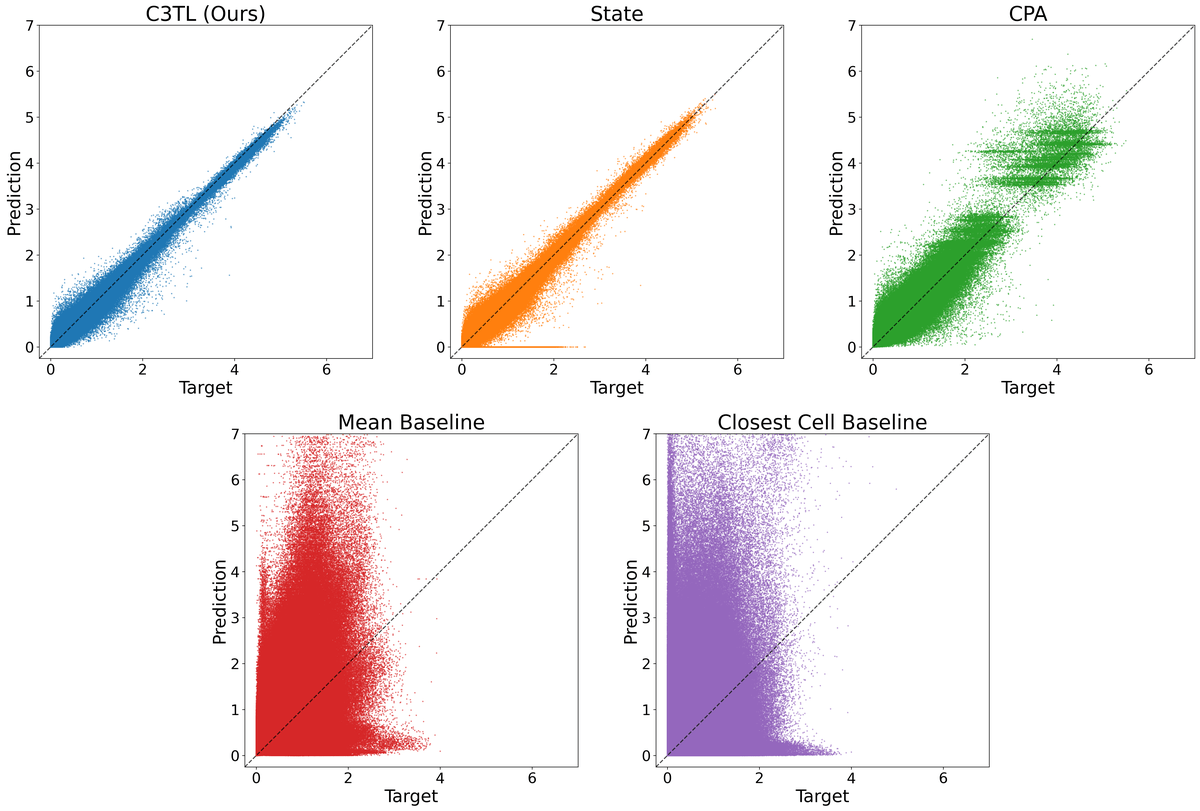
Head-to-head against the State foundation model and CPA:
| Dataset | C3TL correlation | State correlation | C3TL epoch | State epoch |
|---|---|---|---|---|
| Replogle | 0.491 | 0.474 | 0.25s | 10s |
| Parse | 0.670 | 0.608 | 0.11s | 5.4s |
| Tahoe | 0.777 | 0.778 | 1.7s | 59s |
C3TL either wins or ties on Pearson correlation across all three, while running an order of magnitude faster. State uses approximately 19.8GB of GPU memory, CPA uses about 0.5GB, and C3TL uses about 2.1GB, making it roughly 9 times more memory efficient than State. CPA collapses on this task, with correlations near zero on Replogle and Parse.
Where it really shines: data scarcity
The more interesting result comes from the data-limited experiments. The authors systematically shrank both the number of training contexts and the number of perturbations available for adaptation in the target context.
Both State and C3TL exhibit robustness to data scarcity, but C3TL shows a distinct advantage in the extremely scarce regime with 5 training contexts and only 1% of interventions available for adaptation in the target context. Within the Tahoe atlas, a very small number of observations (10 to 100 perturbations) in a target context is sufficient for the model to generate reliable predictions.
This is the regime that matters for most real biomedical work. Comprehensive atlases like Tahoe are not what the average lab has, and the ability to adapt from a handful of measurements to a new patient sample, disease state, or engineered cell line is where in-silico perturbation prediction actually earns its keep.
What the breakthrough really is
The headline story is efficiency: matching a foundation model with a fraction of the parameters and compute. The deeper contribution is a proof that the right inductive bias, context-invariant pooling combined with additive latent structure, is enough to solve a task the field has been attacking with brute force. The authors show mathematically that under their causal manifold assumption, the L2 objective has the correct global minimum, which is a stronger guarantee than most generative perturbation models offer.
Caveats and open questions
A few things to keep in mind before reaching for this in a pipeline:
- No public code repository is referenced in the paper, so anyone wanting to use C3TL will need to reimplement the architecture from the description.
- The model targets pseudo-bulk profiles, so it cannot say anything about cell-to-cell heterogeneity within a population. If your question is about rare subpopulations, single-cell foundation models remain the appropriate tool.
- The theory guarantees the existence of the required functions but does not provide finite-sample learning bounds, which the authors flag as future work.
- Every perturbation of interest must have been observed in at least some contexts. This is not a zero-shot method for genuinely novel compounds or gene targets.
For teams building drug screening pipelines, disease-specific perturbation models, or active-learning loops where a model proposes the next experiment, the argument is clear: the extra performance of a billion-parameter model may not be worth the infrastructure overhead when a properly-structured smaller model can match it on bulk data. The paper is a useful reminder that in biomedicine, the right assumptions still beat raw scale.