
Georgia Tech's V3Fusion Beats the Best Single Vision AI Model by 8%
V3Fusion uses vision and language diversity metrics to prune a pool of VLMs, fuse their answers, and beat the strongest single model by up to 8%.
 Pro
Takeaways
- V3Fusion ensembles VLMs using both visual embedding diversity (Focal-CKA) and output error diversity.
- Beats the best single VLM by 8.09% on MMMU and 4.87% on MMMU-Pro accuracy.
- Genetic algorithm prunes ensemble candidates in under a minute versus hours for brute force.
- Uses V3Fusion-MLP for multiple choice and V3Fusion-LED (149M params) for open-ended VQA.
- Epistemic uncertainty threshold rejects hallucinations without needing an external LLM judge.
- Code, data, and inference dumps released at github.com/sftekin/v3fusion.
Most work on combining multiple vision-language models has treated them as text producers: prompt each one, take the majority vote, or route the query to the best guess. A new framework from researchers at Georgia Tech and Cisco argues that this misses half the picture. If two VLMs look at the same image and encode it in nearly identical ways, ensembling them adds no information, no matter how different their words sound. V3Fusion introduces diversity metrics for both the visual embeddings and the textual errors, then uses those signals to pick and fuse a small team of models that outperforms the best single VLM.
Why voting across VLMs quietly fails
VLMs are lopsided experts. The authors show that on MMMU subjects like Psychology, Math, Electronics, and Art, the ranking of six popular open-source VLMs reshuffles from category to category. DeepSeek-VL2-small wins on Psychology but drops to third on Electronics, and similar swings appear for InternVL2 and Qwen. That is exactly the setup where ensembling should help, except for one catch: models sharing the same architecture have highly correlated errors, meaning a naive pool wastes budget on redundant opinions.

The paper frames three concrete failure modes for existing ensemble, routing, and debate methods: majority-vote failure modes when most models agree on the wrong answer, hallucinations that go undetected without a good uncertainty signal, and the exponential blow-up in candidate combinations (a pool of N models produces 2^N minus N minus 1 possible teams). Prior work like multi-agent debate or LLM judges tries to fix the first two with more prompting, which is slow and prompt-sensitive, and none of them look at the visual encoder at all.
A five-stage pipeline built on two diversity scores
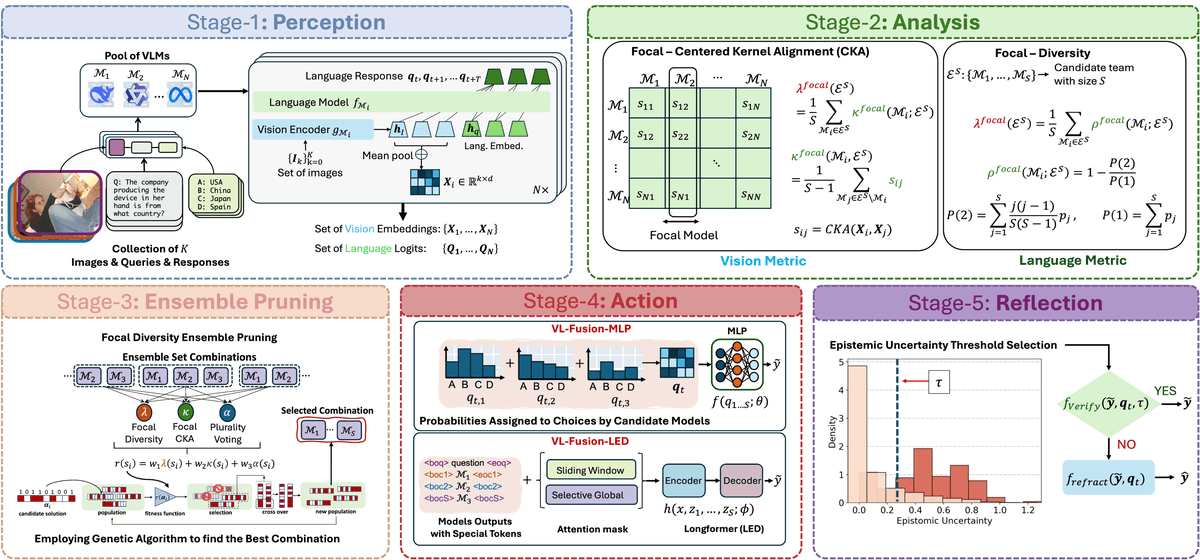
V3Fusion is structured as a perception, analysis, pruning, action, and verification pipeline. The heart of it lives in two new metrics:
- Focal-CKA measures how differently the visual encoders in an ensemble see the same images. The team hooks each VLM's visual encoder, mean-pools the vision tokens, and computes Centered Kernel Alignment between models. CKA is invariant to orthogonal transforms and works across different embedding dimensions, which matters because each ViT uses different patch sizes and pooling. A focal model is chosen inside the ensemble, average pairwise CKA against the other members is computed, and the score is inverted so higher means more diverse visual understanding. Critically, only the episodes where the focal model was wrong are used, so the metric captures disagreement on errors, not on everything.
- Focal error diversity plays the same trick on outputs. For each focal member, it computes the ratio of the probability that two random ensemble members fail together to the probability that one fails, averaged across all focal choices. When failures are perfectly correlated the score is 0, when there is no co-failure it is 1.

Plotting every possible sub-ensemble on those two axes produces a surface with a clear ridge where accuracy peaks. Both metrics correlate positively with ensemble accuracy, and many teams of size 2 to 4 beat the full 6-model ensemble, which is the whole justification for pruning. Brute-force scoring every subset explodes fast: for N equal to 20 there are over a million candidate teams. A genetic algorithm using the average of the two focal scores as its fitness function finds the peak in under a minute for N equal to 20, versus more than 16,000 seconds for brute force, a 99.66% latency cut.
Two fusion heads for two question types
Once a team is chosen, V3Fusion fuses their answers with one of two learned models:
- V3Fusion-MLP handles multiple-choice. Each VLM emits a probability over the answer choices (aggregated from the token probabilities that spell out each option). The MLP concatenates these into a single vector and learns to spot patterns across models, including cases where a middling model quietly assigns non-trivial mass to the correct option that stronger models missed.
- V3Fusion-LED handles open-ended answers. It is a Longformer Encoder-Decoder initialized from BART weights with roughly 149M parameters, taking the question plus the concatenated candidate outputs (wrapped in per-model separator tokens) and generating a fused answer. Sliding-window attention plus selective global attention on the question tokens pushes context length to 16,396 while keeping compute tractable.
The final stage handles hallucinations. V3Fusion estimates epistemic uncertainty as the mutual information between the label and model identity, computed as the entropy of the ensemble prediction minus the mean per-model entropy. To decide when to reject an answer, it fits both a single Gaussian and a two-component Gaussian mixture to the observed uncertainties, runs a likelihood-ratio test, and picks a threshold either at the cluster boundary or at mean plus two standard deviations. Rejected samples fall back to a simple averaged-logit prediction.
What the numbers say
V3Fusion was evaluated on four benchmarks: MMMU, MMMU-Pro, A-OKVQA (multiple choice), and OCR-VQA (open ended). Against a pool that includes LLaVA-v1.6, DeepSeek-VL2, Qwen2.5-VL-7B, and InternVL2-8B, the fused system beats the best individual model by 8.09% on MMMU and 4.87% on MMMU-Pro, with a 2.85% F1 gain on OCR-VQA. Compared to baselines, it lands at 56.09% on MMMU versus 54.8% for multi-agent debate with a judge, and 89.17% on A-OKVQA versus 81.83% for RouteLLM, at 3.28 seconds inference time versus roughly 22 to 28 seconds for the debate methods.
An ablation confirms that all three stages matter: pruning alone or fusion alone give inconsistent gains, but combining pruning, fusion, and rectification is the only configuration that improves every dataset. Comparing Focal-Diversity against Fleiss kappa, binary disagreement, binary entropy, and correlation coefficient for pruning shows the focal metric picks the best team on both MMMU and A-OKVQA.

When to reach for it, and when not to
V3Fusion is a good fit when you have several sub-16B open VLMs already in your inference stack and want a supervised way to squeeze more accuracy out of them without paying for a bigger model. It is also useful in settings that need calibrated abstention, because the epistemic-uncertainty gate is a self-contained rejection mechanism with no external LLM judge. The training footprint is light: with 5% of the OCR-VQA training set the LED head already reaches 82 BLEU-1, and training runs in about 35 minutes versus 1.47 hours for supervised fine-tuning of Qwen2.5-VL-7B.
The trade-offs are real. Inference requires loading the pruned pool in parallel, and memory usage climbs to about 54 GB in the reported setup, which is more than any single member. The framework is also supervised, so it needs a validation set with labels to compute focal scores and train the MLP or LED. And because CKA and focal diversity are estimated from a candidate dataset, distribution shift at deployment can move the peak on the ensemble surface. Full code, inference dumps for the four benchmarks, and training scripts are available on the project's GitHub repository.