
Georgia Tech's SFPO Beats GRPO on Math Reasoning With 4.93x Fewer Rollouts
A new three-stage twist on GRPO cuts rollouts by up to 4.93x and matches best accuracy in a fraction of the wall-clock time.
 Pro
Takeaways
- SFPO restructures GRPO's single update into a fast-reposition-slow three-stage sequence, reusing rollouts safely.
- Up to 2.80 point average accuracy gain over GRPO across math reasoning benchmarks like AIME24 and AIME25.
- Requires up to 4.93x fewer rollouts and cuts wall-clock training time by up to 4.19x.
- Drop-in compatible with GRPO and DAPO, no changes to loss, KL, or rollouts.
- Adaptive entropy-triggered schedule disables interpolation near convergence to prevent late-stage instability.
- Code released at github.com/Urheen/SFPO; also validated on LiveCodeBench coding tasks.
Reinforcement learning has become the workhorse behind reasoning models like DeepSeek-R1, but the algorithm most teams reach for, Group Relative Policy Optimization (GRPO), has a well-known ugly phase. Early in training, when rollouts are still weak, the reward signal is noisy, the gradient estimate wobbles, and each update wastes an expensive batch of generations. A team from Georgia Tech, UIUC, Manchester, NVIDIA, and Emory has proposed Slow-Fast Policy Optimization (SFPO), a drop-in replacement for GRPO's update rule that reuses each rollout batch more aggressively while keeping the policy anchored to safe territory.
The headline numbers are the kind that get attention from anyone paying an RL bill: up to 2.80 average points higher on math reasoning benchmarks than GRPO, up to 4.93x fewer rollouts, and up to 4.19x lower wall-clock time to hit GRPO's peak accuracy. Code is available on the SFPO GitHub repo.
Why GRPO stumbles out of the gate
GRPO trains a policy by sampling a group of candidate responses per prompt, computing rewards, and using the mean and standard deviation across the group to compute a normalized advantage for each response. This gets rid of the value model that PPO needs, which is why it took over LLM reasoning pipelines after DeepSeekMath. But GRPO still does one stochastic gradient step per rollout batch, and that single step is the whole problem.
When the model's answers are mostly wrong or mostly identical, the group-normalized advantage carries very little signal. A single noisy gradient in that setting can push the policy in a bad direction, and the batch of rollouts, which took most of the step's compute, gets thrown away. The paper points out that rollout generation eats over 70% of per-step time in typical setups, so wasting a batch is expensive.
Fast, reposition, slow
SFPO's fix is to restructure a single GRPO step into three phases without changing the loss, the rollout process, or the KL and clipping regularizers.

- Fast trajectory. Instead of one gradient step, take K sequential inner steps on the exact same rollout batch. The idea is that noise in individual gradients partially cancels when you compose several updates, giving a more reliable overall direction. Think of it as integrating along a short path in parameter space instead of trusting one noisy arrow.
- Reposition. Those K steps drift the parameters away from the distribution that generated the rollouts, which makes the update effectively off-policy. To counter this, SFPO interpolates the endpoint back toward the starting point with a mixing coefficient alpha between 0 and 1. Smaller alpha means a shorter, safer step; larger alpha commits more to the fast trajectory. Mathematically this is equivalent to a proximal update with alpha acting as an implicit trust-region radius, an idea borrowed from Lookahead Optimization.
- Slow correction. Take one final gradient step from the interpolated point. This is a predictor-corrector style move that realigns the update with the local curvature at the new location.
There is one more clever bit. Alpha is scheduled adaptively based on policy entropy. The algorithm tracks a rolling z-score of entropy across recent steps, and once entropy starts swinging sharply, the system flips alpha to 0 for the remainder of training, effectively reverting to plain GRPO. The intuition is that near a minimum, the extra aggressiveness of the fast trajectory does more harm than good, so SFPO gets out of its own way.
The numbers
The team tested SFPO on five base models spanning Qwen2.5-Math-1.5B/7B, DeepSeek-R1-Distill-Qwen-1.5B/7B, and Qwen3-4B-Base, evaluated across Math-500, AIME24, AIME25, AMC, MinervaMath, and OlympiadBench. SFPO beat GRPO on every model and on nearly every benchmark. The biggest jumps came on the hardest problems: DeepSeek-R1-Distill-Qwen-1.5B gained 7.5 points on AIME25 (23.33 to 30.83), and DeepSeek-R1-Distill-Qwen-7B jumped from 60.47 to 63.04 average accuracy.

The efficiency story is arguably more important than the accuracy delta. To match GRPO's best accuracy, SFPO needed 3.21x, 3.50x, and 4.93x fewer rollouts on the 1.5B, 4B, and 7B models respectively, translating to 2.62x, 2.65x, and 4.19x wall-clock speedups. Per-step compute goes up slightly (about 1.37x, since Stage I adds inner steps) but that overhead is dwarfed by the fewer total steps needed. GPU memory stays flat because SFPO doesn't store additional optimizer states, only one copy of model weights.
Where the breakthrough actually is
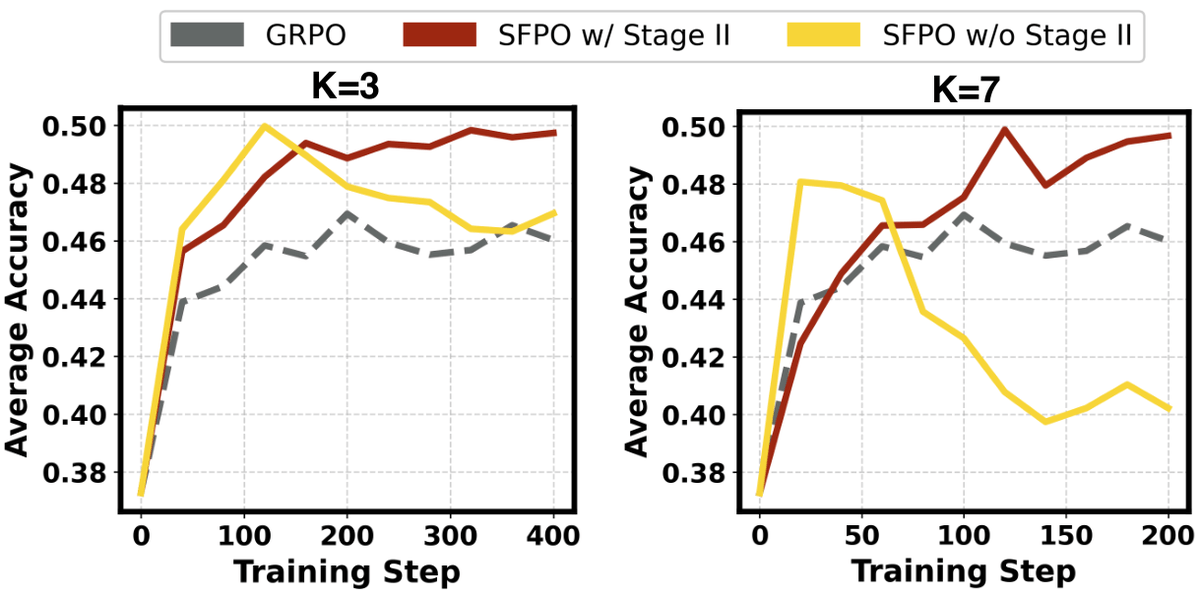
The real contribution isn't just a benchmark bump, it's the observation that reusing rollouts multiple times only works if you also anchor the update. Prior attempts to run multi-step off-policy updates on GRPO batches often degraded performance as training progressed. SFPO shows that the interpolation-based reposition is what makes multi-step reuse actually stable. Ablations confirm that with K=7 inner steps and no reposition, training collapses; with reposition, it keeps improving.
Because SFPO doesn't touch the objective, KL regularization, or rollout procedure, it sits on top of any GRPO-family method. The authors also test it on top of DAPO and find further gains, reaching target accuracy roughly 225 steps earlier on the 1.5B model. They also validated it on coding tasks with LiveCodeBench, where it lifted Pass@1 from 18.91 to 21.77.
When to use it, and when not to
- Use it if you are already running GRPO or DAPO for reasoning RL and rollout generation is your bottleneck. The changes are localized to the update loop.
- Tune K and alpha together. Small K (around 3) with moderately large alpha (around 0.8) works for math; larger K (7) needs smaller alpha (0.2) to avoid off-policy drift.
- Watch entropy. Without the adaptive alpha schedule, training accuracy drops after roughly 100 steps as entropy diverges, so the entropy trigger is not optional.
- Limitations. Gains are demonstrated primarily on math and a single coding benchmark. SFPO also inherits GRPO's core assumptions, so if your reward signal is fundamentally broken, more inner steps just amplify garbage faster.
SFPO is a rare kind of RL contribution: no exotic objective, no new reward model, no architecture changes. Just a structured way to squeeze more reliable gradient direction out of every batch of rollouts you already paid for.