
Georgia Tech's REFINE-DP Teaches Humanoid Robots Door Tasks With 20x Less Data
Georgia Tech's REFINE-DP jointly retrains diffusion planners and RL controllers with PPO, hitting 90%+ success on humanoid loco-manipulation using 20x less demo data.
 Pro
Takeaways
- REFINE-DP jointly fine-tunes a diffusion motion planner and RL controller via PPO for humanoid loco-manipulation.
- Achieves over 90% success on door traversal, pick-and-place, and stair retrieval tasks.
- Reaches 95-97% success from 50 demos, a 20x data reduction versus training from scratch.
- Joint controller optimization halves fine-tuning iterations (20 vs 40) to reach 90% success.
- Cuts orientation tracking error by up to 50% and end-effector velocity by 15%.
- Validated on Booster T1 humanoid (29 DoF); code not yet released.
Getting a humanoid robot to walk up to a door, open it, and stroll through sounds simple until you realize how many things have to line up. The upper body has to grab a handle while the legs keep the whole thing balanced, and the plan for what to do next has to account for what the body is actually capable of doing right now. A new paper out of Georgia Tech's Institute for Robotics and Intelligent Machines proposes REFINE-DP, a training recipe that fine-tunes a diffusion-based motion planner and a reinforcement learning controller together, and reports over 90% success on tasks where pre-trained baselines regularly fall apart.
Why offline diffusion policies keep tripping over themselves
Diffusion policies have become a popular way to teach robots skills from human demonstrations. You collect trajectories, train a diffusion model to generate action sequences conditioned on observations, and let it run. On tabletop manipulators this works reasonably well. On a 29-degree-of-freedom humanoid, it falls apart.
The reason is a two-layer mismatch. The high-level planner is trained offline and decoupled from the low-level controller, which leads to poor command tracking, compounding distribution shift, and task failures. In plain terms: the diffusion planner learns to emit hand-pose and base-velocity commands assuming the body will execute them faithfully, but the whole-body controller drifts under real dynamics, so the planner ends up steering a body that is not quite where it thinks it is. Every step compounds the error.
The usual fix, throwing more teleoperated data at the problem, is brutal on humanoids. Training from scratch requires roughly 1000 trajectories to reach 90% success, and each trajectory has to be gathered by a human operator wearing tracking gear and driving a bipedal robot without breaking it.
The joint fine-tuning idea
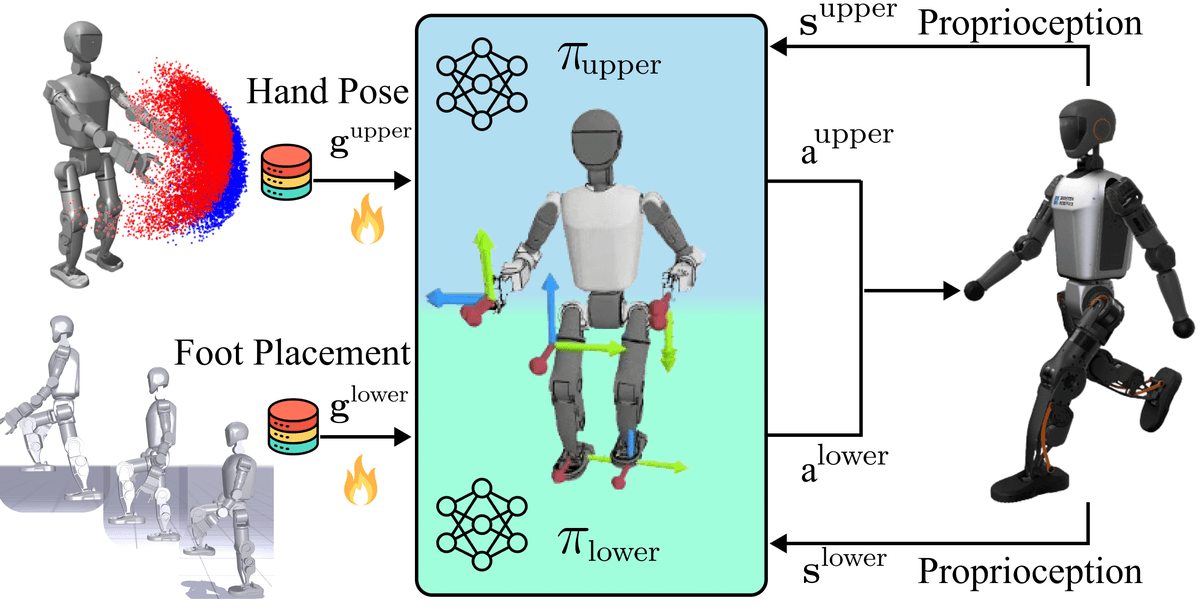
REFINE-DP's answer is to stop treating the planner and the controller as separate problems. Both get updated at the same time inside a single PPO loop. The diffusion policy is fine-tuned via a PPO-based diffusion policy gradient to improve task success, while the controller is simultaneously updated to accurately track the planner's evolving command distribution, reducing the distributional mismatch that degrades motion quality.
The framework runs as a three-stage pipeline:

- Data collection. Expert demos are gathered via human teleoperation and heuristic behavior planners, executed through a frozen low-level RL loco-manipulation controller.
- Diffusion planner pre-training. A diffusion policy with a transformer backbone (a DiT) is trained on the offline dataset to generate base-velocity and hand-pose commands.
- Joint RL fine-tuning. The pre-trained diffusion planner and the RL controller are optimized together in simulation with PPO, keeping the planner's command distribution and the controller's tracking distribution aligned.
The low-level controller itself is split: an upper-body policy tracks hand-pose commands, and a lower-body policy tracks foot-placement commands. Reward shaping uses coarse, fine, and precise Gaussian tracking terms for both position and orientation, plus curriculum-scheduled regularization for action smoothness, joint acceleration, and torque limits. It is nothing exotic on its own, but running it inside the same PPO update as the diffusion planner is what makes the trick work.
What the numbers look like
The team evaluated on a Booster T1 humanoid with 29 degrees of freedom across four tasks: walking to pick up a box, pick-and-place object transport, door opening and traversal, and stepping up onto a platform to retrieve an object. Each method got 100 trials per task in simulation.
Three results stand out:
- Data efficiency. A pre-trained diffusion policy fine-tuned with REFINE-DP reaches 95 to 97% success from just 50 demonstrations, a 20x reduction in data requirements compared to training from scratch.
- Joint optimization matters. Optimizing the low-level controller during fine-tuning alone boosts success rate by 18% on the long-horizon pick-and-place task, and jointly optimizing it halves the fine-tuning iterations needed (20 vs 40) to reach 90% success.
- Smoother motions. Joint optimization achieves the lowest position error, cuts orientation error by up to 50% versus the pre-trained policy, and reduces end-effector velocity by 15% on average, which translates to less jittery manipulation.
There is a subtle diagnostic buried in those numbers. Fine-tuning the diffusion policy in isolation, without touching the controller, can actually degrade tracking. The planner adapts to the controller's inaccuracies by over-commanding, essentially yelling louder at a body that is not listening. That is the compounding distribution shift problem in action, and it is why the joint update is the load-bearing idea.
On real hardware

Simulation success rates are one thing; the paper also includes hardware demos on the Booster T1. The door-opening task went from 73% pre-trained success to 95% after fine-tuning. On real hardware, fine-tuned policies were roughly 10% faster on box transport and 20% faster on door opening than their pre-trained counterparts, largely because they stop doing the indecisive back-and-forth motions that offline diffusion policies tend to produce.
The team also shows the same low-level controller can be repurposed as a teleoperation interface, letting a human operator command the robot directly for tasks like water-bottle pickup, cart pushing, and stair climbing. That is a useful practical consequence of training a controller that actually tracks the command distribution it is given.
What to take away
The honest headline here is not that diffusion policies are broken, but that treating them as a drop-in replacement for a motion planner on a humanoid ignores the coupling between plan and execution. The REFINE-DP paper makes the case that RL fine-tuning is the missing piece, and does so with numbers that are hard to argue with: 20x less demonstration data, halved fine-tuning iterations, and smoother real-world motion.
Some caveats worth flagging:
- Everything is fine-tuned in simulation before deployment, so the usual sim-to-real caveats apply, especially for contact-rich manipulation.
- The paper does not release code at the time of writing. The project page lists a Code link, but it appears to be a placeholder.
- Evaluation is on four tasks with a single robot platform. Whether the same recipe generalizes to more dexterous end-effectors or bimanual coordination under heavy loads is an open question.
Still, if you are working on humanoid manipulation and have been staring at a diffusion policy that looks great in a notebook and mediocre on hardware, the takeaway is concrete. Do not scale the demo pile. Fine-tune the planner and the controller together, and let PPO close the loop that behavior cloning left open.