
Georgia Tech's NeuroSim V1.5 Runs AI Chip Simulations 6.5x Faster
Georgia Tech's NeuroSim V1.5 adds transformer support, TensorRT quantization, and a 6.5x speedup for simulating analog compute-in-memory chips.
 Pro
Takeaways
- Georgia Tech releases NeuroSim V1.5, an open-source simulator for analog compute-in-memory accelerators.
- Adds hybrid ACIM/DCIM architecture supporting vision transformers alongside CNNs.
- TensorRT post-training quantization integration removes the need for custom training pipelines.
- Up to 6.5x faster than V1.4 via GPU-accelerated PyTorch tensor operations.
- Case study: ViTs show lower noise tolerance than CNNs due to GELU activation distributions.
- Code available at github.com/neurosim/NeuroSim with device and circuit expert noise modes.
Designing analog compute-in-memory (CIM) accelerators is a slog. The physics is promising, but the moment you leave clean digital arithmetic you inherit device drift, stuck cells, thermal noise, and analog-to-digital conversion errors that all compound through a network. A team from Georgia Tech's School of Electrical and Computer Engineering, led by Shimeng Yu's group, has released NeuroSim V1.5, an update to their widely used open-source simulator that tackles this problem with transformer support, faster noise modeling, and a redesigned GPU-accelerated backend.
The core idea behind CIM is straightforward. Instead of shuttling weights between memory and compute units, Compute-in-Memory performs multiply-accumulate operations directly in memory arrays, substantially reducing data movement. Analog CIM (ACIM) goes further, encoding weights as conductance or capacitance and letting Ohm's law or charge sharing do the math. The catch: designing robust ACIM accelerators requires accurate modeling of device- and circuit-level non-idealities, and existing tools each cover only pieces of the problem.
What V1.5 actually changes
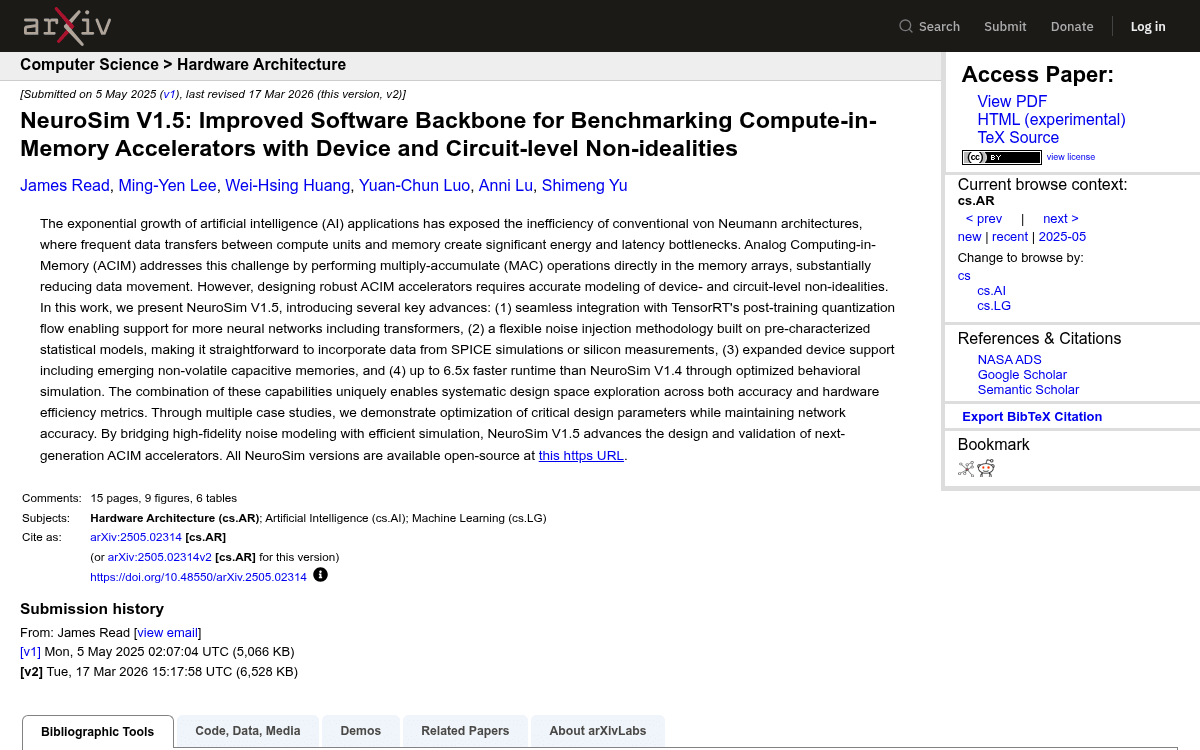
NeuroSim has been around for years as the go-to open-source framework for CIM benchmarking. V1.5 is a substantial refresh built around four contributions: seamless integration with TensorRT's post-training quantization flow enabling support for more neural networks including transformers, a flexible noise injection methodology built on pre-characterized statistical models, expanded device support including emerging non-volatile capacitive memories, and up to 6.5x faster runtime than NeuroSim V1.4 through optimized behavioral simulation.