
Georgia Tech's BehaviorVLM Tracks Mouse Behavior With Just 3 Labeled Frames
A new framework from Georgia Tech uses pretrained vision-language models to track animal pose and segment behavior with just three labeled frames and zero finetuning.
 Pro
Takeaways
- BehaviorVLM unifies animal pose estimation and behavior segmentation using pretrained VLMs with no finetuning.
- Pose pipeline needs only 3 seed frames plus quantum-dot fluorescence markers across 6 camera views.
- Four-stage VLM reasoning achieves 6.59 mm mean 3D error, a 54% reduction over the naive baseline.
- Behavior pipeline chains Deep Embedded Clustering, Qwen3.5 captions, and Qwen3-Next merging.
- Segmentation works from raw video features without requiring tracked keypoints.
- Evaluated on custom quantum-dot mouse data and the MABe2022 Mouse Triplets benchmark.
Tracking how a mouse moves and interpreting what it is doing are two of the most tedious jobs in modern neuroscience. Every new lab setup usually means hand-labeling thousands of frames before a pose model will train, and even then the resulting behavior segments rarely match how a human would describe the animal's actions. A team from Georgia Tech and Emory has proposed a way to skip most of that work by letting pretrained vision-language models do the reasoning instead.
Their system, called BehaviorVLM, tackles pose estimation and behavior segmentation in a single unified pipeline with no task-specific finetuning and only three manually labeled seed frames. It leans on Qwen 3.5 as the visual reasoner and a larger Qwen3-Next model for higher-level semantic merging, producing outputs that are both accurate and human-readable.

Why animal behavior analysis is stuck
Neuroscience labs currently rely on toolkits like DeepLabCut, SLEAP, and Lightning Pose for keypoint tracking. These are accurate but demand fresh manual labels every time the camera rig, lighting, or animal species changes. Pretrained foundation models such as SuperAnimal help, but they still degrade under new geometries. On the behavioral side, unsupervised methods like MotionMapper and Keypoint-MoSeq segment videos into states that switch too fast and rarely map cleanly onto categories a biologist would recognize.
Newer VLM-based tools like MouseGPT have started using language models to describe behavior. MouseGPT is built as a foundation VLM that takes multi-view video and kinematic data as input to interpret mouse behavior with an open-vocabulary approach. But these systems still require training runs and do not automate the full annotation workflow. BehaviorVLM's argument is that you can get further by prompting an off-the-shelf VLM through a chain of verifiable reasoning steps that mimic how a human annotator actually works.
Quantum dots as a shortcut for pose labels
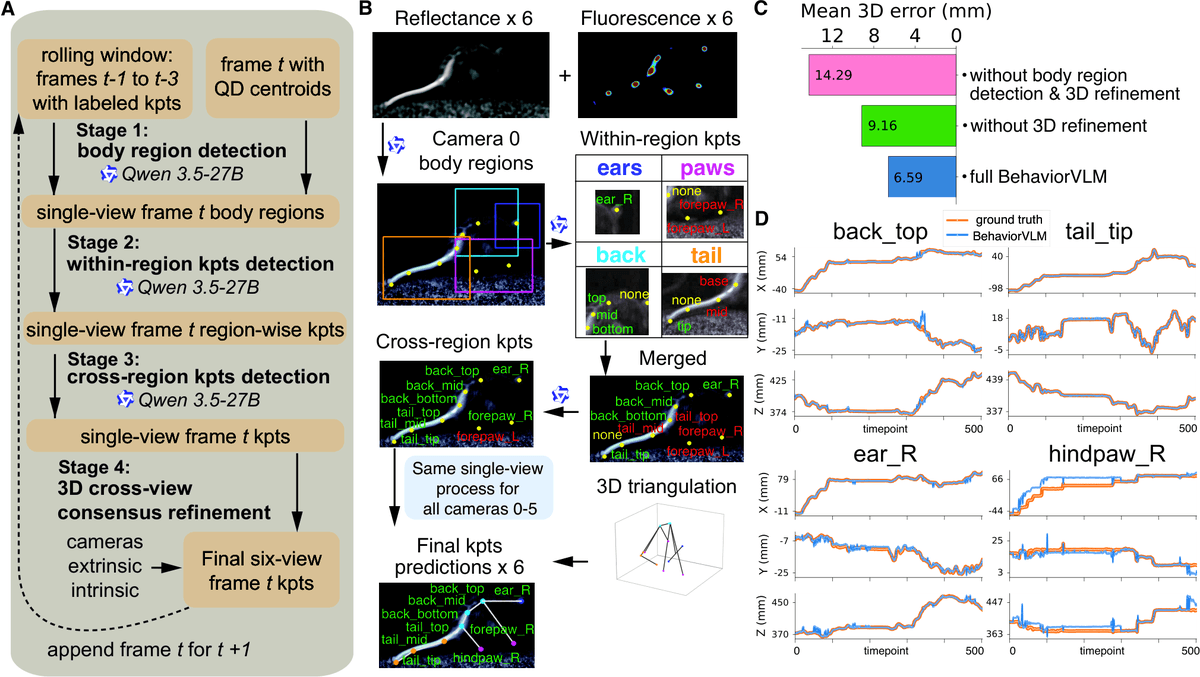
The pose estimation half of the paper uses an unusual data source: mice injected with near-infrared fluorescent quantum dots at 12 anatomical keypoints, filmed by six synchronized cameras. The fluorescence channel gives you the pixel location of every body marker in every view. What it does not give you is which dot corresponds to which body part, and that identity assignment is where the VLM comes in.

BehaviorVLM breaks the assignment problem into four stages:
- Body region detection. The 12 keypoints are grouped into ears, back, paws, and tail. The VLM draws a bounding box around each region, guided by three preceding frames as few-shot examples.
- Within-region assignment. The frame is cropped to each region so the model only has to sort 2 to 4 candidates at a time.
- Cross-region reconciliation. A full-frame pass fixes conflicts, like two labels pointing at the same dot.
- 3D consensus refinement. RANSAC-based triangulation across the six views flags any assignment with a large reprojection error, then swaps in the geometrically plausible alternative.
Predictions from each completed frame get appended to a rolling window and reused as exemplars for the next frame. That way the pipeline only needs three human-labeled seed frames to start the sequence.
The results, in millimeters
On a 500-timepoint recording, the full pipeline achieved a mean 3D keypoint error of 6.59 mm, compared with 9.16 mm when the 3D refinement stage is removed and 14.29 mm when both region decomposition and 3D refinement are stripped out. That is a 54 percent error reduction over the naive baseline. Paw keypoints remain the hardest case because left and right limbs look nearly identical and occlude each other constantly, but the reprojection error from Stage 4 doubles as a confidence score that flags bad labels for later manual review.
Segmenting behavior without keypoints
The second half of the framework tackles behavioral understanding on the MABe2022 Mouse Triplets benchmark, which features three mice interacting in an open arena with a food zone. Unlike traditional pipelines that need keypoints, this one can run directly on video features. It works in four stages:
- Feature extraction. Any combination of keypoint, visual, or fused features can be used. The paper uses the fused representation from LookAgain.
- Over-segmentation via Deep Embedded Clustering. DEC is trained across all animals to produce short, fine-grained clips of roughly 1 to 5 seconds. Over-segmenting deliberately avoids merging distinct behaviors too early.
- Per-clip VLM captioning. Qwen3.5-35B labels each clip and writes a natural-language description covering posture, movement, speed, and social context.
- LLM merging. Qwen3-Next-80B reads the descriptions, merges adjacent clips that describe the same behavior, and returns a refined timeline.

The interesting design choice is the split between perception and cognition. The VLM handles what the video shows, then the LLM does the long-range reasoning over text. The authors argue current state-of-the-art LLMs are simply better at semantic grouping than current VLMs, so it makes sense to convert video to language before doing the merging. The system produces labels like chasing, huddling, oral contact, and oral-genital contact, each attached to a written explanation grounded in the video evidence.
What is actually new here
The real contribution is not any single component but the framing: treat annotation as structured reasoning rather than end-to-end prediction. That has three practical consequences worth noting:
- Every intermediate output can be inspected, filtered, or corrected. Reprojection error surfaces low-confidence pose labels automatically.
- The behavioral pipeline works from raw video features, so it can run on species or setups where reliable keypoints are hard to obtain, like fish or birds.
- The whole system uses off-the-shelf pretrained models, so upgrading the VLM or LLM directly improves results without retraining.
Limits worth knowing
BehaviorVLM depends on the injected quantum dots for pose estimation, which restricts it to lab setups willing to use fluorescent nanoparticle injections. Paw identity confusion still shows up in the results and needs geometric filtering to catch. The behavioral pipeline is evaluated qualitatively on MABe2022 without quantitative comparison against supervised baselines, so the accuracy claim is really about interpretability and label-free operation rather than raw score. And running Qwen3-Next-80B and Qwen3.5-35B on every clip is not cheap. The paper does not currently link a public code release, though the authors reference example segmented videos from the LLM stage.