
Georgia Tech's BaS-SDRE Teaches Robots to Dodge Obstacles Without Crashing
A new control framework fuses barrier states with state-dependent Riccati equations to keep nonlinear systems safe over much larger operating regions.
 Pro
Takeaways
- BaS-SDRE combines barrier states with the state-dependent Riccati equation for safe nonlinear feedback control.
- Safety constraints become extra state variables inside the dynamics, not filters applied on top of a controller.
- A new matrix inequality certifies a much larger region of attraction than prior BaS-LQR designs.
- Controller is computed online via point-wise Riccati solutions, adapting gains near unsafe regions.
- Tested on an unstable 2D system and a planar quadrotor in cluttered obstacle courses.
- Outperforms vanilla SDRE and BaS-LQR baselines, though no open-source implementation is released.
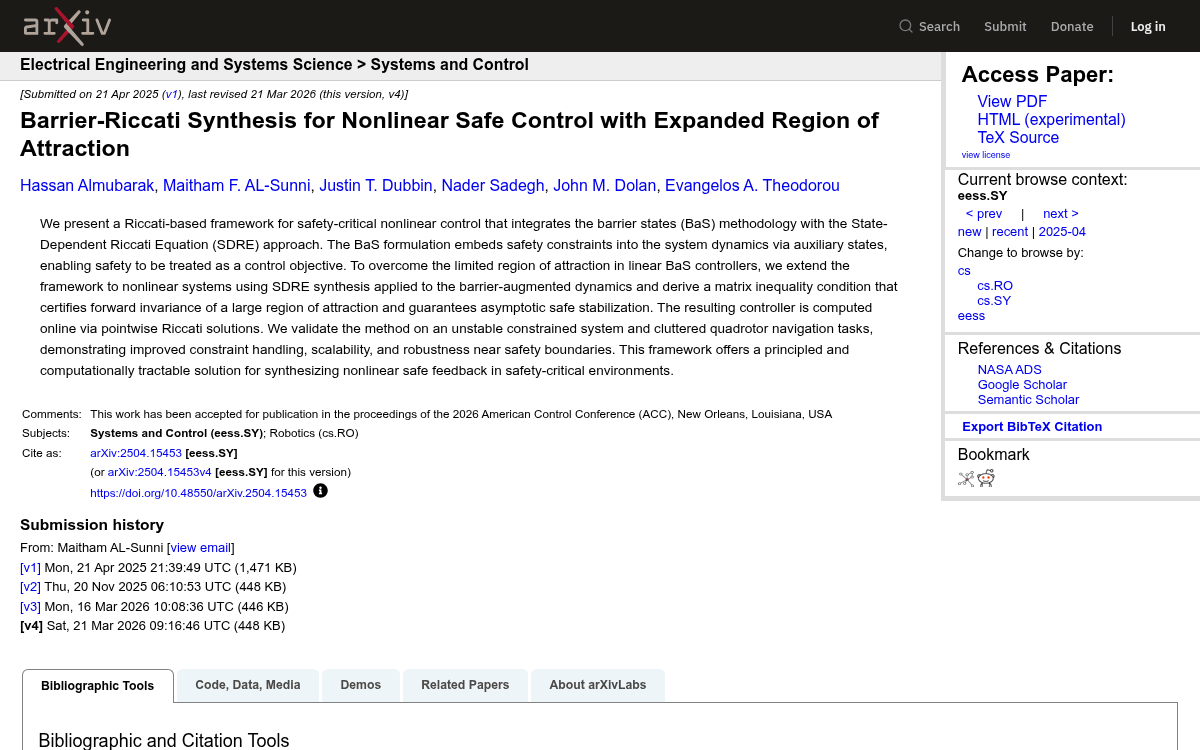
Keeping a robot from crashing into things while it also tries to reach a goal is one of the oldest headaches in control theory. A new paper from researchers at Georgia Tech, Carnegie Mellon, and KFUPM proposes BaS-SDRE, a controller that fuses two well-known ideas, barrier states and the state-dependent Riccati equation, so safety constraints become part of the system dynamics rather than an afterthought bolted on at the end.
The resulting feedback law can be computed online, handles nonlinear dynamics natively, and comes with a certificate proving it works over a much larger slice of the state space than previous barrier-based controllers.
Why safe control is still an open problem
Most classical safety tricks work well on linear systems or simple box constraints. Push them into nonlinear territory, like a quadrotor weaving through obstacles, and they break down. Recent approaches such as control barrier functions (CBFs) and barrier-Lyapunov functions have made progress, but each has quirks: CBFs are usually applied as a safety filter on top of a nominal controller, and barrier-Lyapunov methods tend to be restricted to specific constraint shapes.
The barrier states (BaS) approach takes a different angle, enforcing forward invariance of the allowed set by embedding barrier functions directly into the model of the safety-critical system. In plain terms, the distance to unsafe regions gets promoted into a new state variable that the controller has to stabilize alongside everything else. If that extra state stays bounded, safety is guaranteed.
One byproduct of this method is that it increases the nonlinearity of the system, even converting linear models into nonlinear ones, which shrinks the region of attraction of the closed-loop system. Earlier work paired BaS with LQR, which linearizes everything and only works near the equilibrium. Move the initial condition too far away and the controller fails.
The Riccati twist
The authors' fix is to solve the barrier-augmented problem with the State-Dependent Riccati Equation instead of LQR. SDRE factorizes the dynamics into state-dependent coefficient matrices so the nonlinear system is expressed in a form that looks like a standard linear state-space equation, then solves a Riccati equation point-wise online. You keep the intuition and structure of linear-quadratic control, but the gains now adapt to where the system currently is.
What makes the combination work cleanly is a factorization of the barrier function itself using the Mean Value Theorem, which lets the barrier state slot into the same pseudo-linear form that SDRE expects. The augmented system stacks the plant dynamics on top of the barrier state dynamics, and a single Riccati solve produces a controller that treats safety as just another cost term in a quadratic objective.
The key theoretical contribution is a matrix inequality condition that certifies how far this local guarantee extends. If the cost matrix Q minus the time derivative of the Riccati solution P stays positive definite along trajectories, the closed-loop system is asymptotically safely stable on an arbitrarily large sublevel set. That gives the designer a knob, essentially the choice of Q, to expand the region of attraction toward semi-global coverage.
What the simulations show
The authors test the method on two problems. The first is an unstable 2D linear system with a circular obstacle at (2, 2). BaS-LQR, the linear baseline, fails to stabilize the system safely from many initial conditions, while BaS-SDRE succeeds across the board.

A second experiment starts far from the origin and shows what the nonlinear controller is actually doing. When the system sits comfortably away from the obstacle, the SDRE gain tracks the LQR gain closely. As the barrier state spikes near the unsafe region, the gains diverge, reshaping the feedback law to push harder away from the boundary.

The more interesting test is a planar quadrotor navigating cluttered environments with multiple circular obstacles of varying sizes. The controller has to stabilize the quadrotor to hover at the origin from initial conditions where the vehicle might flip. BaS-SDRE completes both a sparse-obstacle course and a tightly packed one. Vanilla SDRE, which ignores safety, and BaS-LQR, which linearizes too aggressively, both drive the quadrotor through unsafe regions.

Caveats worth flagging
- Suboptimal by construction. The SDRE control law enforces a quadratic value function and only satisfies the Hamilton-Jacobi-Bellman equation point-wise, so it approximates rather than solves the true nonlinear optimal control problem.
- Factorization dependence. The state-dependent coefficient parameterization is not unique, and different choices give different stability, safety, and optimality profiles. Choosing a good one is still open research.
- Online cost. A Riccati equation is solved at every time step, which is heavier than a fixed LQR gain but still tractable for real-time control.
- No code release. The paper does not point to an open-source implementation, so anyone wanting to try it will need to build the pipeline from the equations, including the Kronecker-product Lyapunov solve used to compute the ROA certificate.
The natural home for BaS-SDRE is safety-critical robotics where the dynamics are genuinely nonlinear and constraint boundaries are hit often: aerial vehicles in cluttered spaces, manipulators near workspace limits, autonomous ground vehicles with obstacle avoidance. It offers a principled alternative to layering a CBF safety filter on top of an unsafe nominal controller, and unlike MPC it avoids solving a full trajectory optimization at every step. For anyone building nonlinear feedback where safety matters more than absolute optimality, it stakes out a middle ground that is analytically clean and computationally reasonable.