
Georgia Tech Finds Angry Text Makes LLMs 17% Worse at Answering Questions
Georgia Tech researchers show emotional tone reshapes how LLMs attend to text, introduce AURA-QA dataset, and propose a training fix that improves reading comprehension across emotion types
 Pro
Takeaways
- Georgia Tech researchers show that emotional tone in context passages systematically degrades LLM question-answering accuracy, with a 17-point gap between neutral (48%) and angry (31%) text on LLaMA-3.1-8B.
- The mechanism is traced to attention geometry: emotional tone measurably alters how attention is distributed across tokens, and these patterns predict QA accuracy with AUC 0.75.
- The team introduces AURA-QA, a new 14,400-question benchmark with 1,600 QA pairs per emotion, built from human-authored Project Gutenberg texts and validated by both LLMs and human annotators.
- An emotional regularization training method (LoRA + paired loss) constrains emotional variation to a designated latent subspace, preventing it from corrupting semantic reasoning representations.
- The regularization improves performance across all three tested models (LLaMA, Ministral, OLMo v2) and all four datasets, with up to 6.78% absolute gains and consistent out-of-domain improvements.
- Multi-emotion data augmentation alone is insufficient; the regularization loss is the critical ingredient, and gains are strongest under distribution shift.
A new paper from Georgia Tech asks a question that sounds almost philosophical but has very practical consequences: does the emotional tone of a passage change how well a language model can answer factual questions about it? The answer, it turns out, is yes , measurably, mechanistically, and consistently across models. The research, "Emotion is Not Just a Label: Latent Emotional Factors in LLM Processing", was accepted at ICLR 2026 and introduces both a new benchmark dataset and a training method to address the problem.
The blind spot hiding in plain sight
Large language models are routinely deployed on text that varies widely in emotional tone, yet their reasoning behavior is typically evaluated without accounting for emotion as a source of representational variation. Prior work has largely treated emotion as a prediction target, for example in sentiment analysis or emotion classification. This paper takes a different angle entirely.
The authors study emotion as a latent factor that shapes how models attend to and reason over text. The core question is not "can the model identify that this text is angry?" but rather "does the fact that this text is angry make the model worse at answering a completely neutral factual question about it?" The answer is yes , and the gap is large enough to matter in production systems.
This matters especially in retrieval-augmented generation (RAG), where a model is handed chunks of text pulled from the web and asked to answer questions grounded in those chunks. An analysis of a 10-million-document subset drawn from the RefinedWeb dataset shows that while most web text is neutral or happy, a substantial long tail of emotionally charged content remains that models must process robustly.

Attention geometry as the smoking gun
The researchers do not just observe a performance gap , they trace it to a specific mechanism: attention geometry. Attention geometry refers to the spatial and statistical structure of how a transformer's attention heads distribute focus across tokens. The paper defines and measures a rich set of these features, including:
- Center-of-mass distance: how far attention extends from each query token , a measure of how "non-local" the model's focus is
- Locality: the expected spatial spread of attention across the sequence
- Key entropy: how uniformly attention mass is distributed across all keys at the layer level
- Top-1 margin: how decisively attention concentrates on a single token versus its nearest competitor
- Persistence: how stable attention patterns remain across layers
- Focus-to / Focus-from: how strongly attention flows toward and from answer-relevant spans
The paper shows that metrics such as locality, center-of-mass distance, and entropy vary across emotions and correlate with downstream question-answering performance. To quantify this, the authors trained a logistic regression classifier to predict whether a model would answer a question correctly, using only these attention features as inputs. The classifier achieved an AUC of 0.75, meaning attention geometry alone explains a substantial fraction of accuracy variance. The strongest individual predictor was the "focus-from" feature , how sharply attention radiates outward from answer-span tokens , with an AUC of 0.74 on its own.
They then trained a random forest to predict the emotion of a passage from attention features alone. It achieved 86% accuracy and a macro-F1 of 0.75, confirming that emotional tone leaves a measurable, recoverable imprint on the model's internal attention patterns. High-arousal emotions such as excitement and anger display diffuse, exploratory attention with broader spatial reach and higher entropy, whereas low-arousal or negative emotions such as sadness and disgust exhibit tightly focused, convergent attention with lower entropy. Sarcasm is a special case: it combines wide spatial reach with sharp concentration on isolated tokens, producing a fragmented, redundant attention pattern that the authors connect to the pragmatic duality of ironic language.

The performance gap, precisely measured
The paper's key empirical finding is a systematic performance disparity across emotions on the same QA task. Using LLaMA-3.1-8B in a zero-shot setting on the new AURA-QA dataset, accuracy varies as follows:
| Emotion | Zero-shot accuracy | After fine-tuning |
|---|---|---|
| Neutral | 48% | 58% |
| Excitement | 39% | 55% |
| Disgust | 38% | 49% |
| Happy | 36% | 45% |
| Surprise | 36% | 54% |
| Fear | 34% | 47% |
| Sad | 34% | 49% |
| Anger | 31% | 42% |
The gap between neutral (48%) and happy (36%) text is 12 percentage points. The gap between neutral and angry text is 17 points , from 48% down to 31%. These differences persist even after fine-tuning, though the absolute numbers improve across the board. Critically, this is measured on a controlled, emotionally balanced dataset, so the effect cannot be explained away by differences in sample size or topic distribution.
AURA-QA: a benchmark built for this problem
To facilitate controlled study of these effects, the authors introduce Affect-Uniform ReAding QA (AURA-QA), a question-answering dataset with emotionally balanced, human-authored context passages. Existing QA datasets are either emotionally imbalanced (TweetQA skews heavily toward neutral and happy) or entirely synthetic. AURA-QA is built from Project Gutenberg public-domain books, ensuring natural human writing rather than machine-generated text.
The construction pipeline is carefully engineered:
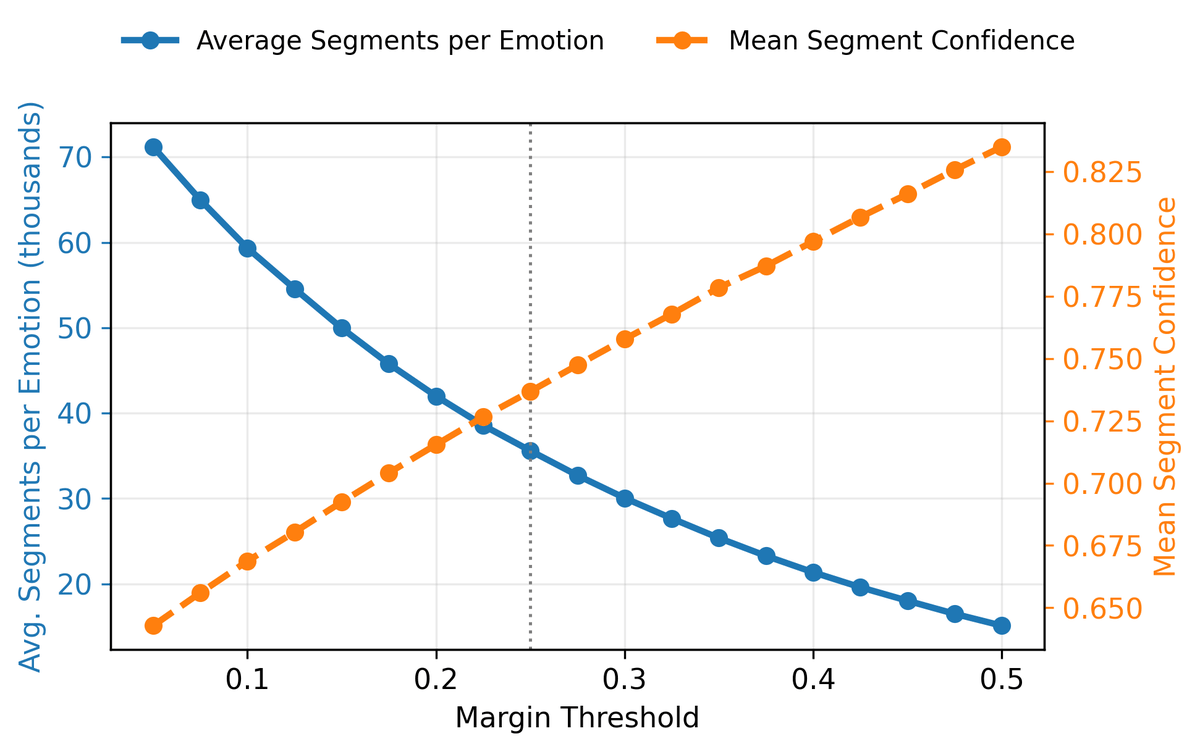
- A transformer-based emotion classifier (an ensemble of T5 and ModernBERT models trained on 323,776 labeled examples) segments book passages into emotionally coherent chunks, keeping only sentences where the dominant emotion wins by a margin of at least 0.25 over the next-best class.
- Three frontier LLMs , LLaMA 3.3 70B, Gemma 3-27B, and Qwen 3 32B , independently verify each passage's dominant emotion. A passage is only kept if all three agree.
- The same three models generate candidate question-answer pairs at Bloom's Taxonomy levels 2 (comprehension) and 3 (application), then a dual-model filter keeps only questions that the large model answers correctly but the small model from the same family fails , selecting for genuine difficulty.
- Human annotators on Amazon Mechanical Turk validate answerability, grounding, and non-triviality.
The result is 14,400 QA pairs, with exactly 1,600 per emotion across nine categories (anger, disgust, excitement, fear, happy, neutral, sad, sarcastic, surprise). Human annotators judged 87.6% of questions to be valid, and LLM-human agreement on emotion labels (58%) falls within the range of human-human agreement (63%), suggesting the automated pipeline is a reasonable proxy for human judgment.
The fix: emotional regularization during training
An emotional regularization framework is proposed that constrains emotion-conditioned representational drift during training. The core idea is that emotional variation should stay confined to a designated "emotional subspace" within the model's hidden states, and should not bleed into the semantic representations used for reasoning.
Here is how it works, step by step:
- Build an emotional latent space: Run the model on a synthetic parallel corpus where the same sentences are rewritten in multiple emotions. Apply centered SVD to the resulting activations. The top singular vectors define an orthonormal basis for the emotional subspace at each layer.
- Project out emotion during training: For each training example, project the hidden states onto the complement of the emotional subspace , removing the emotional component and isolating the semantic representation.
- Apply a paired regularization loss: For each question, present the same context rewritten in two different emotions. The regularization loss penalizes differences between the emotion-stripped representations of the two variants, using both an L2 term (penalizing scale differences) and a cosine term (penalizing directional differences).
- Train with LoRA: The full objective is standard cross-entropy QA loss plus the regularization term, applied via LoRA adapters on every layer.
The intuition: if the model's non-emotional representations are forced to be similar across emotional variants of the same content, it becomes harder for emotional tone to accidentally corrupt factual reasoning.
Results across models and benchmarks
Experiments across multiple QA benchmarks demonstrate that this approach improves reading comprehension in both emotionally-varying and non-emotionally varying datasets, yielding consistent gains under distribution shift and in-domain improvements on several benchmarks. The method was tested on three models (LLaMA-3.1-8B, Ministral, and OLMo v2) across four datasets (Natural Questions, TweetQA, FriendsQA, and AURA-QA).
Key findings from the results table:
- Adding emotional regularization on top of multi-emotion data augmentation improves average performance by 3.03% when training on the emotionally neutral Natural Questions dataset , showing robustness gains even when the training data itself has no emotional variation.
- Multi-emotion data augmentation alone (rewriting training passages in different emotions) is not sufficient: it yields inconsistent results and sometimes hurts performance. The regularization loss is the critical ingredient.
- On TweetQA and FriendsQA , datasets that already contain emotional variation , emotional regularization consistently improves both in-domain and out-of-domain performance, with average absolute gains of 0.9% and 2.9% respectively.
- Average improvement across all model-dataset pairs (the "Avg Δ" row) ranges from 0.19% to 6.78%, with the largest gains on OLMo v2 evaluated on AURA-QA.
Limitations and what's left open
The proposed emotional regularization framework targets a specific mechanism , emotion-conditioned non-emotional representational drift , and is not intended to address all sources of error in question answering. As a result, the benefits can be dataset- and setting-dependent, with particularly strong gains under distribution shift and more variable effects across in-domain settings.
There are a few other practical caveats worth noting:
- AURA-QA passages are drawn from 19th-century public-domain books. The emotional register of Victorian prose may not transfer cleanly to modern web text or social media.
- The emotion verification pipeline relies on LLM consensus, which achieves 58% agreement with human annotators , reasonable, but not perfect. Emotion labels should be treated as weakly supervised.
- The ablation study on emotion pairs (Appendix F) shows that the best emotion pair to regularize across varies by dataset, with 7–13% performance variation depending on the choice. There is no universal best pair.
- The analysis focuses on attention geometry and does not fully characterize other representational pathways through which emotion might influence reasoning.
No code or model weights are publicly released with the paper, though the AURA-QA dataset construction methodology is described in enough detail to replicate. The paper is available on arXiv and was presented at ICLR 2026. For teams building RAG pipelines over emotionally diverse web content, the core takeaway is actionable: emotional tone is not a nuisance variable you can ignore , it actively reshapes how your model reads, and training with explicit emotional regularization can help.