
George Mason Pits GPT-4o Against History, Dating Texts With 0.96 F1
First systematic study benchmarks Claude, GPT-4o, Gemini and open-source models on dating historical texts, revealing where prompting wins and where fine-tuning closes the gap.
 Pro
Takeaways
- First systematic benchmark of LLMs on Temporal Text Classification across English and Portuguese corpora.
- GPT-4o with five-shot prompting hit 0.96 F1 on Portuguese century classification at 100 tokens.
- Proprietary models Claude 3.5, GPT-4o, Gemini 1.5 dominated across zero-shot and few-shot settings.
- Open-source models jumped roughly +0.23 to +0.29 F1 after LoRA fine-tuning but still trailed proprietary APIs.
- Longer input windows helped everyone; 10-token snippets kept even top models near 0.50 F1.
- Synthetic period text generated by proprietary LLMs preserved model rankings but shifted absolute scores.
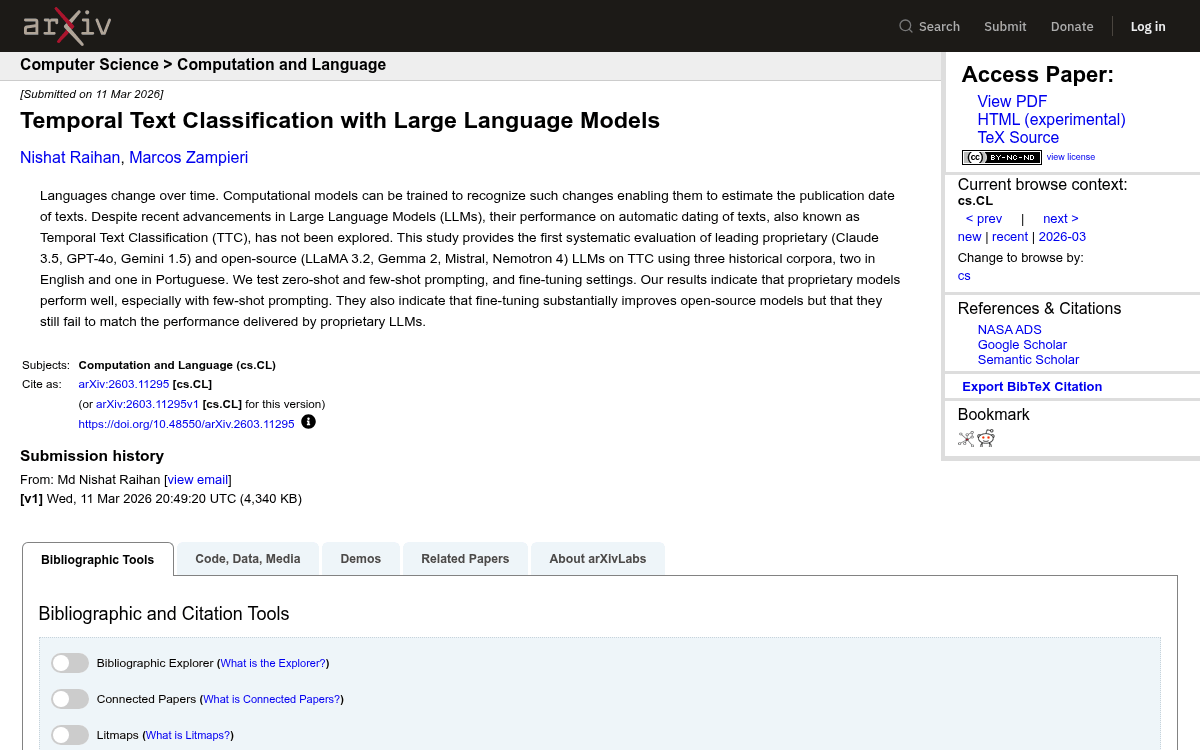
Guessing when a piece of text was written sounds like a parlor trick, but it is a real task in digital humanities and information retrieval called Temporal Text Classification (TTC). Traditionally it has been handled with n-gram features and SVMs. A new study from George Mason University finally asks the obvious question: how do modern large language models do at it? The paper is the first systematic benchmark of proprietary and open-source LLMs on automatic text dating.
The task nobody had properly benchmarked
Temporal Text Classification consists of assigning temporal labels to a diachronic collection of texts, where the labels usually represent pre-defined time spans such as 10 years, 50 years, or a century. It matters because language drifts. Spellings, syntax, and vocabulary from the 1600s look nothing like the 1900s, and being able to place a document in time helps organize historical corpora and detect anachronisms.
Most prior work approached the task using supervised categorization with statistical machine learning classifiers trained on stylistic and n-gram based features. LLMs have crushed neighboring tasks like question answering and machine translation, but nobody had run a clean comparison on dating texts, and this study fills that hole.
How the benchmark was built
The authors tested seven models: Claude 3.5 Sonnet, GPT-4o, and Gemini 1.5 Pro on the proprietary side, and LLaMA 3.1 8B, Gemma 2 9B, Mistral 7B, and Nemotron 4B on the open-source side. They ran three evaluation regimes: zero-shot prompting, five-shot prompting, and, for the open models, LoRA fine-tuning. Input snippets were truncated to 10, 50, or 100 tokens to test how much context the models actually need.
Three historical corpora were used:
- Colonia, a diachronic collection of Portuguese texts including full novels spanning the 16th to early 20th centuries, divided into five century-level classes.
- CLMET, the Corpus of Late Modern English Texts, covering British English from 1710 to 1920 across three 70-year periods.
- DTE from SemEval-2015 Task 7, curated from the historical archive of the British weekly magazine The Spectator.
A TF-IDF SVM baseline was included, matching the traditional approach used in earlier TTC papers. Macro F1 was the headline metric.
Proprietary models dominate, especially with examples
The prompting results were lopsided. Few-shot prompting significantly outperformed zero-shot in most cases, often achieving F1 scores above 0.90 with inputs of 100 or more tokens, showing robust in-context learning where models adapt efficiently from only five examples. GPT-4o topped most tables, hitting 0.96 F1 on Colonia with 100-token inputs, and Claude 3.5 was close behind at 0.93 on CLMET.
Context length mattered a lot. At 10 tokens, even the best models hovered around 0.45 to 0.60 F1. Push the snippet to 100 tokens and scores jumped past 0.85. The pattern held across both English corpora and the Portuguese one, suggesting the temporal signal LLMs pick up is not purely English-centric.
Fine-tuning rescues the open-source models
Left in prompting mode, the open models struggled. Zero-shot F1 scores were modest, generally ranging from 0.26 to 0.36, while five-shot prompting typically reached the 0.44 to 0.53 range. LoRA fine-tuning changed the picture dramatically. Fine-tuning yielded the most substantial gains, achieving F1 scores consistently between 0.61 and 0.77. Gemma 2 was the strongest open model, and Mistral tied it on Colonia after fine-tuning.
Here is the headline comparison at 100 tokens:
| Model | Colonia | CLMET | DTE |
|---|---|---|---|
| GPT-4o (5-shot) | 0.96 | 0.87 | 0.91 |
| Claude 3.5 (5-shot) | 0.91 | 0.93 | 0.74 |
| Gemma 2 (fine-tuned) | 0.73 | 0.75 | 0.78 |
| Mistral (fine-tuned) | 0.72 | 0.68 | 0.76 |
| SVM baseline | 0.69 | 0.78 | 0.72 |
Fine-tuned open models beat the SVM baseline on Colonia but not always on English corpora, and none of them caught the proprietary few-shot numbers.
The synthetic data twist
The authors also asked whether these models can generate convincing period text. They prompted the three proprietary models to synthesize test sets stylistically matched to each era, then reran the open-source classifiers on the fake data. The overall pattern observed on the authentic splits largely persisted on the synthetic test sets, with scores rising from zero-shot to few-shot to fine-tuned for every model and dataset pair. Rankings held, but individual scores shifted by up to 0.12 F1 in either direction, hinting that generated text approximates but does not perfectly replicate historical style.
What it means for practitioners
If you have a dating problem and can call an API, five-shot GPT-4o or Claude on 100-token windows is a strong default and requires no training. If data privacy or cost rules out proprietary APIs, LoRA fine-tuning a 7B to 9B open model gets you into the mid-0.70s F1 range, which beats a classical SVM on some corpora. Very short inputs remain hard for everyone, and there is no released code or model artifact tied to the paper. The authors flag pretraining data contamination as a caveat, which is worth remembering any time an LLM appears to recognize a canonical historical passage.