
Geometric SSM Beats Mamba by Proving Selectivity Doesn't Need Time-Varying Dynamics
New research shows Linear Time-Invariant state space models can match Mamba's selectivity while preserving fast FFT training, using ideas from geometric control theory.
 Pro
Takeaways
- Geometric SSM shows LTI state space models can be selective, contradicting a core Mamba claim.
- Uses geometric control theory: different inputs excite different invariant subspaces of a fixed linear system.
- A dynamic residual generator provides temporal memory outside the main recurrence, unlike Mamba's stateless gate.
- Trains via FFT convolution in O(L log L), with memory independent of internal state dimensions.
- Hits 99%+ on extended induction head where Mamba's selector drops to 20%.
- Scores 81% on sequential MNIST versus 11% for the Mamba baseline; language-scale evaluation is future work.
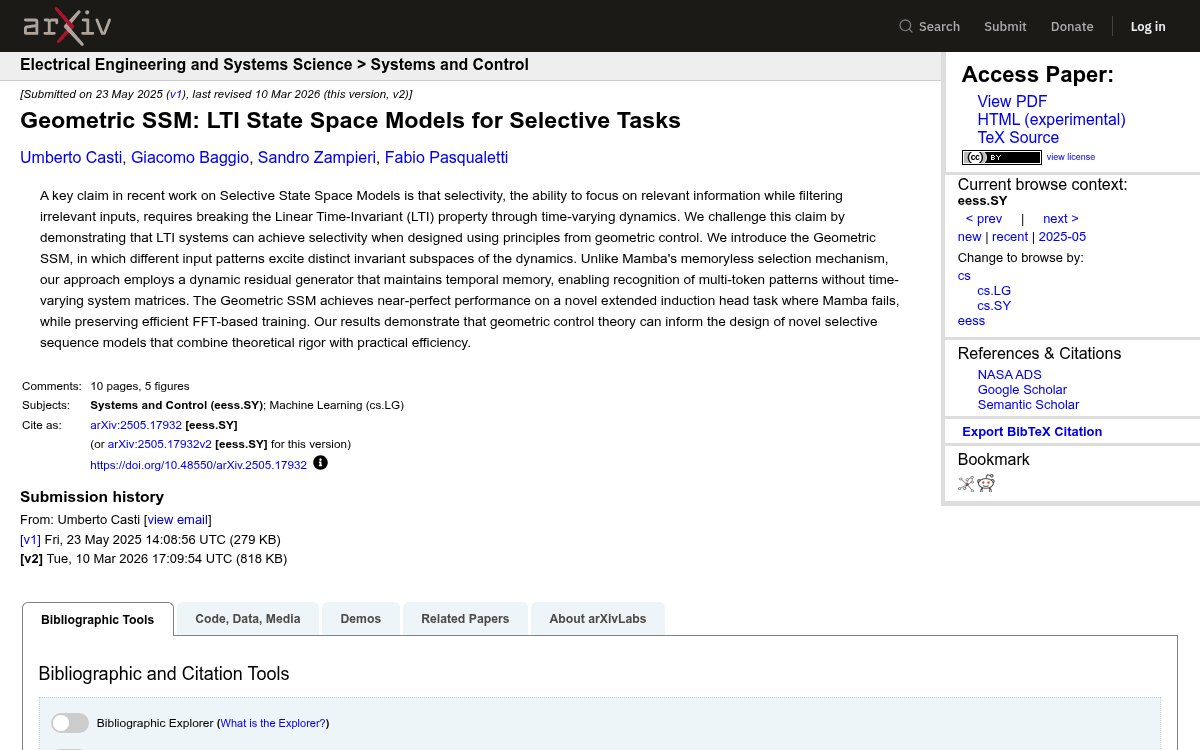
One of the loudest claims in the state space model revival was that Mamba only worked because it broke the Linear Time-Invariant property. Selectivity, the argument went, required system matrices that change with the input, which is exactly what killed the convolutional shortcut in earlier models like S4. A new paper called Geometric SSM pushes back on that assumption and shows it is possible to build a selective sequence model that stays fully LTI, trains with FFT convolution, and even beats Mamba on tasks that require memory across multiple tokens.
The claim under attack
A central claim in Mamba is that this time-varying behavior is necessary for selectivity, that Linear Time-Invariant systems fundamentally cannot process inputs selectively. That claim matters because time-varying dynamics break the convolutional structure of traditional SSMs, sacrificing parallelization benefits and complicating analysis. In practical terms, LTI systems let you compute the entire output sequence as a single convolution with a fixed impulse response, which the FFT turns into an O(L log L) operation. Mamba gives that up in exchange for content-dependent gating.
The authors show this trade-off is a false choice. Drawing on geometric control theory, they show that LTI systems can achieve selectivity when properly designed, with the key insight that different input patterns can be engineered to excite distinct invariant subspaces of the state space, enabling content-dependent responses without time-varying system matrices. This idea comes from the fault detection literature, where engineers routinely design fixed linear systems that respond to some signal patterns and stay silent to others.
Where Mamba's selector runs out of memory
The paper also exposes a concrete weakness in Mamba's selection mechanism. In Mamba, the gating parameters depend only on the current input token, with no memory of what came before. That works when a single trigger token cues a recall, but it falls apart when the trigger is a sequence.
To demonstrate this, the authors introduce an extended induction head task. In this variant the trigger is not a single token but a sequence of tokens of length N_trig, and the model must recognize this multi-token pattern and recall the token that followed its first occurrence. The task could theoretically be solved by expanding the token vocabulary to include all possible trigger sequences, but this approach requires a number of embeddings that grows exponentially with N_trig.
How Geometric SSM is wired
Instead of pushing selectivity inside the recurrence, Geometric SSM moves it outside. The architecture chains three LTI subsystems with a static nonlinear gate:
- Signature system Sigma_f: extracts a feature signal f(t) from the input.
- Main system Sigma_M: takes both u(t) and f(t) and produces a candidate output y_s(t).
- Residual generator Sigma_r: computes a residual from y_s(t) minus u(t), passes it through a sigmoid, and emits a selection signal s(t).
- Gate Sigma_g: interpolates between the previous output and the candidate, using s(t) as the mixing weight.
The critical piece is that the residual system Sigma_r is itself a dynamical system, which enables it to recognize multi-token patterns and adapt the selection signal based on temporal context. That is the memory Mamba's selector lacks. And because every learnable block is LTI, the parallel and series interconnection of LTI systems is guaranteed to yield another LTI system, so the whole trainable core can be represented as a single transfer function.
Training as a transfer function
Rather than a state-space recurrence, training uses the input-output (transfer function) representation, following the state-free approach from Parnichkun et al.. The input is transformed to the frequency domain, multiplied element-wise by the transfer functions evaluated on a truncated Fourier grid, and transformed back to the time domain. Two consequences follow that matter for anyone considering the architecture:
- Total computational cost is O(L m^2 + L m log L) with memory O(L m), independent of the internal state dimensions.
- Unlike Mamba, there is no requirement that the state matrix A be diagonal, so the model retains a dense state matrix without paying the usual quadratic parameter cost.
The numbers
On the standard induction head task with 16-token training sequences, the Geometric SSM hits 99%+ accuracy all the way out to length 1024 using only about 50 parameters, while a stripped-down single-layer Mamba selector with roughly 700 parameters degrades sharply with length. The authors note the original Mamba paper used a two-layer, 74K-parameter model, suggesting the original Mamba results may rely more on model capacity and optimization than on the selection mechanism itself.
The extended induction head is the more dramatic result. Geometric SSM stays above 99% while Mamba's selector collapses to around 20% accuracy, unable to track a 4-token trigger with a stateless gate. On sequential MNIST, where 784 pixels are fed one at a time, Geometric SSM reaches 81% test accuracy against 11% for the Selective SSM baseline, though the authors note the Mamba baseline was memory-constrained on their hardware.
What it is and is not good for
This is a mechanism paper, not a foundation model. The authors are explicit that their goal is not to develop a general-purpose foundation model competitive with full-scale Mamba implementations, but to understand the mechanisms that enable selectivity. All experiments are on synthetic tasks plus sMNIST, and no public code repository is referenced in the paper. Language modeling scale-up is called out as future work.
Still, the practical implications are worth noting. If you need selective behavior in an SSM but want dense (non-diagonal) state matrices, FFT-parallel training, and a memory footprint that does not scale with internal state dimension, the architecture is a serious candidate. It also gives a clean interpretability story: feature extraction, main processing, residual selection, and gating live in separate blocks that can be inspected and reasoned about with standard linear systems tools.
The real breakthrough
The headline is that LTI can be selective. The deeper point is that Mamba conflated two ideas that did not have to travel together: selectivity (responding differently to different content) and time-varying dynamics (letting the system matrices change with the input). Geometric control theory has known for decades how to separate them, and this paper is the first clean demonstration that the SSM community can borrow that trick. Whether the approach scales to billion-parameter language models is unproven, but the theoretical wall between LTI and selectivity has come down.