
GeoArena Exposes How Verbosity Fools AI Photo Location Benchmarks
A new arena-style benchmark judges vision-language models on how they reason about location, not just whether they guess the right coordinates.
 Pro
Takeaways
- GeoArena launches a Chatbot-Arena-style benchmark for geographic reasoning in vision-language models, using pairwise human votes.
- Gemini 2.5 Pro tops the leaderboard at 1319 Elo, followed by Gemini 2.5 Flash and Qwen 2.5-VL 72B.
- 17 frontier VLMs benchmarked including GPT-4.1, Claude Opus 4, Llama 4, Gemma 3, and Qwen 2.5-VL variants.
- Expert reviewers agree with crowd votes 78% of the time, validating preference signal reliability.
- Response length strongly biases votes (β=0.526); Gemma 3 12B drops from 4th to 9th after style adjustment.
- Platform and code open-sourced at GitHub.
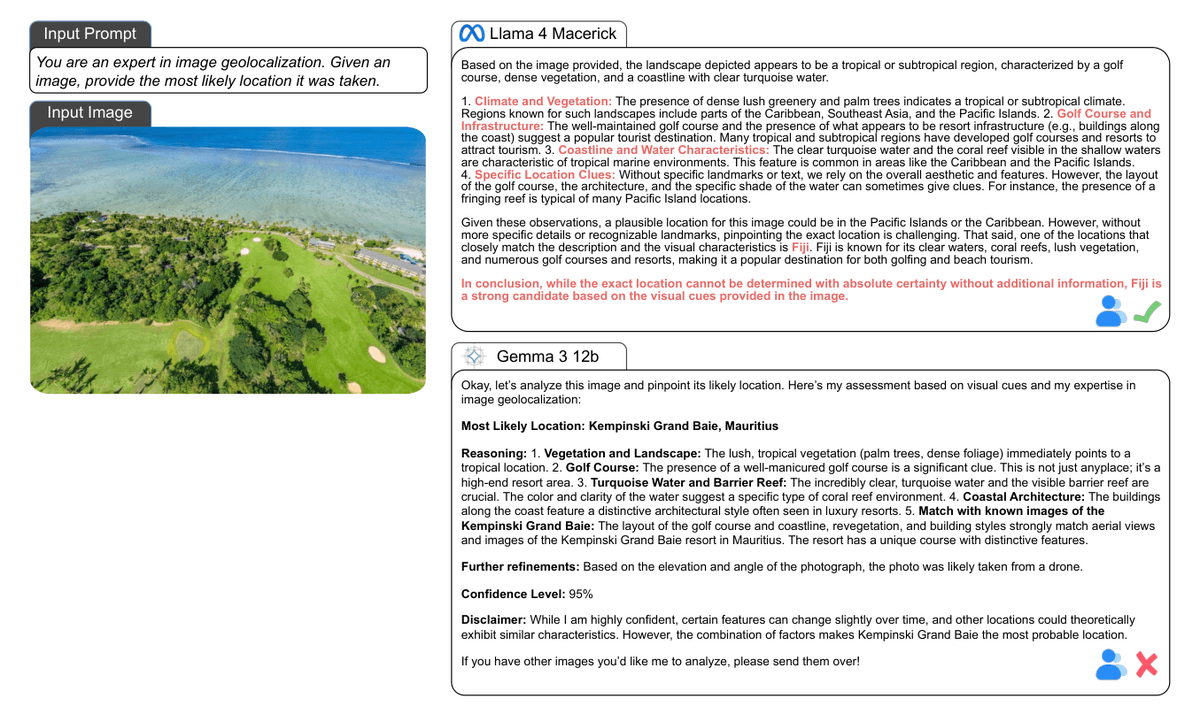
Guessing where a photo was taken has quietly become one of the harder stress tests for vision-language models. It forces a system to combine architecture styles, road signage, vegetation, license plates, and cultural cues into a single spatial hypothesis. Most benchmarks in this space grade only the final coordinate, ignoring how the model got there. A new paper called GeoArena proposes an alternative that borrows heavily from Chatbot Arena: let humans compare two model explanations side by side and vote for the better reasoner.
Why label-matching falls apart in the wild
Existing evaluation paradigms for geographic reasoning remain largely outcome-centric, relying on static datasets with predefined labels and metrics such as coordinate distance or categorical accuracy. Static benchmarks are increasingly vulnerable to data contamination from web-scale pretraining, outcome-level metrics collapse complex reasoning processes into a single label match, and authoritative ground truth is often unavailable or ambiguous for in-the-wild images.
The deeper problem is philosophical. Real-world geolocation is abductive rather than deterministic. A photo of a fern-lined trail could plausibly be in New Zealand, Chile, or the Pacific Northwest, and a good answer weighs the evidence rather than committing to a single pin. The authors argue that if you only score the pin, you never actually inspect the chain of reasoning that got the model there.