
Geo-4D Tops LiDAR Leaderboard Without Training Anything, Using 79% Less Memory
A new training-free pipeline for 4D LiDAR panoptic segmentation tops the SemanticKITTI leaderboard while cutting memory use and runtime dramatically.
 Pro
Takeaways
- Geo-4D is a training-free 4D LiDAR panoptic segmentation pipeline that ranks first on the SemanticKITTI leaderboard.
- It wraps a frozen 3D panoptic network with ICP plus Global Geometry-aware Soft Matching for instance association.
- GGSM solves an entropy-regularized optimal transport problem via Sinkhorn-Knopp instead of nearest-neighbor matching.
- Instances are handled in three modes: static (centroid and covariance filter), dynamic (ICP with GGSM), and missing (3-scan memory bank).
- Cuts memory 60-79% and runtime 26-45% versus IoU-based multi-scan baselines while using only one scan.
- Full paper on arXiv; no public code released at time of writing.
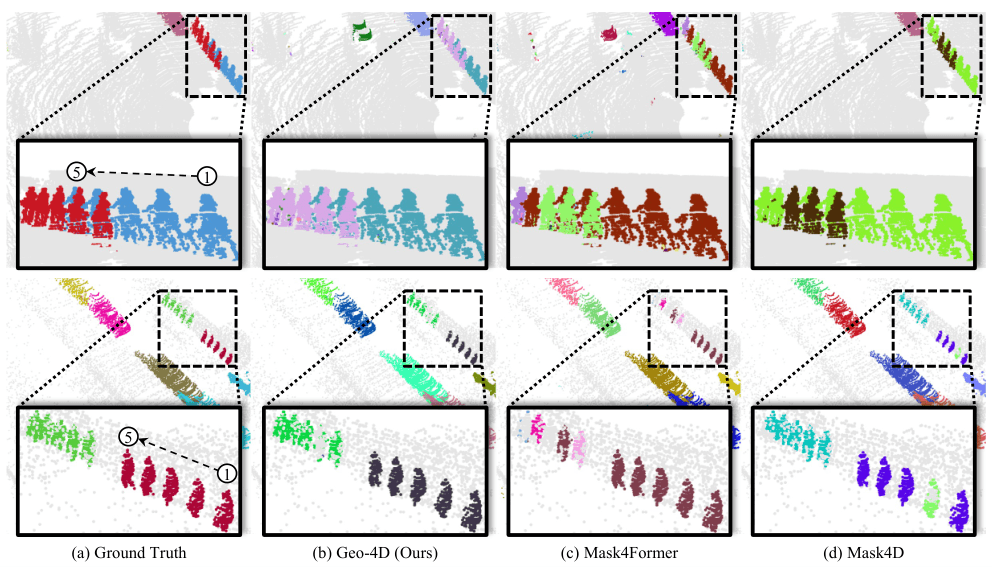
A team from Korea University, Sogang University, Hyundai Motor, and Purdue has taken the top spot on the SemanticKITTI 4D panoptic segmentation leaderboard with a method that does not train anything new. Their system, called Geo-4D, wraps a frozen 3D panoptic network with a classical geometric matching routine and beats every learned tracker on the benchmark, using a single LiDAR scan per step instead of the stacks of scans that competing methods rely on.
Why stacking scans became the default, and why that hurts
4D LiDAR panoptic segmentation is the job of labeling every point in a LiDAR sweep with a semantic class and a persistent instance ID across time, so a car in frame five keeps the same ID it had in frame one. The mainstream of prior works can be categorized into three discrete paradigms: IoU-based association, query-propagated association, and detect and track association.
The dominant IoU-based approach superimposes two to four consecutive scans into one giant point cloud and matches overlapping regions. It works, but stacking point clouds leads to a quadratic growth in computational overhead, which is an inherent challenge in point cloud processing. Query-based trackers like Mask4D and detect-and-track pipelines like CA-Net avoid the stacking but commonly suffer from error accumulation and reliance on costly and dataset-dependent training.

Iterative Closest Point, rediscovered
Geo-4D asks a blunt question: if you already have a strong per-frame 3D panoptic network, do you really need to train anything else to link instances across time? The authors argue no, and reach for Iterative Closest Point (ICP), a decades-old algorithm from point cloud registration. ICP tries to find the rigid rotation and translation that best aligns two point sets by repeatedly matching each source point to its nearest target and solving a least squares problem.
Vanilla ICP fails on noisy LiDAR predictions because nearest-neighbor matching latches onto whichever point is closest, ignoring the overall shape of the instance. Geo-4D fixes this with Global Geometry-aware Soft Matching (GGSM), which treats each instance point cloud as a probability distribution and solves an entropy-regularized optimal transport problem using the Sinkhorn-Knopp algorithm to find correspondences that respect the whole instance geometry, not just local proximity. The point-to-point pairing then falls out of an argmax over the transport plan.

Three flavors of instance
The pipeline splits instances into three cases and handles each differently, which is where a lot of the efficiency gains come from:
- Static: filtered by comparing point-set centroids and covariances between frames. Cheap, and it removes most candidates before the expensive step runs.
- Dynamic: passed through the GGSM-powered ICP loop, then confirmed by an IoU check on the transformed points.
- Missing: cached in a short-term memory bank for the last three scans, so instances that briefly disappear behind occlusions get their IDs back when they reappear.
The static-first filter matters more than it looks. An ablation shows that combining these strategies reduces the runtime by 48.2% while simultaneously improving performance, as it significantly narrows the matching candidates for global geometry association.
Numbers that make the case
On the SemanticKITTI hidden test set, Geo-4D reaches 70.3 LSTQ and 70.0 association score with a single scan. Compared with IoU-based association approaches that rely on 2 to 4 more input point clouds, Geo-4D achieves superior performance using only a single scan, showing improvements of up to 13.2 percent points in association score and 10.0 percent points in LSTQ.
Efficiency gains are equally striking. Against IoU-based baselines, Geo-4D requires 60.7% to 79.4% less memory and achieves a 26.1% to 45.6% runtime efficiency improvement. Peak GPU memory drops to 3.2 GB versus 10 to 19 GB for the multi-scan competitors. On the sparser panoptic nuScenes benchmark, which uses a 32-beam LiDAR at just 2 Hz, Geo-4D still edges out four-scan methods on LSTQ using a single scan, suggesting it generalizes across sensor densities.
What the real breakthrough is
The headline is the leaderboard rank, but the deeper claim is that a well-designed geometric prior can replace an entire learned tracking head. GGSM is what makes ICP robust enough to survive real LiDAR noise, and its complexity is theoretically comparable to the nearest neighbor algorithm, so the accuracy gains come almost for free. The framework also drops into any 3D panoptic backbone. The authors demonstrate it on both DS-Net and Mask4Former (run in single-scan mode) with consistent gains.
Where it falls short
Geo-4D inherits every failure of the underlying 3D panoptic model, so if the segmenter merges two pedestrians into one blob, no amount of geometric alignment will separate them later. The authors also flag three practical limits: real-time deployment is still not solved (inference sits around 2.35 seconds per scan with DBSCAN post-processing, though it drops to 840 ms without it), performance depends on accurate ego-pose to transform points into world coordinates, and partial LiDAR observations of large objects remain tricky. Bijective matching via the Hungarian algorithm was also tested but lost by a small margin to greedy matching, which the authors attribute to segmentation noise where one object gets split into multiple predicted segments.
Availability
The paper does not link a public code repository or model release. Everything needed to reproduce the method is described in the paper and its supplementary appendix, including hyperparameters (all matching thresholds set to 0.1, IoU threshold 0.2, memory window of 3 scans, 30 ICP iterations, Sinkhorn regularization 0.2). All experiments ran on a single RTX A6000.