
GenGNN Beats Graph Transformers at Molecule Generation With 2-5x Faster Inference
GenGNN replaces expensive graph transformers in discrete diffusion with modular message-passing GNNs, hitting 99.49% molecule validity at 2-5x faster inference
 Pro
Takeaways
- GenGNN is a modular message-passing framework that replaces expensive graph transformers in discrete graph diffusion models, achieving 2-5x faster inference.
- Plugged into DiGress, the GenGIN variant hits 99.49% molecule validity on QM9 -- beating the original Graph Transformer backbone.
- Vanilla GNNs (GCN, GIN, MPNN) fail catastrophically on graph generation (as low as 2% validity); GenGNN's six-component framework closes the gap to near-transformer performance.
- Residual connections are the single most critical component -- removing them alone causes validity to collapse to 0% on the Tree dataset, confirmed by formal theorem.
- GenGNN underperforms Graph Transformers on some structural benchmarks (Planar with DiGress), and requires wider hidden dimensions for conditional generation tasks.
- Source code is available via the paper's GitHub link; the framework is a drop-in backbone for both DiGress and DeFoG.
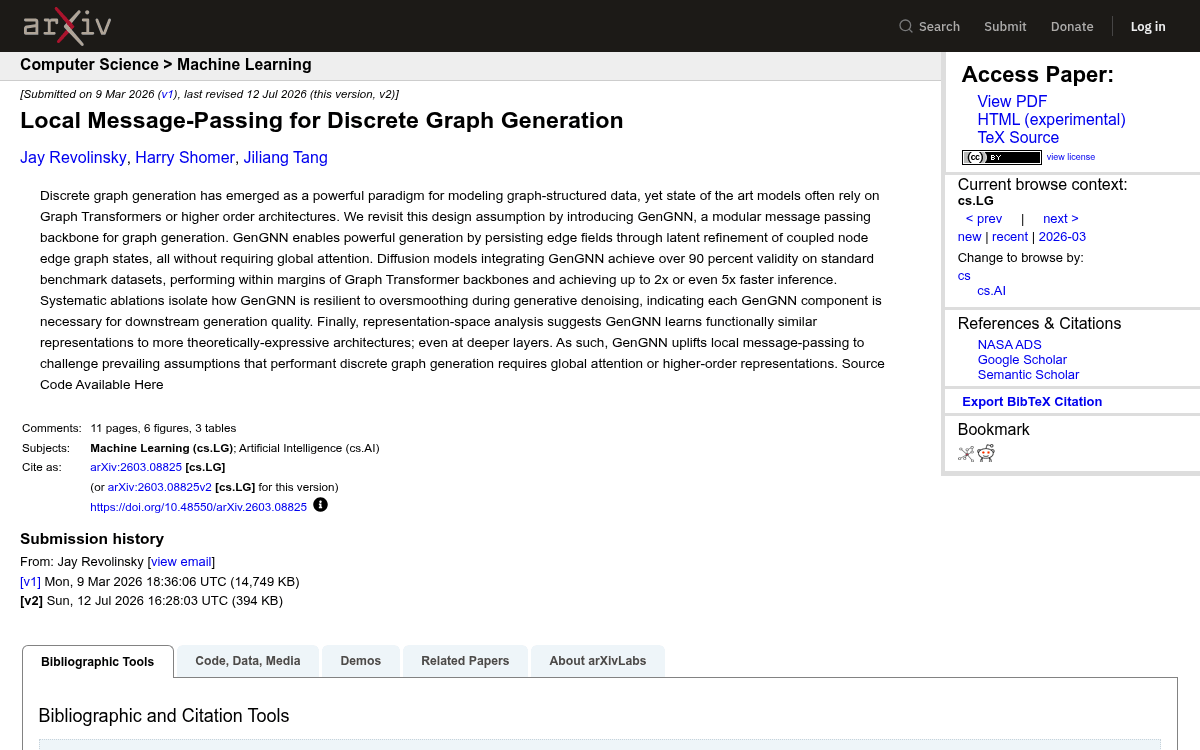
The dominant assumption in discrete graph generation has been simple: if you want state-of-the-art results, you need a powerful, expensive encoder. Models which leverage discrete graph diffusion demonstrate impressive performance for molecule generation, but state-of-the-art models often rely on Graph Transformers or higher-order architectures -- an assumption a new paper directly challenges by introducing GenGNN, a modular message-passing backbone for graph generation.
GenGNN enables powerful generation by persisting edge fields through latent refinement of coupled node-edge-graph states, all without requiring global attention. Diffusion models integrating GenGNN achieve over 90% validity on standard benchmark datasets, performing within margins of Graph Transformer backbones and achieving 2-5x faster inference.
Why transformers became the default
DiGress, the foundational discrete denoising diffusion model for graphs, uses a discrete diffusion process that progressively edits graphs with noise -- adding or removing edges and changing categories -- and trains a graph transformer network to reverse this process. The transformer choice was not arbitrary. The need for integrating expressive neural backbones into graph generative models relies on a simple two-part intuition: message-passing within less-expressive graph networks fails to distinguish simple isomorphic substructures, and GNNs suffer from over-smoothing, which translates to failure when scaling on long-range tasks.
Over-smoothing is the key villain here. In a deep GNN, as information propagates through many layers, node representations gradually converge toward the same value -- the network loses its ability to distinguish between different nodes. This lack of expressivity implies that simple GNNs fail to accurately denoise complicated graph structure across the many diffusion timesteps required for successful sampling. The result: vanilla GNNs applied to graph diffusion produce degenerate outputs, generating clustered communities instead of valid planar graphs.
But the cost of using transformers is real. Simple GNNs are more efficient than expressive models reliant on tuple-based representations, translating to inference speed improvements. Any kind of speed improvement is important for discrete graph diffusion, which currently struggles with scalability from the quadratic time-complexity required for graph reconstruction.

What GenGNN actually does
GenGNN is not a new GNN architecture from scratch -- it is a modular framework that wraps standard message-passing layers (GCN, GIN, MPNN) with a carefully chosen set of components that together overcome over-smoothing. The key insight is that each component addresses a specific failure mode.
The six stackable components of GenGNN are:
- RRWP positional encodings -- Random-walk positional encodings (a way to inject structural position information by computing how likely a random walk is to return to each node) are concatenated to initial node and edge features. This gives the GNN structural awareness without attention.
- Edge gating -- A learned sigmoid gate modulates which edge signals get passed during aggregation, filtering noise from irrelevant connections.
- Node gating -- A second gate controls how much of the aggregated neighborhood signal each node absorbs.
- Feed-forward networks (FFN) -- Two-layer MLPs with GELU activation improve nonlinear expressivity between backbone channels.
- Residual connections -- Skip connections that add the layer input back to the output, preventing the signal from collapsing as layers deepen.
- Layer normalization -- Stabilizes training by normalizing activations feature-wise at each layer.
The theoretical backbone of the paper formalizes why residuals are non-negotiable. Theorem 3.2 shows that under mild assumptions, the denoiser outputs cannot collapse to a single dominant direction at any reverse diffusion step, provided residual connections preserve orthogonal signal components from positional encodings. This is the first formal treatment of how residual anchoring prevents representational collapse in graph diffusion denoisers.
The numbers that matter
Initial benchmarking indicates GenGNN achieves performance competitive with state-of-the-art models -- 99.35% validity and over 2.5x inference speed-up relative to theoretically-expressive architectures on the QM9 dataset. The speedup is comprehensive: 1.7-5x improvements and competitive performance across common benchmarks including Tree, Planar, SBM, ZINC, GuacaMol, and MOSES.
The molecule generation results are particularly striking. When plugged into DiGress, the GenGIN variant of GenGNN achieves 99.49% validity on QM9 -- actually beating the original Graph Transformer backbone's 99.36%. On ZINC250K, GenGNN reaches 96.24% validity versus GT's 94.19%.
The comparison against vanilla GNNs (without GenGNN's enhancements) makes the contribution clear:
| Model | QM9 Validity | ZINC Validity |
|---|---|---|
| Vanilla GNN (MPNN) | 20.51% | 31.1% |
| Vanilla GCN | 18.19% | 2.15% |
| Vanilla GIN | 39.44% | 82.84% |
| GenGNN | 99.26% | 95.55% |
There is a sharp decrease in performance when comparing GenGNN to vanilla GNNs, showing that vanilla GNNs are not enough and an enhanced design is necessary to boost the performance of standard GNNs. The enhancements -- not a new architecture -- are what close the gap.
Ablation reveals the load-bearing components
The paper's ablation study is unusually informative. Each component was removed individually and the effect on validity measured. The results are stark: removing any GenGNN component results in a drastic decrease in validity, often falling over 10% or dropping to 0% entirely.
The most critical finding: there is a near-inverse correlation between MMD (a structural diversity metric) and validity, where GenGNN drops to 0% validity and 77 MMD after the removal of just the residual connection. This provides empirical support for the theorem, detailing the necessity of residual connections to prevent over-smoothing and capture long-range dependencies necessary for diffusion. Removing RRWP alone causes a 72% drop in validity -- proving that structural position information is essential even in a pure message-passing setting.

The metric-space scaling view
Beyond benchmarks, the paper introduces a principled way to inspect whether a GNN backbone is actually learning the right representations. Using a metric called MagDiff -- which measures the diversity of generated graph embeddings in a metric space -- the authors show that GenGNN's learned representations are comparable to Graph Transformer representations, and in some cases better. GenGNN often clusters around MagDiff values lower than GT, indicating message-passing can better capture latent diversity in graph substructure for the QM9 dataset.
The scaling analysis also reveals something important about robustness: GenGNN's gradual performance increase with the number of layers and the stability of its performance at a higher number of layers relative to GT demonstrates that GenGNN is resilient to over-smoothing. The GT backbone at 24 layers on QM9 collapses to 22.55% validity; GenGNN at 24 layers holds at 99.24%.
Where it falls short
GenGNN is not a universal win. On the Planar dataset with DiGress, the GenGNN variants underperform the Graph Transformer on average MMD ratio (3.9 vs 1.2), suggesting that for complex structural tasks requiring fine-grained planarity constraints, the expressivity gap still matters. Only the best-performing GenGNN variants reach structural validity levels near PPGN or GT on some datasets. The SBM (stochastic block model) dataset also shows mixed results, with some GenGNN variants trailing GT on validity.
There is also a hidden cost in conditional generation: GenGNN required 128 hidden dimensions versus GT's 64 hidden dimensions for embedding inputs in order to reach current validation performance under classifier-free guidance. Wider hidden layers partially offset the inference savings.
What this opens up
The practical implications are significant for anyone running graph generation at scale. Breakthroughs in predicting molecular properties, drug repurposing, toxicity assessment, and interaction analysis, along with generative GNNs enhancing virtual screening and novel molecule design, have significantly sped up drug discovery. GenGNN makes these pipelines substantially cheaper to run -- a 2-5x inference speedup directly translates to more molecules screened per GPU-hour.
The framework plugs into both DiGress and DeFoG (the discrete flow matching successor to DiGress) as a drop-in backbone replacement. The modular design means practitioners can swap in GCN, GIN, or MPNN as the base layer depending on their constraints. Source code is available via the paper's GitHub link referenced in the footnotes.
The deeper contribution is theoretical: by formally proving that residual connections prevent representational collapse during discrete diffusion, the paper gives practitioners a principled reason -- not just an empirical one -- to trust simpler architectures. The question the paper poses in its title -- are expressive encoders necessary? -- turns out to have a nuanced answer: the expressivity matters, but it can come from structural design choices rather than from attention mechanisms.