
Gemini 2.0 Alone Matches How Humans Organize Color Into Language
A new ICLR paper tests whether language models spontaneously evolve efficient color categories the way humans do, and finds only one model that convincingly does.
 Pro
Takeaways
- New ICLR paper by Imel and Zaslavsky tests whether LLMs evolve human-like semantic categories.
- Uses color naming and the Information Bottleneck complexity-accuracy tradeoff as the measuring stick.
- Introduces Iterated in-Context Language Learning (IICLL) to simulate cultural evolution of vocabulary inside a model.
- Larger instruction-tuned models show better English alignment and higher IB-efficiency than base models.
- Only Gemini 2.0-flash reproduces the full human range of near-optimal color systems.
- Other state-of-the-art LLMs collapse to overly simple, low-complexity category systems.
A pair of cognitive scientists just ran a classic human categorization experiment on large language models, and the results are more interesting than the usual benchmark chart. Evolution and compression in LLMs: On the emergence of human-aligned categorization, by Nathaniel Imel and Noga Zaslavsky, asks whether language models trained purely on next-token prediction end up carving the world into concepts the same way humans do, and whether that behavior emerges from an actual inductive bias or is just parroted from training data.
The short version: Imel and Zaslavsky find that language models can iteratively restructure random naming systems into efficient, human-like ones, but only Gemini 2.0-flash reproduces the full range of tradeoffs humans exhibit. Everything else collapses to overly simple category systems.
The compression theory of meaning
The theoretical backbone here is the Information Bottleneck (IB) principle. The idea is that languages compress percepts into words by optimizing a tradeoff between the complexity and accuracy of their lexicons, and there is empirical evidence that this principle gives rise to human-like semantic representations, particularly in how human languages categorize colors. Across dozens of languages, the color vocabularies humans actually use sit remarkably close to the mathematically optimal curve for that complexity-accuracy tradeoff.
Color naming is the ideal testbed because there is decades of behavioral data on it, most famously the World Color Survey grid of 330 chips. Large language models are not trained for this objective, which raises the question of whether they are capable of evolving efficient human-aligned semantic systems. If they are, that says something deep about what next-token training actually installs in a model.
Two experiments, one grid of colored chips
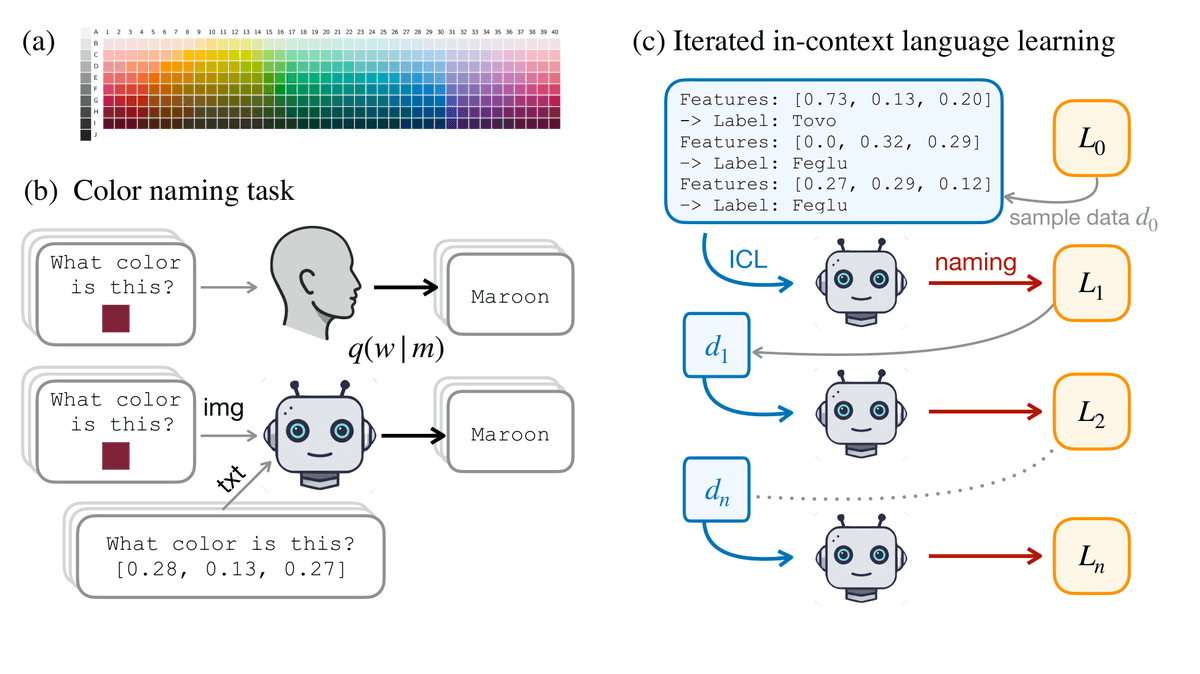
The authors replicate two influential human studies with LLMs. The first is a straightforward English color-naming task where models label the WCS chips, then get scored on their IB complexity and their alignment to English speakers. The second is more clever: they simulate cultural evolution of language inside a model.

They call this method Iterated in-Context Language Learning, or IICLL. It works like the classic iterated-learning paradigm from cognitive science, but the "generations" are LLM contexts:
- Seed the model with a random, meaningless mapping from color chips to invented words.
- Have the model learn that pseudo-language in context and produce labels for new chips.
- Feed its outputs as the training data for the next "generation" of the same model.
- Repeat and watch how the system drifts.
If the model has a human-like bias toward efficient compression, random noise should evolve, generation after generation, into something that looks like a real color lexicon sitting near the IB-optimal curve.
What actually happened
On the direct English task, models varied widely in complexity and English-alignment, with larger instruction-tuned models achieving better alignment and IB-efficiency. Base models were noticeably worse than their instruction-tuned counterparts, and across model families, size and instruction-tuning were associated with higher complexity and better alignment to English color categories.
The iterated-learning experiment is where the story gets sharper. LLMs, like humans, iteratively restructure initially random systems toward greater IB-efficiency, showing the drift is not just memorization of training text. But only a model with the strongest in-context capabilities, Gemini 2.0, is able to recapitulate the wide range of near-optimal IB-tradeoffs observed in humans, while other state-of-the-art models converge to low-complexity solutions. In plain terms, the weaker models find one crude "three-color" partition and stay there; Gemini 2.0 explores the same rich spectrum of naming systems that different human languages occupy.
Why this matters beyond color chips
The color grid is a proxy. The real claim is about whether LLMs share a fundamental principle of semantic organization with humans, which has practical implications for any system where a model has to invent, negotiate, or adapt vocabulary on the fly. Think agent-to-agent protocols, few-shot taxonomy induction, or coordinating labels with a user whose ontology drifts over time. A model that converges to trivially low-complexity partitions will feel dumb in exactly those settings.
It also gives a cheap, interpretable probe for in-context learning quality. IICLL does not require gradient access, does not require ground-truth labels, and the IB curve gives you a single number to compare models on. That is a nicer diagnostic than yet another MMLU delta.
Caveats worth keeping in mind
- The strong result is a single-model effect. Gemini 2.0-flash is the only LLM that hits the full human range, so the finding is more "it is possible" than "LLMs generally do this."
- Color is a uniquely well-studied perceptual domain. Whether the same efficient-compression bias transfers to abstract categories (kinship, containers, emotions) is untested here.
- Related work such as From Tokens to Thoughts finds that LLM concept structures can diverge from human ones on other tasks, so the picture is mixed.
The arXiv listing links the PDF and HTML versions of the paper; code and released artifacts are not advertised in the abstract, so anyone wanting to rerun IICLL will likely need to reimplement the protocol from the methods section.