
GAIR's OpenSWE Releases 45K Coding Environments Worth $1.47M for Free
A fully open pipeline for building software engineering agent training data, with 45,320 Docker environments across 12.8k repositories and open-sourced infrastructure.
 Pro
Takeaways
- OpenSWE releases 45,320 executable Docker environments across 12.8k Python repositories, fully open-sourced on GitHub.
- Multi-agent synthesis pipeline runs on a 64-node cluster, completing construction in about two weeks.
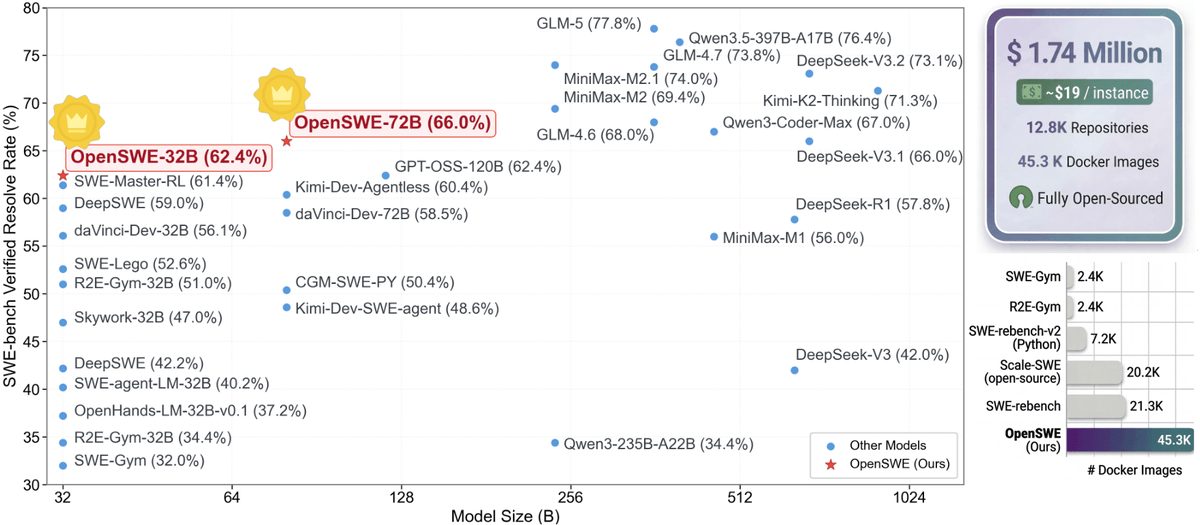
- OpenSWE-32B hits 62.4% and OpenSWE-72B hits 66.0% on SWE-Bench Verified, SOTA among Qwen2.5-based SFT methods.
- Difficulty-aware filtering removes PR-Issue misalignment and trivially easy tasks, yielding 13k curated trajectories from 9k environments.
- Training on SWE data transfers: up to 12 points on math benchmarks and 29 on HumanEval, without hurting factual recall.
- Total project cost of $1.47M is fully disclosed, including $891K construction and $576K trajectory sampling.
Building autonomous software engineering agents that can read issues, edit code, and run tests requires something most academic labs cannot afford: massive libraries of executable, verifiable environments. Industrial labs have them but do not share, and existing open datasets top out at a few thousand repositories. A new project called OpenSWE tries to break that pattern by releasing the largest fully transparent Python SWE training framework to date, along with every Dockerfile, evaluation script, and pipeline component behind it.
OpenSWE comprises 45,320 executable Docker environments spanning 12.8k repositories, representing over $891,000 in construction costs, with all Dockerfiles, evaluation scripts, and distributed infrastructure fully open-sourced. The team behind it, from SII, SJTU, and GAIR, spent an additional $576,000 on trajectory sampling and curation, ultimately yielding about 13,000 curated trajectories from a subset of roughly 9,000 high-quality environments. Total bill: around $1.47 million, publicly documented.
Why executable environments are the real bottleneck
Unlike static code generation benchmarks, SWE agents need to actually run things. They must compile code, execute tests, and observe runtime behaviors to iteratively refine their solutions. That means each training instance has to ship with a working Docker container, the correct dependency versions, and an evaluation script that can distinguish a real fix from a fake one.
The scaling problem is nasty. Environments synthesized from real repositories frequently suffer from PR-Issue misalignment, where the submitted patch does not actually resolve the described issue, or triviality, where the issue description directly reveals the solution. Either failure mode wastes training compute: unsolvable examples produce no signal, and trivial ones produce shortcut learning.

A multi-agent factory running on 64 nodes
The synthesis pipeline is itself a multi-agent system. For each candidate GitHub PR, four specialized agents cooperate in a feedback loop:
- Repository exploration agent - performs bounded retrieval using three narrow APIs (browse, search, digest) to extract dependency versions and test commands from README, CI configs, and manifests.
- Dockerfile agent - builds a reproducible container, drawing on pre-built base images that avoid runtime installs.
- Evaluation script agent - generates a bash script that applies patches, runs only the relevant tests, and emits machine-readable exit markers.
- Test analysis agent - inspects logs, verifies that tests fail without the fix and pass with it, and routes targeted feedback back to whichever agent needs to iterate.

Two engineering tricks matter here. Rather than starting from generic Ubuntu images that require runtime Python installation, we pre-build a suite of openswe-python base images covering Python 2.7 and 3.5-3.14, each bundled with a conda package, a pre-activated testbed environment, and configured package mirrors for reliability. And instead of cloning repos inside the container, we maintain a local bare repository cache and inject the codebase via COPY, with each task's target commit checked out in advance. Together these eliminate the two biggest sources of build flakiness: network timeouts and GitHub rate limits.
The cluster itself is deliberately loosely coupled. Unlike tightly coupled frameworks such as MPI or Ray, where a single node failure can halt the entire job, our architecture ensures that nodes operate independently. Communication and task distribution are managed through a file-based message queue hosted on a shared filesystem. Systemd handles process resurrection, a cleanup daemon prunes zombie containers, and Prometheus plus Grafana provide observability. With this 64-node cluster, we completed the construction of 45,320 validated environments in approximately two weeks, reducing what would otherwise be a months-long process.
Difficulty-aware curation, not just scale
Once environments exist, the team samples resolution trajectories using GLM-4.7 as the actor and DeepSCEek-v3.2 as the construction model. Each instance gets four attempts under both the OpenHands and SWE-Agent scaffolds at temperature 1.0 with 300 steps. Only instances solved in one or two of four attempts survive - that middle band is the sweet spot for learning signal. Steps containing formatting errors are masked, and anything containing git pull in a bash action is dropped to block reward hacking.
The numbers on SWE-Bench Verified
Fine-tuning Qwen2.5-32B-Base and Qwen2.5-72B-Base on the curated trajectories produces strong results. OpenSWE-32B achieves a resolution rate of 62.4%, surpassing all methods on Qwen2.5 series. At the larger scale, OpenSWE-72B reaches 66.0%, outperforming daVinci-Dev-72B by 7.5%. Notably the 32B result is achieved from a non-Coder base model, meaning the environment data compensates for the lack of code-specialized pretraining.
The head-to-head with the closest open competitor is decisive. The most pronounced gain appears at the 32B SWE-Agent setting, where OpenSWE outperforms SWE-Rebench by 12.2% absolute (62.4% vs. 50.2%). Data scaling analysis also shows a log-linear improvement trend with no saturation, confirming that additional high-quality environments continue to yield meaningful gains.
Transfer beyond software engineering
The more surprising finding is what SWE training does to unrelated benchmarks. Training on OpenSWE improves the 32B base model on HumanEval by over 29 points and on HumanEval+ by 31 points. Math benchmarks jump too: up to 12 points on mathematical reasoning and up to 5 points on science benchmarks, without degrading factual recall. MMLU stays essentially flat while MMLU-Pro gains up to 8.9 points, which matches the intuition that debugging cultivates multi-step reasoning without changing what the model knows.
What is actually released
Everything sits in the GAIR-NLP/OpenSWE repository: the 45,320 Docker environments, evaluation scripts, the distributed synthesis pipeline, and the trained checkpoints. For anyone doing SWE agent research, this closes the gap with proprietary industrial datasets in a way that the paper argues is critical for reproducibility. The dataset scale table alone tells the story: previous open efforts ranged from 2.4k to about 32.7k tasks; OpenSWE ships 45.3k, all built from real PRs rather than synthetic augmentation.
What to watch for
A few caveats worth naming. Python only, so cross-language coverage still belongs to newer efforts like SWE-rebench-v2. The trained models are supervised fine-tuning baselines rather than RL agents, so there is likely headroom above the reported 66%. And the difficulty filter, while effective, depends on trajectory sampling budget - the $576K curation cost is not trivially reproducible even if the raw environments are free. Still, for research groups that could never afford to build the substrate themselves, having a validated 45k-environment corpus with the full recipe attached is a meaningful shift in what is possible.