
GAIR's Darwin-CC Beats Every Major AI Training Dataset Across 18 Benchmarks
A closed-loop evolutionary system replaces manual prompt engineering to curate pretraining corpora, producing a 504B-token dataset that beats DCLM and FineWeb-Edu.
 Pro
Takeaways
- DataEvolve automates pretraining data curation via an evolutionary loop of observer, designer, cleaner, and judge agents (paper).
- Darwin-CC (504B tokens from Nemotron-CC) scores 44.13 average across 18 benchmarks, beating DCLM by 1.71 points.
- MMLU improves +18.64 over raw data, MedQA +13.48, CSQA +18.80 for 3B models trained on 500B tokens.
- Evolved strategies converge on targeted cleaning with domain preservation, not textbook-style rewriting used by prior methods.
- Suboptimal strategies gain only 1.03 points over raw, confirming iterative evolution (not just LLM processing) drives quality.
- Code available on GitHub and dataset on Hugging Face.
Curating pretraining data has become a hand-crafted craft. Every domain, format, and quality tier needs its own cleaning recipe, and modern web corpora fragment into hundreds of these categories. A new framework called DataEvolve from GAIR-NLP proposes to take humans out of that loop entirely, letting language models discover their own cleaning strategies through iterative optimization. Applied to Nemotron-CC, the approach produced Darwin-CC, a 504B-token corpus that outscores DCLM, Ultra-FineWeb, and FineWeb-Edu across 18 benchmarks when used to train 3B models from scratch.
Why manual curation hit a wall
The follow-up to Data Darwinism Part I frames the problem bluntly. Modern pretraining corpora comprise hundreds or thousands of categories formed by intersecting subject domains, content types, quality levels, and other dimensions, each exhibiting distinct characteristics. Designing a strategy for each one means analyzing artifacts, writing prompts, sifting for good few-shot examples, and iterating. And validation is punishing: even validating a single candidate strategy requires cleaning the data and training a model at scale, making iterative refinement practically infeasible.
Prior corpora like FineWeb-Edu and DCLM sidestep this by filtering (keep good documents, drop bad ones). Newer approaches such as Nemotron-CC and WRAP go further, using LLMs to rewrite web text into textbook or Q&A formats. Both directions have limits: aggressive filtering throws away recoverable content, while rewriting requires hand-tuned prompts per domain and risks homogenizing style.
An evolutionary loop with four agents
DataEvolve treats strategy design itself as an optimization problem. For each data category it runs a closed loop with four LLM-based components and two long-term memory pools.

- Data observer inspects sampled documents and catalogs quality issues (broken equations, HTML noise, ambiguous medical jargon).
- Strategy designer writes a cleaning prompt from those observations, or refines the best prompt from the previous generation.
- Data cleaner executes the current strategy on a fresh document batch.
- Quality judge scores each original/cleaned pair from 1 to 10 and returns diagnostic feedback on what worked and what got missed.
Two persistent stores make the search cumulative rather than random. An experience pool accumulates discovered quality issues across all iterations, and a strategy pool tracks evolved strategies with their performance scores and diagnostic analyses. Each generation's winner becomes the parent for the next; losers get pruned. Crucially, documents are resampled every iteration so strategies cannot overfit to specific examples.
The key trick that makes this tractable is a proxy fitness function. Instead of training a model to measure a strategy's value, DataEvolve uses the judge's average sample score, cutting evaluation cost from thousands of GPU hours to a few API calls per iteration.
The concrete setup
The team ran DataEvolve on 8 categories from Nemotron-CC covering mathematics, computer science, medicine, and other STEM at two quality tiers, totaling 672B raw tokens. Each category evolved for 30 generations using a mix of frontier and open models:
- Observer: GPT-4o-mini analyzes 100 sampled documents per iteration
- Designer: o4-mini synthesizes a refined cleaning prompt
- Cleaner: gpt-oss-120b applies the prompt to 500 documents
- Judge: gpt-5-mini evaluates 50 randomly sampled pairs
The winning strategy per category was then applied to the full corpus, yielding 504B cleaned tokens (a 25% reduction). Training used 3B-parameter Qwen2.5 models from scratch on 500B tokens with identical hyperparameters across all comparisons.
Results across 18 benchmarks
Darwin-CC beats every established corpus tested under matched training budgets.
| Corpus | Average (18 benchmarks) | MMLU | MedQA |
|---|---|---|---|
| FineWeb-Edu | 36.52 | 28.38 | 26.36 |
| Ultra-FineWeb | 36.29 | 25.53 | 24.84 |
| DCLM | 42.42 | 28.54 | 24.88 |
| Raw Nemotron-CC | 40.17 | 27.49 | 26.77 |
| Darwin-CC | 44.13 | 46.13 | 40.25 |
The MMLU jump of over 18 points versus raw data is the headline number, with similar gains on CSQA (+18.80), MedMCQA (+12.10), and MedQA (+13.48). The gap over raw data grows from 2.49 points at 250B tokens to 3.96 points at 500B tokens, suggesting the quality advantage compounds with more training.

An ablation confirms the iterative loop actually matters. Data cleaned with the suboptimal strategy achieves only 41.20 average score, barely above raw data (+1.03 points) and significantly below Darwin-CC (gap: 2.93 points). On MMLU specifically, the suboptimal strategy gained only 5 points where the evolved best gained nearly 19. Automated cleaning is not automatically effective.
The surprise: evolution converged on cleaning, not rewriting
Across all 8 independently evolved categories, the winning strategies looked remarkably similar in spirit. DataEvolve learns to clean, not to transform. Contrary to prior approaches that rephrase web text into idealized formats (textbook-style exposition, Wikipedia articles, or question-answer pairs), discovered strategies focus on removing unwanted content and normalizing formatting while preserving original text.
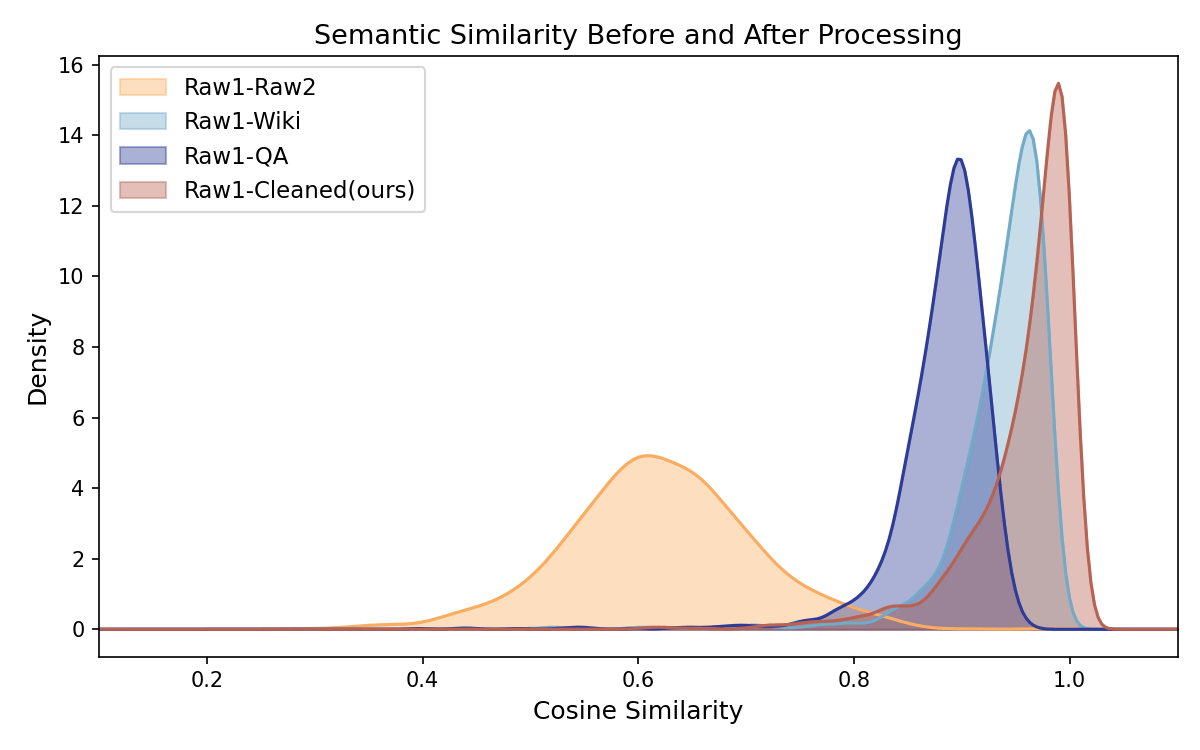
The operations fell into three buckets: stripping web artifacts (HTML, ads, PII), normalizing formatting (whitespace, punctuation), and applying domain-specific preservation rules. Mathematics strategies protected theorem statements and LaTeX; medicine strategies kept clinical units and drug names; CS strategies fenced code blocks. Semantic similarity to originals averaged 0.958 for DataEvolve-cleaned documents versus 0.882 for Q&A rewriting, meaning content was preserved rather than paraphrased.
The analysis also identified four traits that separated high-scoring from low-scoring strategies: concrete measurable thresholds instead of vague judgments, targeted deletion of specific elements rather than whole-document filtering, explicit preservation rules alongside deletion rules, and conservative operations that prefer removing uncertain fragments over risky transformations.
Where cleaning hurts
Cleaning is not universally good. On benchmarks that reward informal or colloquial language, raw data actually wins. HellaSwag, PIQA, SIQA, and DROP all showed cleaned data trailing raw from early in training. The likely reason: aggressive artifact removal also strips conversational registers, shifting the language distribution toward formal, structured prose. A third bucket of benchmarks (BBH, WinoGrande, AGIEval, RACE) showed no meaningful difference either way.
Limitations are real. The paper covered only 8 academic STEM categories, so the cross-corpus comparison against general-purpose datasets isn't strictly apples-to-apples. The 30-iteration budget is fixed with no adaptive stopping criterion, and the sample-based fitness proxy introduces noise: quality differences between strategies often only emerge after training on hundreds of billions of tokens, and performance rankings can even reverse at earlier stages of training.
Both the framework code and Darwin-CC dataset are open. For teams building pretraining pipelines, the practical takeaway is that a small orchestration of API calls, run offline before any GPU is touched, may extract more value from a raw corpus than another round of prompt-engineering by hand.