
FutureSearch Builds a Self-Updating AI Benchmark Where Gemini 3 Pro Wins
FutureSearch's LLM pipeline generates 1,499 real-world forecasting questions at scale, outperforming human-curated Metaculus on question quality and enabling rigorous AI benchmarking.
 Pro
Takeaways
- Automated benchmark factory: FutureSearch built a pipeline that generates and resolves real-world forecasting questions at scale using LLM web research agents.
- Beats human curation: The system produces unambiguous questions ~96% of the time, compared to ~92% for Metaculus, with an estimated annulment rate of only 4%.
- 95% resolution accuracy: An automated ensemble of Gemini 3 Pro + Claude Opus 4.5 resolves questions with ~95% accuracy, replacing ~13 minutes of manual human work per question.
- Model rankings confirmed: Gemini 3 Pro (0.134 Brier), GPT-5 (0.149), and Gemini 2.5 Flash (0.179) rank in expected capability order across 1,499 questions.
- Decomposition works: Breaking questions into sub-questions before forecasting improves Brier scores from 0.141 to 0.132, a statistically significant gain.
- Open tooling: All prompts are published in the paper; the pipeline runs on the open-source futuresearch-python SDK.
Evaluating how well an AI can predict the future is one of the hardest problems in the field. You need thousands of well-formed questions, a way to check whether those questions are actually answerable, and a mechanism to score the answers months later. Until now, that work was either done by hand or scraped from narrow, repetitive data sources like stock prices and weather. A new paper from FutureSearch changes that equation entirely.
The team built a fully automated pipeline that generates and resolves high-quality forecasting questions at scale using LLM-powered web research agents. They used it to produce 1,499 diverse, real-world questions, resolved them several months later, and showed the resulting benchmark is good enough to meaningfully rank frontier AI models.
Why forecasting benchmarks are so hard to build
Forecasting is unlike most ML tasks. In classification, every example has a ground-truth label. In forecasting, the "correct" answer is a probability, and you only ever observe one outcome: the event either happened or it didn't. This means you need a lot of questions to tell two forecasters apart statistically. Distinguishing a well-calibrated 70% forecast from a poorly-calibrated 60% forecast requires observing outcomes across many questions.
The problem is that making good questions is expensive. Existing benchmarks for evaluating AI forecasters, including the Metaculus AI Forecasting Benchmark Series, ForecastBench, and Bench to the Future, rely either on labor-intensive human curation or on automated generation from recurring data sources like economic indicators and sports statistics, which produces highly correlated or relatively trivial questions. Some studies consequently struggle with statistical power, limiting the conclusions that can be drawn.
The pipeline, step by step
The question-generation system consists of a multi-stage pipeline that iteratively calls LLM agents to suggest, refine, and critique forecasting questions. The whole thing runs end-to-end without human intervention. Here is how it works:
- Seeds: The pipeline starts with a seed, a news article or company report that grounds the system in a real-world event. Seeds came from three sources: GDELT (a global news event tracker), Media Cloud (a news aggregator), and Stockfisher (S&P 500 revenue forecast rationales). In total, 2,500 seeds were used.
- Proto-questions: A ReAct agent (a model that interleaves reasoning and web search) reads each seed and proposes 1-7 rough question ideas. Web search is critical here: without it, models hallucinate resolution sources and propose questions about events that already happened.
- Refinement: A second ReAct agent turns each proto-question into a fully specified forecasting question with precise resolution criteria, defined terms, and a linked source of truth.
- Verification: Four separate verifier agents evaluate each question for overall quality, ambiguity, auto-resolvability, and non-triviality. Questions must pass all four to survive.
- Deduplication: Questions are embedded, clustered with DBSCAN, and checked for duplicates within each cluster using an LLM.
Starting from 2,500 seeds, the pipeline generated 14,073 proto-questions, refined them into 14,073 full questions, and filtered down to a final set of 1,499 after verification and deduplication.

Beating Metaculus at its own game
The key quality metric for a forecasting question is whether it can be resolved unambiguously. On Metaculus, roughly 8% of questions get annulled because they turn out to be unanswerable or disputed. The system produces verifiable, unambiguous questions approximately 96% of the time, exceeding the rate of Metaculus, a leading human-curated forecasting platform. The estimated annulment rate for the generated questions is only about 4%.
Resolution accuracy is equally important. The system resolves questions at approximately 95% accuracy. When a human expert manually resolved a random sample of 100 questions, only 4 errors were found: 2 wrong binary answers and 2 missed annulments. Manual resolution, even with AI assistance, took an average of 13 minutes per question, which gives a sense of the labor the automated system replaces.
The resolver uses an ensemble of three Gemini 3 Pro agents plus a Claude Opus 4.5 tiebreaker for disputed cases. One interesting finding: Gemini 3 Pro tends to accept Google search snippets at face value without verifying whether the cited sources actually meet the resolution criteria, while Opus 4.5 uses more creative strategies like querying the Wayback Machine to verify historical data.
Does it actually rank models correctly?
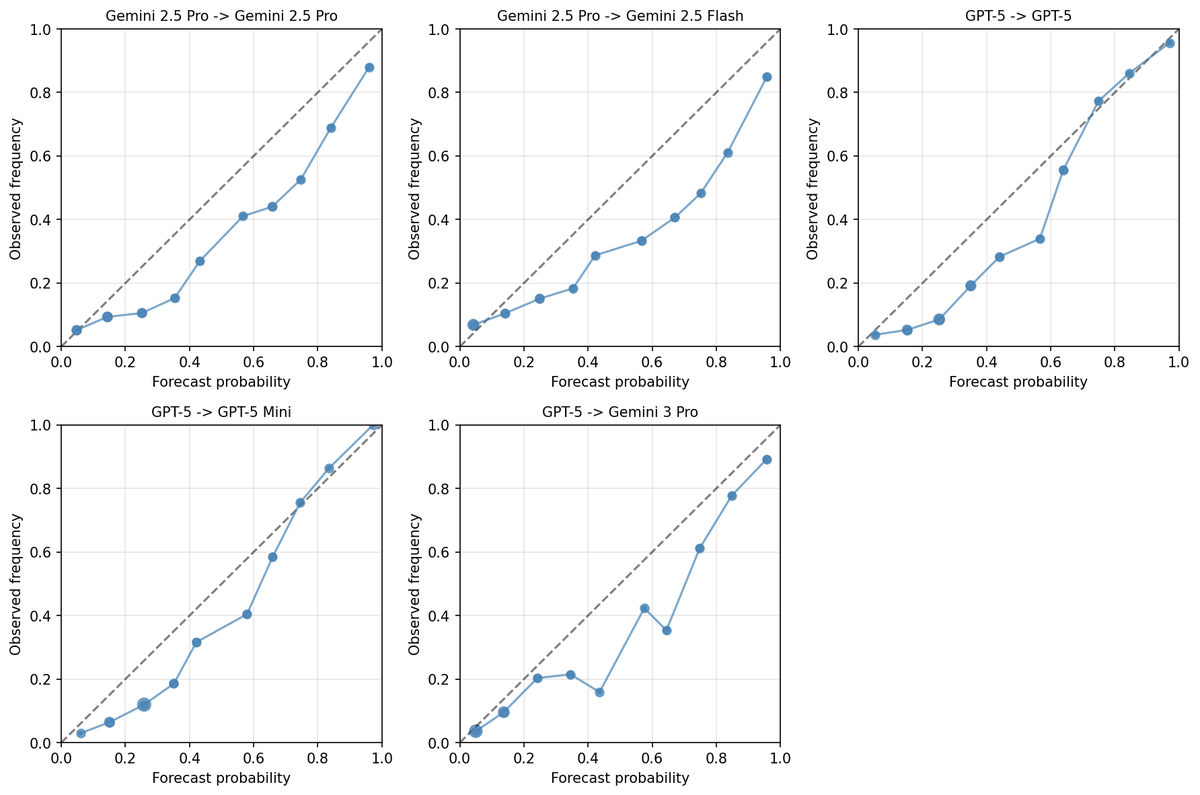
A benchmark is only useful if better models score better on it. The team tested five model combinations and measured performance using the Brier score (a proper scoring rule where lower is better, 0 is perfect, and 0.25 is equivalent to always guessing 50%). Forecasting agents powered by more intelligent LLMs perform better on these questions, with a Brier score of 0.134 for Gemini 3 Pro, 0.149 for GPT-5, and 0.179 for Gemini 2.5 Flash.
| Forecast Model | Research Model | Brier Score | 95% CI |
|---|---|---|---|
| Gemini 3 Pro | GPT-5 | 0.134 | [0.123, 0.146] |
| GPT-5 | GPT-5 | 0.149 | [0.141, 0.157] |
| GPT-5 Mini | GPT-5 | 0.155 | [0.146, 0.163] |
| Gemini 2.5 Pro | Gemini 2.5 Pro | 0.165 | [0.155, 0.176] |
| Gemini 2.5 Flash | Gemini 2.5 Pro | 0.179 | [0.168, 0.191] |
The rankings are highly stable: Gemini 3 Pro ranks first in 100% of 10,000 bootstrap resamples, and GPT-5 ranks second in 99.1%. Larger models consistently beat their smaller counterparts within each family.
Question decomposition as a forecasting strategy
The paper also uses the generated benchmark to test a concrete forecasting improvement: breaking a hard question into 3-5 sub-questions, researching and forecasting each one independently, then using those sub-forecasts as additional context for the final answer. Evaluating this question decomposition strategy on a generated question set yields a significant improvement in Brier scores (0.132 vs. 0.141). The decomposition approach outperformed the baseline in 94.4% of bootstrap samples.
This matters beyond the benchmark itself. It shows the generated question sets are sensitive enough to detect real improvements in forecasting methodology, not just differences between model families. That is the property you need if you want to use a benchmark to guide research decisions.
What the questions actually look like
The 1,499 questions span 12 topic clusters identified by LLM-based clustering. The largest clusters are regulatory and policy actions (22.5%), US government and public policy (12.6%), and macroeconomics and markets (11.7%). Some examples of the specificity involved:
- "Will the U.S. FDA approve topical ocular reproxalap for the treatment of dry eye disease on or before December 31, 2025?"
- "Will Blue Origin's New Glenn lift off on a second orbital mission between 2025-10-15 and 2025-12-31?"
- "Will the December 2025 WASDE project U.S. 2025/26 corn ending stocks at ≤ 2.05 billion bushels?"
Diversity within clusters is high: 70% of randomly sampled question pairs within the same topic cluster were rated completely different, and no duplicates were found in the 180 evaluated pairs.
Known limitations
The system has real failure modes worth knowing about. LLM agents struggle with questions that require filling out forms, clicking to load dynamic content, or extracting specific values from long PDFs. The hardest questions to resolve are those that require verifying something did not happen when that absence would not be widely reported. For example, a question about whether OFAC added specific entities to a sanctions list cannot be reliably resolved by checking whether Google mentions it, since absence of coverage is not the same as absence of the event.
The news-seeded approach also naturally skews toward current affairs. Science and technology topics are underrepresented relative to geopolitics and policy, which matters if you want to evaluate forecasting on technical domains.
Code and tooling
The pipeline is built on top of Everyrow, FutureSearch's open-source Python SDK for LLM-powered dataframe operations. The paper includes all agent prompts in the appendix, making the system fully reproducible. The Everyrow package has since been superseded by the futuresearch-python SDK, which includes the same ReAct agent infrastructure used in this work. All prompts for question generation, verification, forecasting, and resolution are published in the paper's appendix.
The broader implication is straightforward: if you can generate arbitrarily many high-quality forecasting questions on demand, you have an evaluation surface that is effectively impossible to saturate. As models improve, you generate harder questions. As domains shift, you reseed from new news sources. The benchmark grows with the field rather than aging out of it.